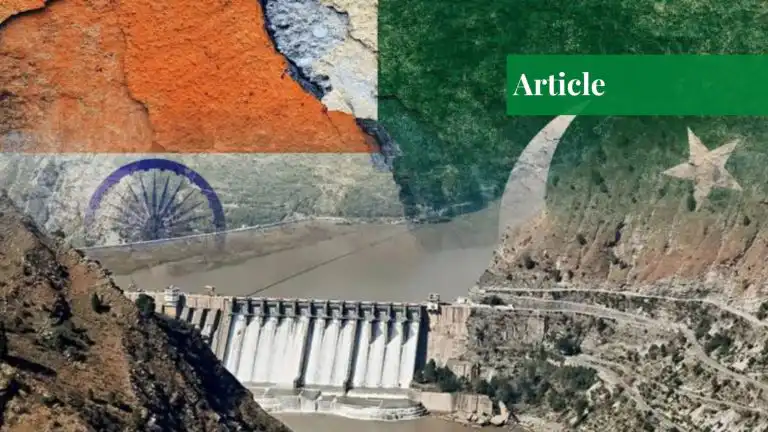
The Indus Water Treaty has yet again emerged in July 2026, not because of one isolated diplomatic exchange, but because several unresolved disputes converged in June and July 2026. A Court of Arbitration award concerning maximum pondage was published on June 5; Pakistan then internationalised the issue through a major Islamabad seminar on June 30 and at the United Nations in July; India repeatedly reaffirmed that the treaty would remain ïn abeyance, and monsoon-driven rises in the Chenab produced fresh allegations over flooding and the withholding of upstream information.
In analyzing South Asia’s escalating hydro-politics, we must carefully decouple India’s Legitimate national security anxieties from its legally tenuous water policy. Following the April 2025 Pahalgam Assault, New Delhi chose to freeze the historic Indus Water Treaty, asserting that normal bilateral diplomacy cannot coexist with state-sponsored cross-border militancy. While New Delhi holds an undeniable right to demand a measurable, verifiable crackdown on extremist cells, its subsequent hydro-diplomatic retaliation lacks solid legal justification. Furthermore, India raises a highly valid procedural grievance regarding a fractured dispute mechanism: the framework has developed into an administrative stalemate, with Islamabad pushing for a Court of Arbitration while New Delhi lobbies for an independent Neutral Expert to oversee identical inquiries into Kishenganga and Ratle power initiatives. Yet, weaponizing the accord ignores a glaring systemic risk explicitly flagged by the World Bank, forcing concurrent legal channels to simultaneously issue highly contradictory verdicts: a dangerous path that could permanently shatter the treaty’s functionality.
Yet, from a structural perspective, these security anxieties do not automatically translate into treaty-based prerogative to suspend the agreement. Article XI explicitly dictates that the framework strictly governs the rights and liabilities of both nations concerning river water utilisation, while Article XII mandates that any alteration or dissolution necessitates a formally ratified treaty signed by both capitals. Crucially, the text lacks any explicit mechanism permitting either state to unilaterally place the accord in abeyance. While broader arguments under customary international law remain fiercely contestable, state-sponsored terrorism allegations, grave as they are, do not inherently constitute a proven Pakistani violation of the treaty’s core water provisions.
Crucially, the current Court of Arbitration has already ruled that New Delhi’s abeyance declaration does not strip the tribunal of its jurisdiction. While India boycotts the body as improperly constituted, insisting instead that the Neutral Expert remains the sole valid forum, this procedural standoff must be evaluated objectively, especially given the World Bank’s Prior warnings regarding the dangers of dual tracks. Nevertheless, even when accounting for this fierce jurisdictional impasse, unilateral suspension remains a legally untenable position. High-stakes security disputes must be decoupled and addressed through specialized strategic, diplomatic, and legal frameworks, not by weaponizing critical transboundary water cooperation as a political leverage point.
Consequently, Islamabad is fundamentally correct in its assertion that the treaty remains operational and that all disputes must be funneled through its established institutions. Pakistan views upstream dam operations as vital matters of national security. With approximately 80 percent of Pakistani agriculture completely reliant on the Indus system, any volatility surrounding the timing of river flows, rather than just the overall annual volume, directly threatens crop sowing, irrigation schedules, hydroelectric planning, and disaster preparedness. Ultimately, the data sharing mandates of Article VI exist precisely because upstream transparency carries immediate, existential survival value for the downstream state.
However, Islamabad must recognize that its own approach is not without strategic vulnerabilities. Its recurrent warnings that any upstream water interference constitutes an “act of war” represent a highly volatile rhetorical posture, particularly between two nuclear-armed adversaries. Furthermore, reflexively labelling every sudden variation in river flows as deliberate Indian weaponization without independently verifiable evidence risks undermining Pakistan’s legitimate legal standing on the world stage. This was evident in late July 2026, when New Delhi flatly rejected accusations of triggering floods in the Chenab River, pointing instead to torrential downpours between July 20 and 23 and citing Pakistan’s own domestic flood advisory, which attributed the surge to upper-catchment rainfall. While the complete collapse of the trusted bilateral data sharing makes deep-seated mutual suspicion inevitable, geopolitical paranoia can never serve as a substitute for verifiable proof.
More importantly, Islamabad has long externalized a water crisis that is fundamentally domestic in nature. While transboundary and climate-induced pressures are undeniably severe, the World Bank has concluded that Pakistan’s most critical water challenge and its greatest opportunities lie within its own borders. The country faces severe systemic bottlenecks such as low agricultural productivity, highly inefficient irrigation infrastructure, weak public service delivery, unmonitored groundwater depletion, widespread contamination, and ecologically damaging allocation policies. Crucially, groundwater sustains over half of Pakistan’s Agricultural sector and 70 percent of its domestic water needs nationwide, yet state regulation, volumetric metering, and institutional monitoring remain woefully inadequate. While India possesses the geographic leverage to aggravate Pakistan’s vulnerability, New Delhi did not engineer that vulnerability single-handedly.
Ultimately, the fallout from a sustained erosion of the Indus Water Treaty would reverberate far beyond a routine bilateral legal dispute. It is the agrarian sector and vulnerable tail-end farming communities that would suffer the immediate consequences, absorbing the shocks of unpredictable irrigation cycles, devastating crop failures, and runaway food price inflation. Concurrently, any further reduction in bilateral data sharing would severely blind regional flood detection and drought warning networks. Moreover, an acceleration of upstream dam construction devoid of transparent, independent technical scrutiny will only deepen valid anxieties regarding reservoir pondage capacities, peak-hour operations, and abrupt water releases. Perhaps most dangerously, the collapse of these long-standing treaty mechanisms would dismantle one of the final remaining institutional crisis management channels to have survived decades of active India-Pakistan conflict.
The escalating climate crisis acutely magnifies these systemic dangers. The Hindu Kush Himalayan glaciers melted 65 percent faster between 2011 and 2020 than in the previous decade, injecting deep instability into regional snowpacks and river basins. This ecological shift triggers a volatile paradox of acute water scarcity and catastrophic excess; diminishing snow persistence threatens to choke vital early summer supplies, while erratic, intense cloudbursts trigger devastating flash floods. Consequently, New Delhi and Islamabad find themselves locked in a zero-sum dispute over a river system that is rapidly losing its predictability, precisely at a historical juncture when institutional cooperation and real-time data synchronization are most critical for regional survival.
To de-escalate this crisis, the immediate intervention must be a 90-day humanitarian water protocol. Under this temporary framework, New Delhi and Islamabad should immediately restore the daily exchange of high-flow data, reservoir release logs, and emergency-warning communications through their respective Permanent Indus Commissioners. Crucially, to build institutional trust, this identical data stream should be synchronized with a mutually accepted, independent technical repository. Concurrently, both capitals must pledge to refrain from manipulating upstream dam operations for geopolitical coercion, while agreeing to permit independent technical verification whenever disputed flow anomalies occur.
Over the longer term, the path forward lies in an Article XII protocol designed to modernize rather than dismantle the existing treaty framework. This structural update should integrate climate risk resilience mechanisms, mandatory environmental-flow standards, comprehensive drought and flood protocols, and binding data sharing deadlines. It must also incorporate safeguards for evolving hydropower technologies, all while preserving the bedrock river allocations of the original accord. Simultaneously, Pakistan must prioritize internal reforms by implementing volumetric groundwater metering, restructuring counterproductive crop and electricity subsidies, rehabilitating crumbling canal infrastructure, and publishing transparent provincial water accounts. For its part, India just restored institutional cooperation, fully disclosed its upstream project operations, and decoupled its counter-terrorism demands from essential, transboundary water obligations.
Ultimately, any objective assessment reveals an asymmetric truth rather than a false equivalence, i.e., New Delhi lacks legal jurisdiction for bypassing the established framework, whereas Islamabad stands on solid ground regarding institutional continuity. Nonetheless, Pakistan severely compromises its diplomatic leverage by indulging in escalatory rhetoric, making unsubstantiated claims, and neglecting its own systemic water inefficiencies. The global community must recognize that the weaponization of vital lifelines does not culminate with the closing of sluice gates; rather, it is set in motion at the precise moment that institutional norms, data transparency, and structural predictability are intentionally dismantled.
If you want to submit your articles and/or research papers, please visit the Submissions page.
To stay updated with the latest jobs, CSS news, internships, scholarships, and current affairs articles, join our Community Forum!
The views and opinions expressed in this article/paper are the author’s own and do not necessarily reflect the editorial position of Paradigm Shift.