The only sure basis of an alliance is for each party to be equally afraid of the other.
– Thucydides
I have been commenting on the Makkah Accord from the very beginning that it was conceived – I labelled it as ‘dead-on-arrival’ and a symbolic arrangement more than any practical alliance. I found no practical manifestation in its projected structure; there was no mention of a common threat nor of joint objectivity or even a method for cohesive operability. My comments were pointed towards a three-nation defence pact against an unannounced enemy; a structure that I could not see flying as it was. However, having now analysed the Accord and seen its pros and cons, I am still convinced it has no military value, but it can evolve into something much larger and even better if allowed to evolve.
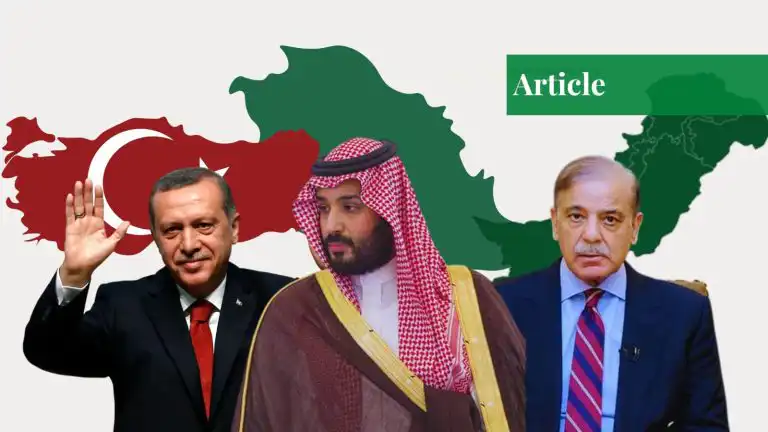
The accord has already started to see changes in its structure, the first being the name, which has changed from the Makkah Joint Defence Agreement to the Makkah Alliance. This is a clear indication of the accord not having come to any final form and is ‘still a work in progress’. Nevertheless, the contents are shrouded in secrecy, and as such we cannot analyse the Alliance for what it really stands for till we know more. Such agreements are usually never made when a crisis/war or a conflict is ongoing within the theatre, for fear of it being perceived, for the right or wrong reasons, as alignments against certain countries. Therefore, such agreements are usually made/constructed when the region is stable. However, in an apparent rush to sign some sort of an accord, the three countries, Saudia, Turkey, and Pakistan signed up on the 7th of August at Makkah and then sat down to a coordination conference on the 31st of August in Istanbul. So far it has been agreed upon to set up the HQs in Riyadh, and that Pakistan is to be the first Secretary for the Alliance, and of course the change in the name, which I expect, may change again.
A defence agreement naturally flows from a common threat perception and an identified common objective. This agreement has none and as such remains open to speculation. Secondly, now we are further confused: is this a deterrence, and if it is, against whom? Or a defence agreement, and if so, against what threat? In the wake of where it stands now, the practical manifestation of this alliance, specifically in the military sense, does not appear to be realistic or even implementable. As such, questions of its interoperability, logistics, budget, training, and application are wide-open. However, a lot of emphasis has been made towards the NATO-style Article 5, “An attack on one would be considered an attack on all”; but with no visible ways or means to execute such a joint commitment planned or conceived as yet.
The current Houthi initiative in Yemen is being called a test of the Alliance. It is not. Whereas the Saudis are involved in a kinetic engagement with the Houthis, there is at present no invasion of Saudi land, and instead a tit-for-tat lobbing of missiles at one another is the current nature of the conflict. The Alliance has so far not yet worked out the method to apply itself militarily, and the Saudi’s cannot expect that their allies would fight the Houthis on their behalf, instead of their own forces. The Saudis, with about 400 modern fighters, cannot expect others to become their front-line forces and need to commit themselves to combat in a battle initiated by themselves. Thus, as a critic, I would say this agreement should never have been signed during an ongoing Gulf Conflict; that if it had to be done, it should have first been an MOU; and finally, looking at its lack of efficacy, it should never have been named as a Defence Agreement. So at this moment we are struggling to come to grips with what exactly this Makkah Alliance is.
One question that comes up again and again is: how was this conceived; did Pakistan, Turkey and Saudia, simply decide on cobbling together such an arrangement, and why, but more importantly, why now? Was it to threaten Iran or Israel, or was it designed to fill the vacuum being created
by a diminishing US presence? It is worth mentioning that all three countries in the alliance are closely befriended by the US and are susceptible to doing what the US wants them to do. So considering this to be an initiative without US consultation/nod of approval is very difficult to envision. The US also publicly stated they supported the initiative and that it was in line with their new policy of burden-sharing. The three countries in question could well be safeguarding US influence and positions within the region while the US could withdraw its military assets to a safer place and maintain a strong military presence from a distance.
There is also another possibility that is being discussed, i.e., that this is actually an Iranian initiative. The regional security paradigm has been Iran’s consistent demand, and they have been continually asking the countries within the region to set up an alternative to the US-provided security system. Iran’s President’s visit to Pakistan in early August is one indication; the Iranian favourable press is another; the joint statement by the alliance that this was a defensive arrangement and not against any country is yet another such indication, while Pakistan’s Field Marshal’s visit to Iran, in the aftermath of the signing of the Agreement, reflects on Iran being part of the consultative process.
It was also announced that Iran was being invited to the Alliance, though it was played down by Iran; yet it does show some sort of consent by Iran. China’s obvious support further confirms that it had China’s blessing, encouraging Iran to pursue this Alliance – a diminished US presence in the region allowed greater space to China. It is very likely that Iran pursued the making of the Alliance for now and after a stabilising period, could join it at a later stage. If this is true, then Washington’s support for the Alliance amounts to trying to join the arrangement when seeing a fait accompli – the writing on the wall – and before it became totally irrelevant to the region, the US decided to support the Alliance. Thus ensuring that room for US relevance would remain. If this is the case, it would look like a win-win situation, where everyone appears to be happy. However, if Iran is not involved, then a monumental contradiction arises, i.e., structuring a regional security paradigm excluding one of the most important countries of the region that now controls the two choke points, Hormuz and Bab el Mandeb, is hardly a realistic structure or one that can manifest itself in any form.
The question as to who actually conceived the plan for an Alliance, till now, remains an open question that can be disputed, debated, and discussed. However, why the region has found a need for such an alliance at this time is another important matter. In the Global Order that the world had gotten used to living under was where the US remained the predominant unipolar hegemon. They disrupted international conventions, practices, rules, and regulations at will and whenever it served US interests, even at the cost of any other nation, community, event, or region. The US felt it was above any restraining laws and ignored the UN, or then manipulated it, and conducted itself outside the international parameters of bilateral and multilateral engagements. Kidnapping President Maduro of Venezuela is one such example, and claiming Greenland for the US is another.
The gross violation of the WTO and tariff wars mounted by the US indicate a lack of respect for any written agreements. Kashmir remains the longest outstanding resolution in the UN; Palestine is another, while the Gaza genocide flies in the face of the authority invested within the International Court of Justice. With the collapse of international laws and the rule-based order, regions need to look for alternatives to UN-implemented justice and propriety or US largesse. With a unipolar world being challenged in more ways than one, alternative systems are now being explored, and the Makkah Alliance is probably one such initiative.
Another paradox is related to defining the region in an apparent regional initiative. Out of the three countries in the Alliance, there are two, Pakistan and Turkey, that do not belong to this region. So what then defines the ‘Region’ in the context of the Makkah Accord?
For much of modern history, international security has been organised around states and regions. Alliances were created to defend territories, borders and political interests. Geography was understood largely in terms of countries and neighbourhoods. That paradigm may now be changing. The emerging strategic competition is increasingly about corridors — the routes through which energy, minerals, goods, electricity, capital, data and technology move from their sources to their destinations.
If “region” is interpreted conventionally, the Makkah Accord is a three-country defence arrangement centred on the Middle East, Türkiye and South Asia. But if the region is understood functionally, a very different picture emerges. Pakistan sits at the intersection of South Asia, Central Asia, the Arabian Sea and the Gulf. Saudi Arabia occupies the Gulf–Red Sea space and is becoming a major energy, investment and logistics hub. Türkiye links the Middle East with the Mediterranean, Black Sea and Europe. The three countries therefore occupy strategically important positions along several east-west and north-south routes.
Security may increasingly be organised around the corridors that connect countries, rather than merely around the countries themselves. The corridor is becoming the strategic unit. Consider what the world actually needs to move.
- Energy must move from producers to consumers.
- Minerals must move from deposits to processing centres and industrial markets.
- Electricity increasingly crosses borders.
- Goods move through ports, railways, roads and maritime chokepoints.
- Digital information moves through fibre-optic cables and data networks.
- Hydrogen, oil, gas and other forms of energy increasingly require dedicated infrastructure.
Consequently, the security of a modern economy depends not only upon defending territory. It depends upon ensuring the continuity of connectivity. This would mean defining the Corridor in which the region is interested and affected. In this case, it would include the Indian Ocean, the Red Sea, the Mediterranean Sea, the Bosporus, the Caspian Sea and the Suez Canal. A trade corridor whose eastern gateway rests in the Bay of Bengal and the Western Gateway in Egypt extends all the way up to Sevastopol in the Black Sea. With SCO and BRICS emerging as new global entities, the BRI from source to destination becomes the core strategic asset that needs protection and security. However, the BRI is not necessarily at the exclusion of other trade corridor initiatives such as the IMEC, etc and these could be alternatives in an environment where the age of corridor strategy becomes dominant – a multi-polar world where no one is more equal than others.
The Makkah Alliance should therefore be watched not merely for what it is today, but for what its geography and future membership could make it tomorrow. If it remains a three-country defence arrangement, its significance will primarily be military and political. If it expands geographically while retaining its defensive character, however, it could become part of something much larger: an emerging architecture connecting South Asia, the Gulf, the Middle East, Central Asia, Türkiye and Europe. And if countries such as Bangladesh, Egypt, Jordan or eventually Iran become part of that wider architecture, the distinction between regional security and global connectivity could begin to disappear.
The age of corridor strategy is a consequence of a unipolar world collapsing. When universal systems and conventions become less capable of providing certainty, states do not necessarily abandon international law or the UN. They begin constructing additional layers of certainty around themselves. The Makkah Alliance may be one of those layers. The Makkah Alliance is not the manifestation of a completed new regional order. It is an embryonic response to the erosion of the old one — a dynamic experiment whose ultimate nature, membership, scope and relationship with the wider international system are still being determined. The Makkah Alliance may therefore be less a replacement for the old order than an early response to its diminishing reliability. The new order, if one is emerging, is not yet visible in finished form. It is being constructed through experiments in regional security, connectivity and interdependence. We are not witnessing the birth of a new order yet. We are witnessing the search for one.
If you want to submit your articles and/or research papers, please visit the Submissions page.
To stay updated with the latest jobs, CSS news, internships, scholarships, and current affairs articles, join our Community Forum!
The views and opinions expressed in this article/paper are the author’s own and do not necessarily reflect the editorial position of Paradigm Shift.