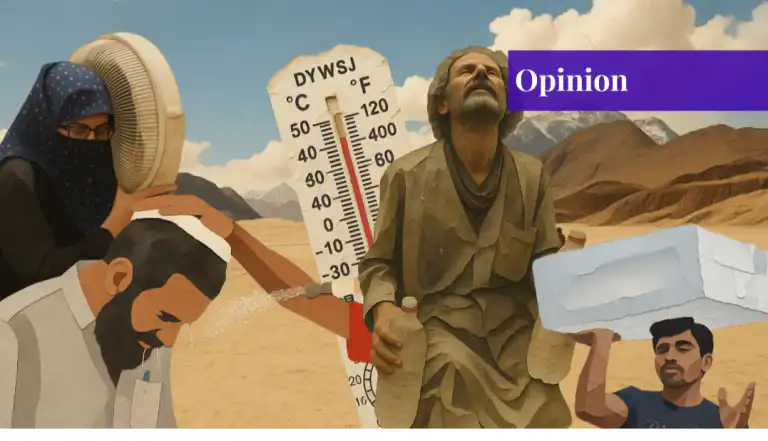
Heat is not the only problem in Pakistan. It exists without proper safeguards, silently and repeatedly. The country is in a state of reaction and not prevention, and Sindh, Punjab and Balochistan record-breaking temperatures year after year. The heatwave is no longer an annoyance of the summer. Behind the mask of ordinary weather lies a public health emergency, and institutional failure and industrial neglect sit at its core.
The evidence keeps mounting. In the spring of 2026, a record-breaking pre-monsoon heatwave swept across South Asia, pushing temperatures in parts of Pakistan and India towards 45–50°C and killing at least ten people in Karachi in a single stretch, according to World Weather Attribution. By July 2026, an extraordinary heatwave had killed at least 196 people nationwide as temperatures again passed the 50°C mark, with Punjab the worst hit at around 120 dead and Jacobabad once more reaching 52°C. This was no isolated year. In 2024, an extreme heat event killed more than 568 people and caused over 7,900 hospitalisations, while the 2025 India–Pakistan heatwave arrived early and pushed Balochistan close to 49°C. Hundreds of lives are lost in Karachi in a matter of days. The government’s response is invariably a few relief camps and some public announcements, and that is it, until the next summer. The loss is not bad luck. It is a deliberate policy choice to look away.
Although Pakistan accounts for less than 1% of global greenhouse gas emissions, it ranks among the top ten most climate-vulnerable countries in the world. This is not a problem that can be ignored. Yet it is intellectually dishonest to blame global emitters while overlooking domestic negligence. This is not a matter of climate change alone; it is also a policy failure at home. There is no excuse for refusing to face both facts at once.
In Pakistan, urbanisation has proceeded without planning, and urban areas have become dangerous heat islands. Trees are being replaced by concrete. Housing schemes have consumed green spaces without any environmental impact assessment. There are no thermal regulation standards in industrial zones. Each season, the NDMA issues warnings, and yet there is no law or binding policy requiring industries or provincial governments to take precautionary action. Warning without enforcement is just noise: it makes governance look responsive while offering no real protection.
Those least to blame bear the brunt of the human cost. Daily-wage labourers, brick-kiln workers, rickshaw drivers and agricultural workers toil for long hours in the sun, unprotected by any occupational heat safety legislation. A construction worker in Lahore has no legal right to a heat break. A peasant in Rahim Yar Khan has no assurance of a cooling centre. Meanwhile, the companies that rely on their labour bear no responsibility for unsafe heat exposure. Older adults, outdoor workers and those in the informal sector are consistently the most susceptible to heat stress.
Public health systems are weakest exactly where the need is greatest. Every summer, hospitals across interior Sindh and southern Punjab report outbreaks of heatstroke, dehydration and cardiac attacks. Yet investment in heat emergency preparedness remains tiny. The routine acceptance of preventable deaths during extreme weather is a form of normalisation, and that normalisation is itself a political act.
Some argue that Pakistan cannot afford detailed heat action plans. That position is indefensible. Ahmedabad, India, introduced South Asia’s first Heat Action Plan in 2013 after a deadly 2010 heatwave, and it has since been credited with averting roughly 1,190 deaths a year, achieved with modest investment and sustained political commitment. After the 2015 Karachi heatwave, which claimed over 1,200 lives, a similar framework was drawn up for Karachi. But funding for implementation was inadequate and limited. Poverty is not the real obstacle in Pakistan. The problem is the absence of continuity in political attention.
Three straightforward steps must be taken now, through legislation.
First, there must be a legally binding National Heat Emergency Framework, one that can be activated to open cooling centres through the provincial governments, to restrict outdoor activity during identified hot hours, and to prepare hospitals well in advance of summer rather than after the casualties begin to mount.
Second, industry must be held legally accountable. Employers in high-temperature environments should be required to meet occupational heat safety standards, and penalties should be set at a level that genuinely ensures compliance.
Third, urban greening must be built into development policy. No project should be approved without verified green-cover and heat-mitigation plans. Shaded public spaces in cities should be a legal requirement, not a matter of political discretion.
Beyond this, the Loss and Damage climate financing agreed at COP27 must be pursued vigorously. Pakistan has a moral and legal claim on the international community, but realising it demands evidence and institutional seriousness of the highest order.
Every summer without structural reform is a political choice, and one whose cost in health and life falls on the poor and the vulnerable. The state has committees to spare. What it lacks is the political resolve to recognise heat as the deadly emergency it is, to legislate for it, and to invest in readiness. The hot weather will return. The real question is whether governance will finally rise to meet it.
If you want to submit your articles and/or research papers, please visit the Submissions page.
To stay updated with the latest jobs, CSS news, internships, scholarships, and current affairs articles, join our Community Forum!
The views and opinions expressed in this article/paper are the author’s own and do not necessarily reflect the editorial position of Paradigm Shift.

Fiza Rashid is a Monitoring Officer at the Suthra Punjab Authority and an MPhil graduate in Environmental Science from Government College University Lahore.