

From a wheat field outside Gujrat to a drained dam in Java, a Pacific Ocean weather pattern most of Asia has never seen the likes of is already sending its first bills.
A farmer on the edge of Gujrat, in Pakistan’s central Punjab, will tell you plainly: this is the hottest year of his life. Not the hottest week, not the hottest month — the hottest year, full stop, in a lifetime spent watching the same fields turn from green to gold every April. This year the gold came early, and thin. His neighbor, two plots over, says something close to the same thing: a smaller harvest, a smaller income, and an electricity bill that has only moved in one direction all summer. Multiply that conversation by a few hundred million people across two continents and you have, roughly, the shape of what “the strongest El Niño in living memory” looks like from the ground — months before it shows up in anyone’s GDP figures.
That phrase, “living memory,” actually undersells it. The El Niño now building in the tropical Pacific is forecast to beat every event ever reliably measured, not edge into a top five. The 2023-24 El Niño, the one that helped make 2024 the hottest year on record, was — by the World Meteorological Organization’s own count — merely one of the five strongest since 1877. This one is being discussed in different units. In a September update putting the odds of it persisting through February 2027 at “nearly 100%,” UN Secretary-General António Guterres described it this way: El Niño is “being supersized before our eyes.”
A Record Nobody Asked For
Strip away the adjectives and the underlying numbers still hold up — though which numbers depends on which of two rulers is used. Zeke Hausfather at Berkeley Earth pooled forecasts from more than 660 ensemble members spanning 14 seasonal models in July and landed on a consensus peak of 3.6°C above average in the Niño 3.4 region, the standard measure of El Niño’s core strength — roughly 0.8°C hotter than that index’s previous record, set in 2015-16 at 2.75°C. But Niño 3.4 has a known flaw: in a warming world, it struggles to separate El Niño itself from the ocean’s broader warming trend. NOAA’s preferred fix, the Relative Oceanic Niño Index, strips that trend out — and by RONI’s accounting, the record holder isn’t 2015-16 at all; it’s 1982-83. Whichever ruler is used, this year clears it: models put the odds of a record peak at roughly 91 percent in Niño 3.4 terms and 77 percent in RONI terms. Hausfather’s own summary of what the models were showing: something outside the envelope of anything we have ever observed.
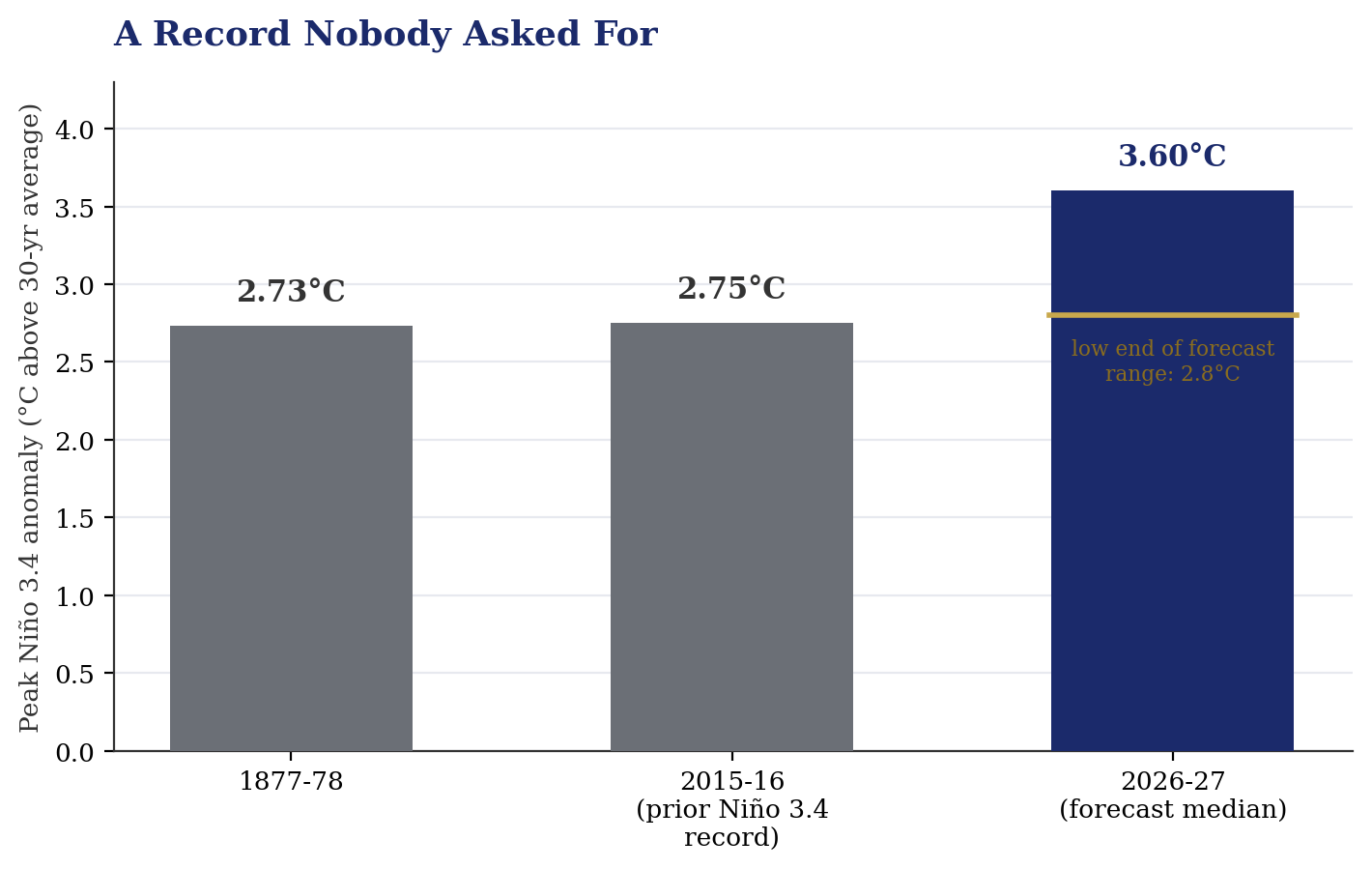
Figure 1. Peak El Niño intensity: the strongest events on record versus the 2026-27 forecast (multi-model median).
Source: Zeke Hausfather, The Climate Brink, “The Strongest El Niño Ever” (July 13, 2026)
There’s a catch, and it matters for how this story gets told over the next year. El Niño typically peaks between November and January, and its effect on global temperature lags the ocean by three to five months. Most of this event’s heat lands in 2027, not 2026 — which is why forecasters were giving 2026 only a modest chance, around 28 percent as of July, of edging out 2024 as the hottest year on record, with 2027 the likelier record-breaker. What Asia is living through right now is the opening act. The main event hasn’t peaked yet.
The View From Punjab
Pakistan’s weather service flagged this back in May, warning that El Niño conditions were likely to develop over the 2026 monsoon season alongside below-normal rainfall across most of South Asia. By June, forecasts had Gujrat and the rest of upper Punjab sitting 5 to 7°C above normal, with highs in the low 40s; further south, Dadu in Sindh hit 51.5°C, a new record for the site. That is the heat the farmer outside Gujrat is describing when he says he has never felt a year like this one — the data agrees with him.
The harvest confirms it too. Pakistan’s wheat crop hit a record 31.4 million tonnes in 2024-25; the 2025-26 crop is forecast at roughly 27.5 to 28.9 million tonnes, 10 to 13 percent below that — the product of a smaller planted area and rainfall running nearly 39 percent under normal through the growing season, with heat striking central Punjab and upper Sindh at exactly the wrong moment: grain-filling, when every extra degree over the optimum can strip five to seven percent off the eventual yield. Basmati fared no better. Punjab had targeted 5.5 million acres of paddy this season, but July’s rain never arrived, pushing transplanting back by weeks and forcing farmers onto expensive groundwater pumping just to save what was already in the ground. Less grain, and a higher cost to grow it — precisely the two complaints coming out of the fields around Gujrat.
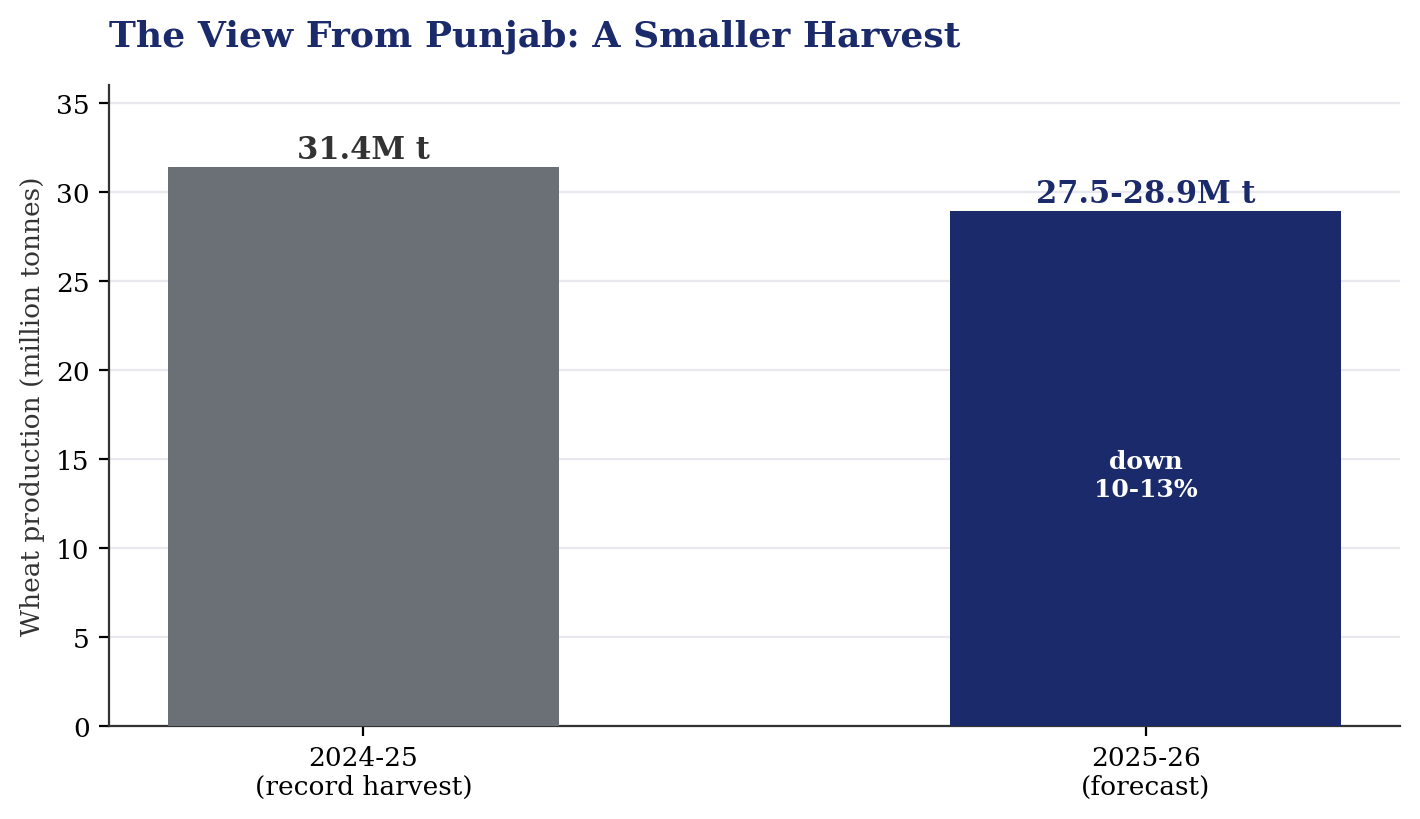
Figure 2. Pakistan’s wheat harvest: the 2024-25 record against the 2025-26 forecast.
Source: World Grain, “Pakistan Anticipating Record Wheat Crop” (2024-25). Voyage Freight, citing USDA FAS (2025-26 forecast)
The bills compound it. Pakistan’s grid was already strained this summer by peak demand of 27 to 28 gigawatts against a fuel supply disrupted by the US-Israel war on Iran, which cut off the Qatari LNG imports the country’s power plants lean on. Rawalpindi and Islamabad — the twin cities roughly two hours up the road from Gujrat — were fielding complaints that July about outages arriving alongside rising bills, tubewells running dry along with the taps they fed. A temporary relief of roughly two rupees per unit, worth more than Rs 67 billion to consumers since June, expired at the end of August — meaning bills were due to climb again in September, just as the cushion that had softened the hottest summer on record ran out. Warmer year, smaller harvest, costlier power: that isn’t a farmer’s impression of the story. That is the story.
The Same Sky Over India
Cross the border, and the pattern doesn’t change, which is itself worth noting — this is usually where the same weather turns into two different national stories, and this year it hasn’t. India’s southwest monsoon came in 15 percent below normal nationally, its driest since 2009. Indian Punjab took the worst of it: a 38 percent rainfall deficit, with Haryana at 31 percent and Uttar Pradesh at 28 percent. Sown area for the kharif season fell nearly five percent against last year.
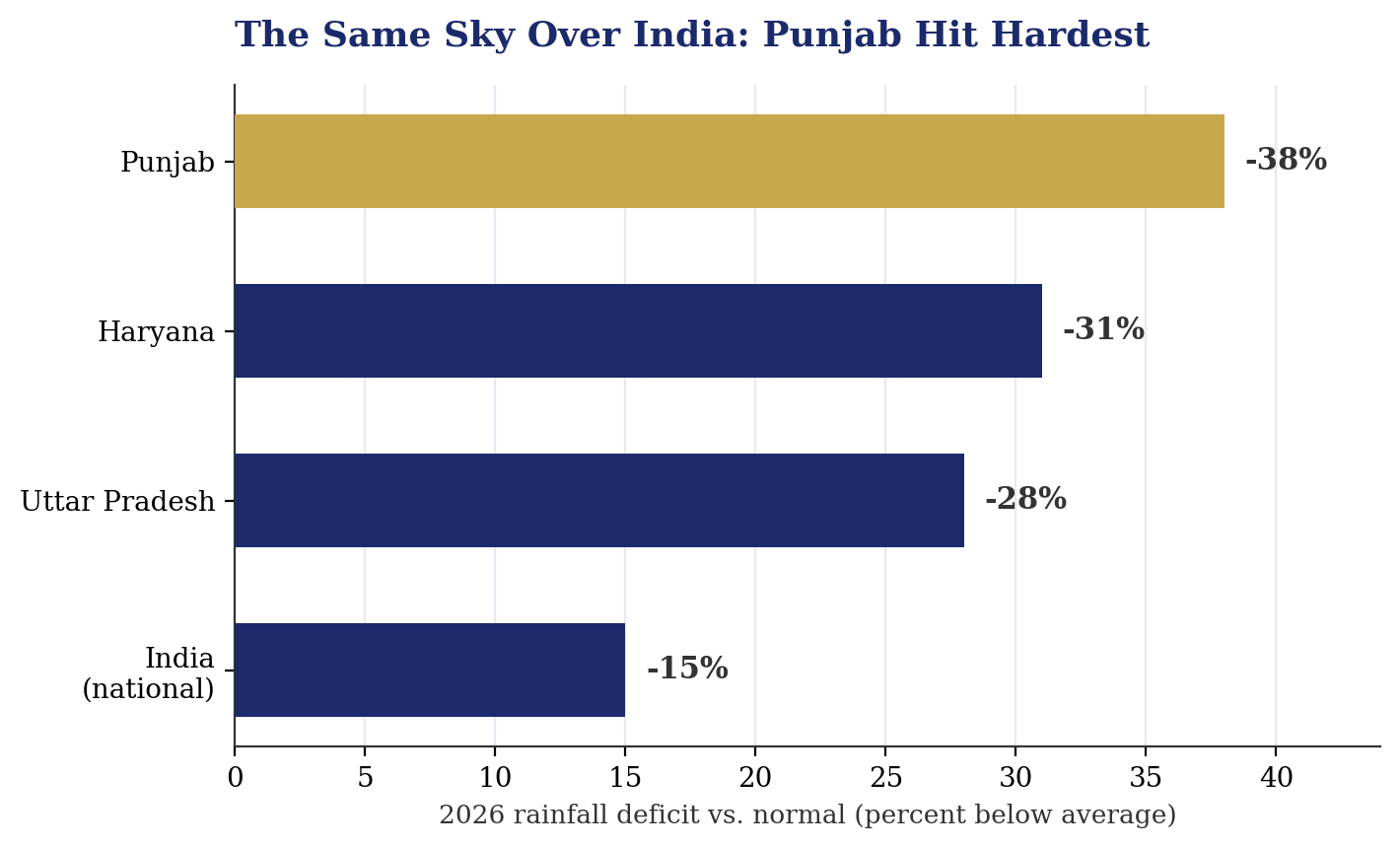
Figure 3. How far short of normal the 2026 monsoon fell, state by state.
Source: International News and Views, “India Rainfall Deficit 2026” (state figures, through late July) · News24, “El Niño 2026: India Heads for Driest Monsoon Since 2009” (national figure)
Mumbai’s reservoirs were down to roughly a tenth of capacity by mid-June, leaving the city’s 13 million residents about forty days of drinking water and forcing its first construction-site supply cuts in over a decade. None of this is unprecedented in kind, only in scale: research compiled by ICRIER going back to 1951 finds that 11 of 15 moderate-to-severe El Niño years produced a contraction in Indian farm output, averaging a 9.7 percent drop in monsoon rainfall and a 5.7 percent fall in kharif foodgrain production; the last so-called “super El Niño,” in 2015-16, slowed farm growth to just 0.5 percent that year. Agriculture is only around 14 percent of India’s GDP now, far less than it once was, but it still employs more than half the country’s workforce — so a bad monsoon still travels straight into rural incomes, the same channel it travels through in the fields around Gujrat.
Where the Rice and the Palm Oil Grow
Move further east, and the crop changes, but the mechanism doesn’t. Southeast Asia’s wet season normally runs from June through October, refilling reservoirs and setting up the next planting cycle; this year the rains that should be doing that have largely not shown up. Rice sowing was delayed across the Philippines, Cambodia, Thailand, and Vietnam, and by August, drought-fed wildfires in Indonesia had burned more acreage in July alone than in the previous six months combined, sending haze as far as Malaysia and Singapore. Associated Press reporting out of Indonesia this week described drought already scorching farmland, straining reservoirs, and denting fish catches across a region that entered this El Niño already drained by the same energy crisis squeezing Pakistan, with less money in reserve to absorb the new shock. The world’s three largest rice exporters — India, Vietnam, and Thailand — are all exposed at once, which is precisely the combination that tends to move global food prices rather than just local ones. Rafisura, a UN official quoted in the same dispatch, put it plainly: agriculture is “definitely on the front line.”
Palm oil tells the same story from a different crop. Indonesia and Malaysia between them grow most of the world’s supply, and Eddy Martono, who chairs Indonesia’s palm oil association, has warned that growers will simply stop fertilizing rather than risk burning their trees without rain to dissolve the nutrients into the soil. In Banten province, drought had already lowered the Karian Dam enough by late July to expose houses that had sat submerged for years. North of Bangkok, rice farmer Boonmark Marksuuk is pumping groundwater to compensate for rain that never came, absorbing higher fuel and fertilizer costs on top of it. None of this stays local for long: import-dependent governments in Jakarta and Manila face rising rice and fuel import bills of their own, and the shortfall eventually reaches supermarket shelves well outside Asia.
What the Rest of the World Is Saying
Outside the region, coverage of this event has mostly settled into a familiar genre: scientists reaching for superlatives, and economists trying, and mostly failing, to agree on what those superlatives will cost. The last event of comparable ambition, 1997-98, has been priced anywhere from $45 billion — the World Bank’s original estimate of direct costs to governments — to $5.7 trillion, a 2023 Dartmouth study that traced the economic drag across five years and folded in agriculture, health, and conflict. That isn’t a rounding error. It’s a roughly hundred-fold gap between two credible estimates measuring two different things, and it should make anyone quoting a single dollar figure for the current event — floated estimates already run as high as $10 trillion — treat that number as a placeholder rather than a fact.
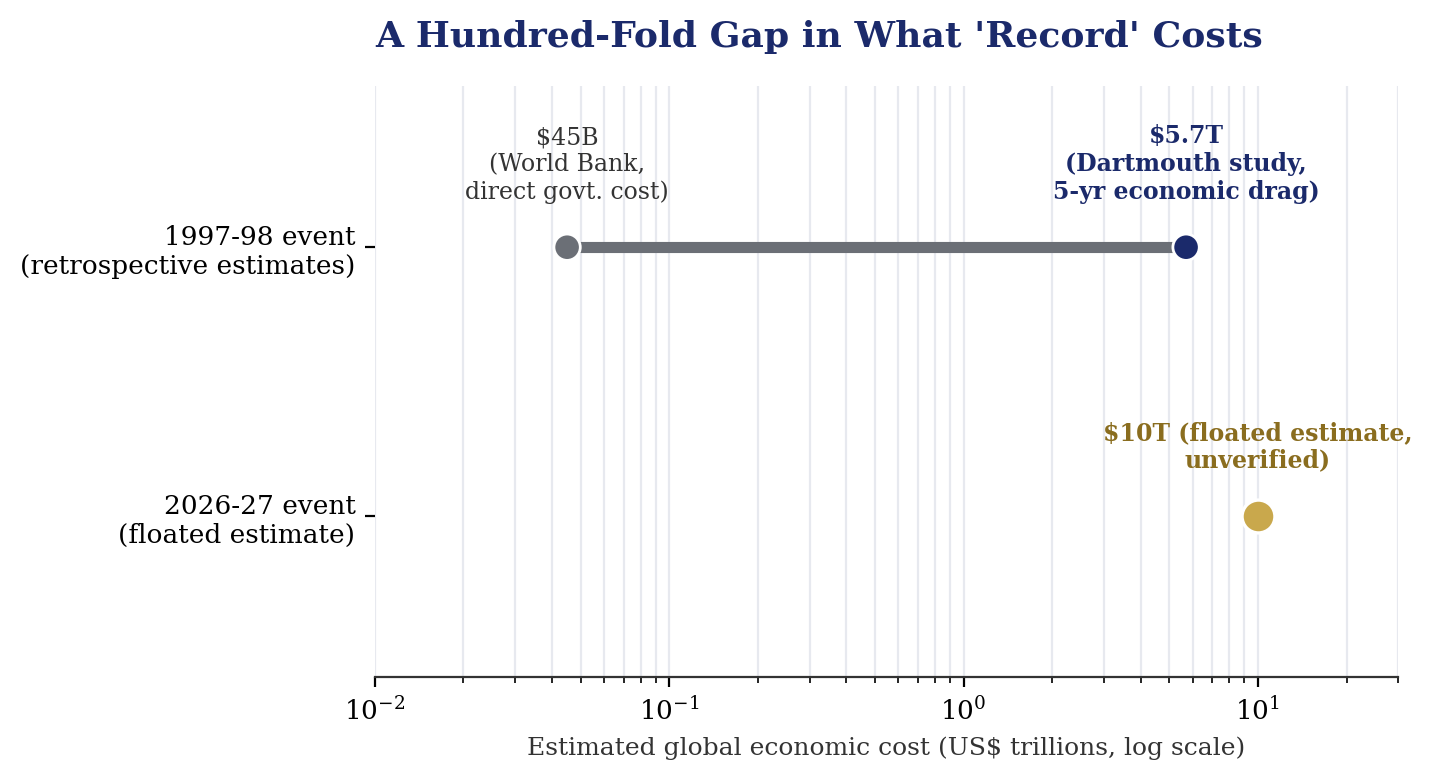
Figure 4. How wide the uncertainty really is: retrospective cost estimates for 1997-98 span two orders of magnitude; the current event has only a single, unverified figure so far.
Source: Courthouse News, “El Niños Are Far Costlier Than Once Thought…” (May 18, 2023) (1997-98 estimates). Gizmodo, “This El Niño Is on Track to Become the Strongest on Record…” (July 27, 2026) (2026-27 estimate)
What’s less disputed is the shape of the weirdness elsewhere. By early September, the Atlantic was closing in on the record for the latest first hurricane of any season on file, while reinsurer Munich Re was forecasting the opposite in the northwest Pacific: a typhoon season running above its 30-year average, with a greater-than-usual chance of landfall in Japan, China, Taiwan, or Korea. Same event, opposite ends of the same ocean, pulling storm tracks apart. That asymmetry previews the kind of year 2027 is shaping up to be: unevenly distributed, and heaviest exactly where Asia already sits.
So, How Bad Does It Get?
Put the ground-level account next to the aggregate data, and they agree almost too well: the farmer outside Gujrat describing his worst year isn’t an anecdote standing in for a trend — he is the trend, measured in one field. Pakistan’s wheat harvest is down by roughly the percentage the heat and rainfall data would predict. Punjab on both sides of the border took the worst of the region’s monsoon failure. Southeast Asia’s rice and palm oil belt is losing the same rains for the same reason. None of that is exaggerated by the “strongest in living memory” framing — if anything, the framing undersells an event whose own forecasters are now measuring it against a century and a half of records and still running out of adjectives.
What should temper the alarm, a little, is timing and honesty about the numbers. The worst of this event’s global temperature effect, by ENSO’s own mechanics, is still coming in 2027, not now. The economic estimates attached to it are drawn from a methodology so contested that comparable past events carry price tags a hundred times apart. And El Niño remains, as WMO’s own scientists note even about this record-strength forecast, a naturally occurring climate cycle rather than something caused by climate change — one riding on top of human-driven warming, not a replacement for it. None of that will matter much to a farmer weighing a lighter harvest against a heavier electricity bill in Gujrat this September. The models will still be arguing over how bad 2027 gets long after he already knows how this year ended.
If you want to submit your articles and/or research papers, please visit the Submissions page.
To stay updated with the latest jobs, CSS news, internships, scholarships, and current affairs articles, join our Community Forum!
Find our FREE quizzes and MCQs here!
The views and opinions expressed in this article/paper are the author’s own and do not necessarily reflect the editorial position of Paradigm Shift.

Asnan Asad is a final-year BS International Relations student at the University of Gujrat, Pakistan, with research interests in Pakistan's foreign policy, the China-Pakistan Economic Corridor (CPEC), and regional security. He has interned at Inter-Services Public Relations (ISPR) and the Institute of Regional Studies, and is an active member of IIRIS, his university's IR student society.