

She is a clinical psychologist and author with over six years of experience in freelance writing, specializing in mental health, social issues, and global affairs. She co-authored L’Art de Vivre, a book on positive psychology, and contributed to flood relief efforts in 2022. She also qualified the CSS Special Competitive Examination in 2023. Through her work, she is committed to promoting resilience, raising public awareness, and fostering informed discourse by combining psychological insight with socio-political analysis.
Introduction
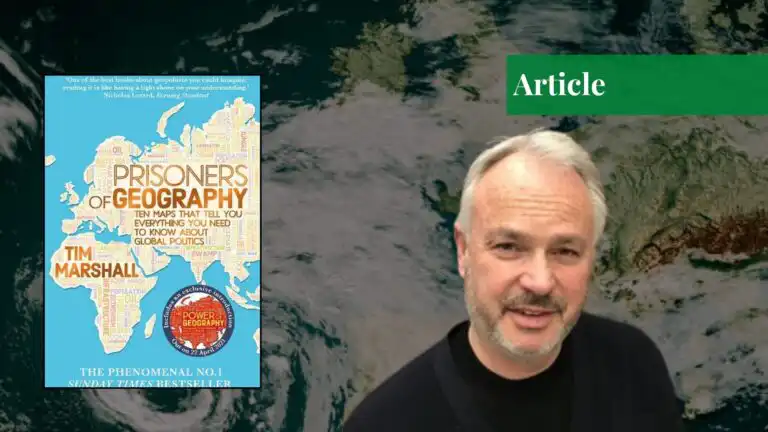
Tim Marshall’s book, “Prisoners of Geography: Ten Maps That Tell You Everything You Need to Know About Global Politics” focuses on the significance of the physical environment including land, water, and mountains to shape the geopolitical destinies of the world. Marshall contends that geography plays a vital role along with culture, politics, economic, and ideological forces in the geopolitical and geostrategic dynamics of the world. Marshall has put in a blend of historical insights and the role of geography in the past in his writing. This detailed summary will explore this compelling book by examining its core features and themes.
Structure
In his book, Marshall has put forth an evident thesis about how geography leaves limited options for states to act in certain situations. His book focuses on ten regions of the world, one chapter for each one: Russia being the first, followed by China, the United States, Western Europe, and Africa, shifting to the Middle East—the longest chapter in the book, India and Pakistan in a single chapter, South Korea and Japan, Latin America, and the last chapter discusses the Arctic. The key theme in each chapter is how geography shapes the world’s destiny.
Summary
The first chapter of the book covers Russia. Marshall contends that Russia, the largest country in the whole world, is a cold and flat land which makes its invasion very easy. Consequently, Russia quests for more buffer zones outside its territory to deter such invasions. China has an internal unity because of its river systems, however, geographical barriers like the Himalayas and deserts shape the country’s strategic moves. The United States, the superpower, has come a long way just because of the perfect geography it has been blessed with. Covered by oceans on both sides, the US has focussed more on its expansion and economic rise ever since its birth. Next, in Europe, a mosaic of states and cultures, the geographical features like rivers, seas, and mountains are fragmented. This, in particular, has helped the interconnected states to grow economically.
Africa, where economic and political growth has been hindered by the lack of river force, suffers because of its location and connections in the world. Similarly, the Middle East, the region of conflicts, and its geography have made it a game of power for the competitors. Then, India and Pakistan, being the two hotbeds of conflicts like the Kashmir issue, Water issues, and Border conflicts with the neighbors, have come a long way because of the geo-strategic importance they hold in the world. Latin America, isolated and under the influence of the United States has not developed much. Lastly, the Arctic, where melting ice has created a new hope for the competitors in the world, has shown the world how geography changes with climate changes.
Geopolitical Analysis
Prisoners of Geography, with its key focus on different regions, has used the historic geopolitical events of the world and presented them through the lens of geography. The world has seen wars, colonization, bipolarity, uni-polarity, and an emerging multi-polarity. Marshall’s point of view explicitly explains how geographical factors have shaped such events, progressed through these events, and how the world has come out of such events changing political, economic, and even geographic dynamics of the world. Interestingly, Marshall claims that the United States has become a superpower just because of how intelligently it has utilized its geographical strengths. Additionally, the Middle East conflicts are also because of the geographical constraints within and among the states.
Strengths of the Book
Acknowledging the strengths of the book, first and foremost, the book is very engaging and captivating for the reader. The language is very simple and can be understood easily. Secondly, every argument made has been supported by historical events that ground it in authenticity and make it more interesting to read. Moreover, this book provides a broader view of the world; instead of focusing on a single region, it covers the whole world through ten maps, which is commendable.
Limitations of the Book
However, there are some shortcomings in the book too. Firstly, the geography-centric view of Marshall in the book underestimates the role of politics, ideology, economy, culture, and society. Moreover, the book oversimplifies some complex events of history by ignoring other aspects of such events.
Relevance to Contemporary Affairs
Moreover, this book also gives an insight into how geography is shaping contemporary issues like the Russia-Ukraine Conflict: the geographical importance of Ukraine for Russia is making Putin use all his power to keep Ukraine away from Western influence. Similarly, China’s Belt and Road Initiative is the one project that has connected China to the entire world and has successfully given it a geographic presence across the globe.
Similarly, the instability in the Middle East is example-gratia of the fact that geography makes world powers act the way they do. In addition, the territorial competition in the Arctic region can also be relatable to the geographical underpinnings discussed in the book. The book is very informative and useful for understanding the geography of the world, the consequential factors that impact states, and most importantly, how geography can shape the power dynamics of the world in the future.
Applying the Lens of Geography to Pakistan
Specifically, Pakistan is connected to two power rivals, China and India on two sides, an unstable Iran on another, and Afghanistan, a hotbed of problems on the other. Furthermore, in the south, it connects to the Arabian Sea.
The geography of Pakistan has shaped its history in many ways. From security issues with India and Afghanistan to friendship with China; from the porous border with Afghanistan to the vast Arabian Sea, the geography of Pakistan brings its own unique opportunities and challenges. However, how Pakistan progresses through these will shape its future in the world for decades to come.
Conclusion
To cap it all, Prisoners of Geography is a very well-written and thought-provoking book. It explains the role of geography in international relations and global power dynamics. It divided the world into ten regions and explains all the events through the lens of history. Furthermore, it has some strengths and limitations. Overall, it is a very informative read, especially for beginners who want to understand geopolitics. To follow up on this geopolitical analysis of global powers, one should read “Power of Geography” also authored by Tim Marshall.
To all the readers, you must get your hands on this book, you will not regret it, I promise!
If you want to submit your articles and/or research papers, please check the Submissions page.
The views and opinions expressed in this article/paper are the author’s own and do not necessarily reflect the editorial position of Paradigm Shift.