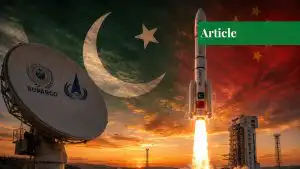
The Launch of PRSS-1
On August 1st, 2025, Pakistan’s space programme achieved a decisive breakthrough, crossing yet another threshold in its space odyssey when the Pakistan Remote Sensing Satellite-1 (PRSS-1) was inserted into its designated orbit by a Kuaizhou-1A launch vehicle from China’s Xichang Satellite Launch Centre. This landmark mission represents the third successful orbital insertion for Pakistan in just seven months, a testament to both SUPARCO’s rapidly maturing engineering capabilities and the depth of Sino-Pakistani collaboration in space technology.

Just a few months earlier, on 17 January 2025, SUPARCO celebrated the launch of its first fully indigenous Earth-observation satellite, PRSC-EO1, which rode a Long March-2D launcher into low Earth orbit. In May, Pakistan extended its reach beyond our planet when ICUBE-Qamar, a compact lunar microsatellite developed in Karachi, hitched a ride on China’s Chang’e-6 mission and commenced surface-mapping experiments around the moon. Those endeavours were, in many ways, proof-of-concept flights, crucial learning exercises in design, integration, and flight operations.
With PRSS-1, however, SUPARCO has moved decisively into the realm of purpose-driven missions, fielding a medium-class remote-sensing platform equipped with high-resolution multispectral and panchromatic imaging payloads, onboard data-processing hardware, and a suite of radiation-hardened subsystems.
Technical Sophistication and Data Utility
PRSS-1 integrates advanced optics capable of resolving ground features down to sub-meter accuracy. At the same time, its onboard processing unit applies real-time compression and preliminary analytics before downlinking via upgraded X-band ground stations. This architecture significantly accelerates data turnaround, delivering actionable intelligence to end users within hours of acquisition.
In practical terms, provincial disaster-management authorities can now access near-instant floodplain assessments to deploy relief resources more effectively in advance. Agricultural agencies will utilize vegetation health indices and soil moisture maps to optimize irrigation schedules and enhance crop yields. Meanwhile, CPEC project managers gain an independent, high-fidelity view of infrastructure progress, enabling them to exercise tighter oversight and mitigate risks.
Implications for Governance
The deployment of PRSS-1 carries profound implications for evidence-based policymaking in Pakistan. First, real-time geospatial data enables federal and provincial ministries to base their decisions on objective measurements rather than anecdotal reports. Whether allocating water quotas, approving land-use changes, or authorizing road-building contracts, decision-makers now have a robust, transparent information base that can reduce cost overruns and curb malfeasance.
Second, public access to selected satellite products fosters greater civic participation and accountability; journalists, academics, and civil-society organizations can verify government claims against an impartial data stream. Finally, inter-agency coordination, long hampered by siloed information flows, stands to improve dramatically as SUPARCO’s centralized geospatial platform harmonizes inputs from the agriculture, environment, interior, and water resources ministries into a unified analytical framework.
Astro-political Dynamics and Strategic Posture
On the international stage, Pakistan’s accelerated launch cadence and growing satellite constellation signal a shift in South Asian astro-politics. While India has maintained a more visible presence with regular launches and interplanetary missions, Pakistan’s trio of successful flights in 2025 positions Islamabad as a credible contender in the region’s space domain. Continued reliance on Chinese launch services underscores the strategic partnership between the two countries.
This relationship now extends beyond terrestrial infrastructure into the peaceful exploration of near-Earth and cis-lunar space. Yet the transfer of technical know-how, from avionics assembly to mission planning, suggests an emerging trajectory towards greater indigenous autonomy. Over time, SUPARCO engineers expect to adapt Chinese design standards to local requirements, ultimately paving the way for domestically produced small launch vehicles and ground segment facilities.
Navigating International Norms
Pakistan’s expanding space activities also bring complex legal and diplomatic considerations. As a participant in United Nations COPUOS forums, though not a signatory to the Artemis Accords, Islamabad must articulate clear policies on space debris mitigation, spectrum allocation, and the peaceful use of lunar resources. ICUBE-Qamar’s lunar operations, in particular, will invite scrutiny regarding planetary-protection protocols and data-sharing obligations under evolving international frameworks. Proactive engagement in multilateral discussions will be essential to ensure Pakistan’s long-term access to cooperative ventures and to uphold the norms of responsible behaviour in space.
From Capability to Impact
Promtpto, the accurate measure of PRSS-1’s success will be the tangible benefits it delivers on Earth. If flood-forecast models derived from its imagery shave hours off evacuation timelines in Sindh, if Punjab’s farmers use its vegetation indices to sidestep drought-induced losses, or if CPEC stakeholders avert construction delays through unambiguous progress monitoring, then the rupees spent and the engineering challenges overcome will be well justified. SUPARCO’s Space Vision 2040 roadmap envisages a diverse constellation encompassing observation, communication, and navigation satellites; PRSS-1’s flawless performance sets a high bar for the missions to follow.
Pakistan’s Leap into a New Space Order?
With PRSS-1 now operational, Pakistan stands at a pivotal moment in its space history. No longer merely a student of orbital mechanics, Islamabad is emerging as a practitioner of mission-oriented space applications, poised to harness satellite data for governance, economic development, and environmental stewardship. By converting orbital assets into practical solutions, Pakistan’s space programme is reshaping how the nation responds to climate risks, cultivates its land, and upholds infrastructure integrity, while steadily charting a course toward greater strategic autonomy in the rapidly evolving astropolitical arena.
If you want to submit your articles and/or research papers, please visit the Submissions page.
To stay updated with the latest jobs, CSS news, internships, scholarships, and current affairs articles, join our Community Forum!
The views and opinions expressed in this article/paper are the author’s own and do not necessarily reflect the editorial position of Paradigm Shift.

Mohammad Zain is an International Relations student at NUML, Islamabad. With an associate degree in English Literature and Linguistics and a BS in International Relations, he brings a unique blend of analytical and literary skills to his writing.