Islamabad, August 29: The proposed bill on reproductive health education in schools requires detailed discussion regarding technical and thematic shortcomings, as well as its compatibility with constitutional provisions and alignment with societal values and Islamic teachings. Central to the debate is the need to develop a framework for health and moral education that is both responsive to contemporary challenges, such as technological change and shifting social dynamics, and reflective of Pakistan’s cultural and religious foundations.

Such a framework should recognize the central role of parents in guiding the moral development of youth while ensuring that education initiatives remain rooted in indigenous traditions rather than uncritically adopting external models of sexuality education.
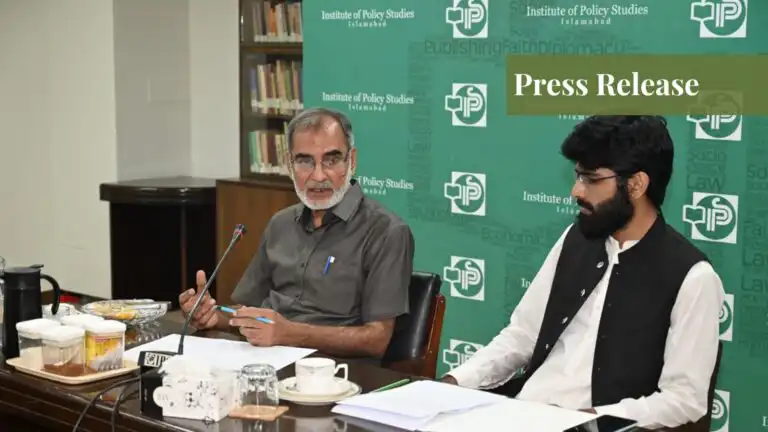
This was discussed at a roundtable hosted by the Institute of Policy Studies (IPS), Islamabad, under its initiative ‘Legislative Watch’ to critically examine multiple dimensions of the proposed bill, approved by the Senate Standing Committee on Federal Education and Professional Training last month.

Those who attended the session included Imran Shafique, Advocate, Supreme Court of Pakistan; Arshad Saeed Khan, senior educationist; Dr. Waqas Khan, religious scholar; Ameena Sohail, senior lawyer; Syed Muaz Shah, legal commentator; Ammar Mehboob, curriculum expert; Dr. Umme Kulsoom, senior physician and social worker; Advocate Muhammad bin Sajid; and Khalid Rahman, Chairman IPS.
The forum, which brought together scholars, educators, policymakers, legislators, social activists, and civil society stakeholders, discussed ways to balance educational needs with cultural and religious considerations. Speakers recommended imparting the knowledge related to family affairs, spousal roles and responsibilities, and values of haya (chastity) through a framework rooted in indigenous culture and civilization.

Participants deliberated on the issue from educational, social, and legal perspectives. Reviewing the text of the original law of 1976 and the amendment proposed in it through the current bill, it was observed that questions remain regarding clarity, scope, and the approach of the proposed legislation. Several speakers raised concerns about the compatibility of the proposed law with the country’s constitutional provisions, the spirit and scheme of the original statute, societal values, and the Islamic paradigm of life.
Acknowledging that the changes brought by technology and evolving social patterns needed a thoughtful intervention, some participants cautioned that the initiative could risk introducing Western concepts of sexuality into Pakistan’s education system, potentially conflicting with the nation’s moral and cultural framework, while others suggested developing an approach that is deeply embedded in Islamic tradition and grounded in an indigenous value framework.
Speakers highlighted policy contradictions, noting that while the law restricts marriage under 18, children are nonetheless exposed to explicit content through the internet and affected by the increasing trend of co-education. This, they argued, needs a holistic approach within the context of local culture.

The rules and norms of social engagements, roles, rights, and responsibilities, and the moral challenges posed by virtual content, cannot be dealt with effectively through the measures and means that have not been delivered even in Western societies. Several speakers emphasized the central role of parents, families, and communities in providing moral guidance to youngsters, rather than delegating these responsibilities to classrooms.
The forum also discussed legal and constitutional issues with reference to Articles 31, 35, and 227 of the Constitution, which require alignment with Islamic teachings and the protection of family integrity. The participants highlighted the need for more local evidence supporting the intervention and clarity in the Senate committee’s recommendations regarding age limits and parental consent.
In his concluding remarks, Khalid Rahman urged policymakers to carefully review the proposal and consider developing an indigenous, values-based framework for health and moral education that is both responsive to contemporary challenges and reflects Pakistan’s cultural and religious foundations.
If you want to submit your articles and/or research papers, please visit the Submissions page.
To stay updated with the latest jobs, CSS news, internships, scholarships, and current affairs articles, join our Community Forum!

The Institute of Policy Studies (IPS) is an autonomous, not-for-profit civil society organization dedicated to promoting policy-oriented research, dialogue, and human & technological development for better governance. IPS provides a forum for informed discussion and dialogue on national and international issues. The contributions spanning over forty-three years and the overall impact signifies the importance of pragmatic research on policy issues. The institute highlights the role of think tanks in modern democratic polities.