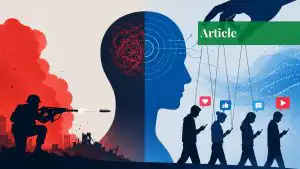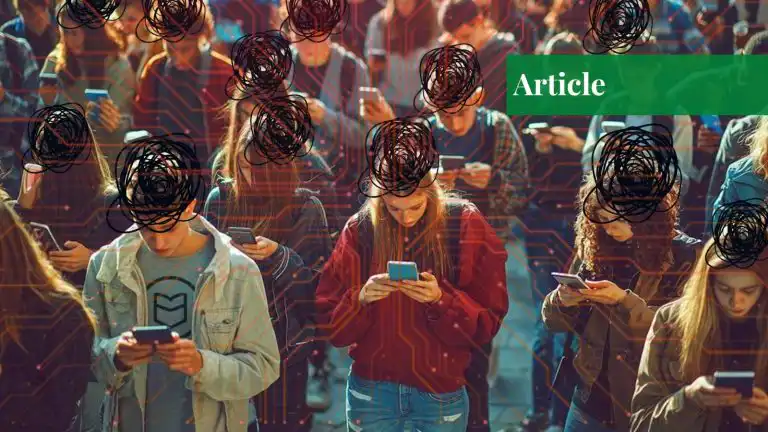
You told yourself it was just for a minute. A quick check of the news app, a brief pass through the feed, perhaps a scan of what everyone else was doing with their Tuesday morning. An hour later, your jaw is tight, your shoulders are in your ears, and you have absorbed a dense inventory of disasters, provocations, and curated evidence that other people’s lives are proceeding rather better than your own. You didn’t seek out this emotional state. You don’t particularly enjoy it. And yet — and this is the thing worth examining carefully — you will almost certainly do it again tomorrow. The fact that you will is not an accident, a character flaw, or a failure of willpower. It is, from the perspective of the companies whose platforms you were using, the system is working exactly as designed. Welcome to the attention economy: an industrial architecture built on the discovery that human anxiety, more reliably than almost any other emotional state, keeps people scrolling.
The term “attention economy” was coined by psychologist and Nobel laureate Herbert Simon in 1971 and developed into a full theoretical framework by Michael Goldhaber in the mid-1990s, but its contemporary significance was anticipated by neither of them. Simon observed that information abundance creates attention scarcity — that in a world producing more content than any person can process, the limiting resource is no longer data but human cognitive focus. What Simon could not have predicted was that the same observation would become, four decades later, the founding principle of the largest industry in human history. Global digital advertising revenue exceeded $700 billion in 2025, the overwhelming majority of it generated by platforms that offer their services free of monetary charge and finance themselves entirely through the sale of human attention. Every minute you spend on these platforms is the product being sold. Every advertisement you see is a sale being completed. The transaction is real; only the currency is unfamiliar.
There is no conspiracy here; the attention economy has learned that negative emotion is more effective than positive emotion at driving engagement. It’s an evolutionary misfire, and to understand why, we need to make a quick diversion into the architecture of the human brain. The limbic system is the part of the brain that processes threat, fear, and urgent survival information. It is much older and faster than the prefrontal cortex, where rational evaluation and deliberate decision-making are housed. The amygdala, the brain’s threat-detection centre, fires in response to alarming information before the rational mind can decide whether the alarm is warranted. UC San Diego psychiatry professor Susan Tapert, one of the lead investigators on the Adolescent Brain Cognitive Development study, describes this as a negativity bias with deep evolutionary roots: “Negative images and news tend to spark more brain activity than positive information. Historically, being alert to dangers like predators or conflict meant a better chance of survival.” The brain that learned to pay attention to threatening information outlived the brain that did not. That attention bias, which served our ancestors well on the savannah, now makes us disproportionately reactive to the specific kind of content that social media algorithms have learned to amplify.
Platform engineers didn’t design for anxiety consciously. They designed for engagement, and engagement data returned the same answer repeatedly: outrage, fear, disgust, and moral shock generate more clicks, longer sessions, more shares, and more return visits than contentment, beauty, or quiet joy. A study published in Nature Human Behaviour found that moral and emotional language in social media posts increases their spread by up to twenty percent per word. Research on X’s (formerly Twitter’s) recommendation algorithm confirmed that content evoking negative moral emotions travels significantly further and faster through networks than neutral or positive content. The algorithm did not decide that fear was more profitable than joy through any act of conscious malice. It learned it through billions of data points — and then it learned to serve more of it, because serving more of it increased the metrics that were being optimised. The result is an information environment in which the most emotionally corrosive content propagates most efficiently, not because anyone chose that outcome but because no one was optimising for any other.
The theoretical framework that best captures what is actually happening beneath the surface of this system belongs to Shoshana Zuboff, whose 2019 work, The Age of Surveillance Capitalism, named the economic logic with precision that has not been improved upon. Surveillance capitalism, as Zuboff defines it, is not simply the collection of user data to improve products. It is the unilateral extraction of human behavioural data – harvested without meaningful consent, not just the declared preferences of users but their unconscious patterns, emotional reactions, and micro-interactions – to predict and modify their behaviour in ways that serve commercial interests. The platforms aren’t selling you a service. They are creating a predictive model of you, based on the observed residue of your behaviour. They are selling the outputs of that model to advertisers who want to change what you do. You are both the raw material and the product. The service is the bait.
The reward model that Zuboff’s framework describes at the macro level finds its neurological expression in what researchers have now termed “dopamine-scrolling.” A 2025 paper in Perspectives in Public Health by Sharpe et al. described dopamine-scrolling as “a modern public health challenge requiring urgent attention,” documenting how the variable-reward schedules embedded in infinite scroll design — the same mechanism that makes slot machines psychologically compelling — exploit the brain’s dopamine-driven anticipation circuits. The scroll is not rewarded consistently, which is precisely the point: intermittent reinforcement, the psychological schedule under which rewards arrive unpredictably, produces more persistent and compulsive behaviour than consistent reinforcement. The pull-to-refresh gesture, widely understood by product designers to mimic the slot machine’s lever, was not included in smartphone design by accident. The bottomless feed, pioneered by Facebook and now universal, was not introduced as a convenience. Both are engineered reward delivery systems calibrated to the specific psychological vulnerability they exploit.
Which is the dopamine loop at the individual level? Social comparison—the systematic, algorithmically-dictated process of sizing up your own life against the curated performances of everyone else’s—manufactures anxiety at the social level. Social comparison theory was developed by Leon Festinger in 1954. It suggested that people have an intrinsic motivation to evaluate themselves by comparing their own opinions, abilities, and circumstances to those of others. What Festinger could not have anticipated is a technological context that compels users to make hundreds or thousands of such comparisons in a single sitting, all biased towards the most extraordinary, most aesthetically polished, and most emotionally curated representations of human life. Instagram does not show you an average life. It shows you the most impressive version of the best moment of the most attractive people who have access to the best filters. A 2025 PMC study on social comparison confirmed what clinical experience had long suggested: upward social comparison on social media is consistently associated with decreased self-esteem, increased depressive symptoms, and heightened anxiety, with effects particularly pronounced among adolescents and young adults whose identity formation is most actively in progress.
Jonathan Haidt, whose 2024 work The Anxious Generation synthesised a decade of clinical and empirical research into the mental health consequences of smartphone-based adolescence, argues that the rapid shift to phone-based childhood constituted a fundamental restructuring of the developmental environment for young people worldwide. Platforms built for maximum engagement have rewired attention, reward, identity formation, and peer validation – and the impact has been a steep, quantifiable rise in anxiety, depression, loneliness, and emotional fragility in adolescents and young adults in the countries where smartphone adoption was quickest and earliest. The World Happiness Report 2026 essay by Haidt and Rausch extended this analysis globally, finding consistent patterns of social media harm across diverse national contexts. The anxiety being reported by this generation is not imagined, not the product of excessive sensitivity, and not disconnected from the platforms they use. It is a measurable public health outcome of an economic model that requires their distress to function.
The Fear of Missing Out — FOMO — predates social media in its basic psychological form, but the digital environment has industrialised it into something qualitatively different from its analogue predecessor. The occasional awareness that others were having experiences you were excluded from, which is what FOMO described in pre-digital life, was bounded by the limits of what you could observe. You could not know about most of what you were missing. A 2025 analysis from UT Dallas described how social media has removed this boundary entirely: the feed delivers a continuous, curated stream of evidence for everything enjoyable, social, or significant that is happening without you, in real time, around the clock. FOMO is no longer an occasional emotional visitor. It is a permanent ambient condition, engineered and maintained by algorithmic systems that have discovered it keeps users returning to check whether the situation has improved — which, by design, it never quite does.
The Georgetown Law Denny Center’s 2025 analysis of the attention economy and the collapse of cognitive autonomy frames this dynamic in its most consequential terms: FOMO and social comparison are not side effects of a platform architecture aimed at other goals. They are, functionally, the goal — because the emotional gap between who you are and who the feed implies you could or should be is precisely the psychological space that advertising occupies. You scroll because you are anxious. You are shown a product that promises to address anxiety. The anxiety returns when you close the app, driving you back. The whole cycle requires your dissatisfaction as its fuel. A contented user is a user with nowhere to go, no problem to solve, no gap to close. Contentment, in the attention economy, is the one psychological state that cannot be monetised.
This ongoing emotional processing takes a cumulative toll on the human brain that clinicians call cognitive fatigue — a draining of the attentional and self-regulatory resources necessary for sustained thinking, complex decision-making, and emotional regulation. All three are taken care of by the prefrontal cortex, which runs on a metabolic budget. It is drained when constantly being called upon to deal with threatening information, cope with anxieties about social comparison, assess whether a notification warrants a response, and suppress the urge to check the phone again. A major study published by Frontiers in Psychology in 2024 documented social media fatigue as a distinct psychological syndrome characterised by emotional exhaustion, reduced capacity for empathy, impaired concentration, and increased vulnerability to misinformation — the latter being particularly significant, since a cognitively depleted mind is less capable of the critical evaluation that separates reliable information from manipulative content. The attention economy does not merely harvest your focus. It degrades the very apparatus that would allow you to resist being harvested.
The architecture described across the previous sections can be summarised in a single uncomfortable proposition: anxiety is the attention economy’s most profitable product. This is not a metaphor. It is a structural feature of an economic model whose revenue depends on engagement, whose engagement depends on emotional arousal, and whose emotional arousal data consistently returns negative states — fear, outrage, envy, inadequacy, urgency — as the most reliable drivers. Fast Company’s May 2026 analysis drew the comparison with the tobacco industry with uncomfortable precision: like nicotine products, social media platforms target the same neural reward pathways, create compulsive use loops through design rather than chemistry, and are marketed as social goods while generating measurable public health costs that are externalised onto the users and the healthcare systems that treat them. The industry’s internal documents, surfaced through litigation and whistleblower disclosures, contain the same pattern as the tobacco papers: awareness of harm, suppression of findings, and continued optimisation for the profitable behaviour.
The scale of this economy is worth stating plainly. The global digital advertising market that the attention economy supports is worth more than $700 billion annually. The mental health crisis it has demonstrably contributed to — particularly among adolescents, who are its most vulnerable and most targeted demographic — generates costs in healthcare, lost productivity, educational underperformance, and human suffering that no one has yet successfully quantified but that are plainly vast. Shoshana Zuboff’s formulation captures the asymmetry precisely: “The goal of everything we do is to change people’s actual behaviour at scale.” The behaviour being changed, and the people being changed, have no meaningful say in the process. They are users in the technical sense and subjects in every other.
The attention economy did not intend to manufacture an anxious civilisation. It is intended to maximise engagement. The two turned out to be the same thing, and that equivalence is the most important fact about the digital environment in which most of the world’s population now spends a significant portion of its waking hours. The solutions being proposed — algorithmic transparency laws, minimum age requirements for social media, design regulations prohibiting infinite scroll and variable reward schedules, digital literacy education, and user-controlled feed settings — are all real, all partial, and all currently losing the race against the engineering resources of a trillion-dollar industry that has every financial incentive to keep the model running.
What is required, beyond any single regulatory intervention, is a cultural recalibration in how we understand what is being done to us and what it costs. The attention economy depends, as all extractive systems do, on the assumption that the people being extracted from lack either the awareness or the power to resist. Awareness, at least, is now available. The science of what these platforms do to the brain, the body, and the social fabric is no longer speculative. It is documented, replicated, and increasingly impossible to attribute to anything other than deliberate design. The question that remains is whether that awareness can be translated, before the damage deepens further, into the kind of collective demand for something different that every previous public health reckoning has ultimately required. The feed will keep scrolling until someone decides it should stop.
If you want to submit your articles and/or research papers, please visit the Submissions page.
To stay updated with the latest jobs, CSS news, internships, scholarships, and current affairs articles, join our Community Forum!
The views and opinions expressed in this article/paper are the author’s own and do not necessarily reflect the editorial position of Paradigm Shift.

Abdul Basit | MS International Relations | Researching soft power, cultural diplomacy and global politics | Writing on geopolitics, foreign policy and defence affairs.