Abstract
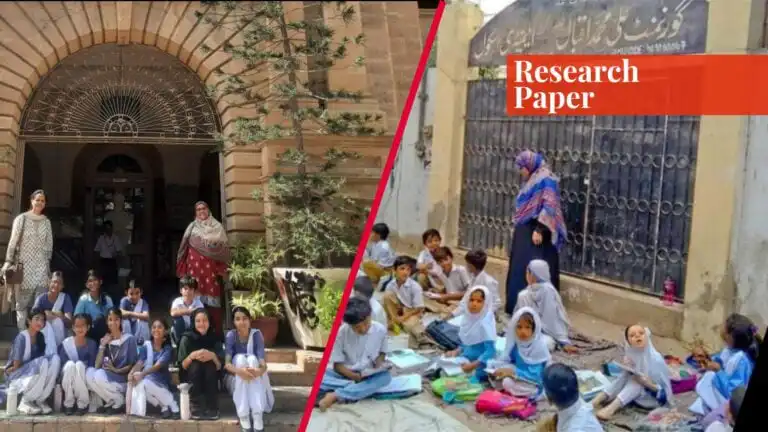
With an emphasis on the effects of curriculum, instructional strategies, and classroom environments, this study investigates how students in Karachi’s public and private secondary schools acquire critical thinking skills. The study highlights the significant disparities in promoting critical thinking between the teaching approaches of a government school (Government Girls Secondary School, University Campus Karachi) and an elite private school (Nixor O Levels College).
Private schools use a variety of innovative and thought-provoking instructional strategies to foster students’ analytical reasoning, problem-solving, and intellectual independence. Government schools, on the other hand, mostly focus on rote memorization, which limits pupils’ ability to think critically and engage with academic material more deeply.
In order to foster critical thinking and close the educational gap, this study highlights the need for educational reform in government institutions. According to the findings, public schools should move toward competency-based learning and creative teaching strategies in order to provide students the tools they need to succeed in a world that is becoming more complex and dynamic by the day.
Introduction
Education is a very complex concept that involves many different philosophies and approaches, from traditional to modern systems. Such educational paradigms often differ fundamentally in their methodologies, goals, and impacts. Traditional education often positions the teacher as an authority figure, emphasizing obedience and rote learning while discouraging inquiry and critical engagement (Hoodbhoy, 2018).
Furthermore, education is among the vital ingredients to gauge the level of development of a society (UNDP, 1990). Education not only contributes to improving the human condition of society but also provides a civilized society (as economic agents are engaged in production, supplying labor, consuming goods and services, and participating in political decision making) and hence generates spillover effects and expands the welfare of society without making anyone else worse. Education creates improvement in human capital, which is considered an essential determinant of growth (Saeed & Fatima, 2015).
However, in today’s world of fast-paced change, critical thinking is the essence of successful learning, preparing the child for a world of uncertainty, in terms of the complex dimensions of the 21st century. Robert (2015) adds that, in this regard, efforts by nations such as the USA through their Partnership for 21st Century Skills promote critical thinking in schools and school curricula. It promotes problem-solving abilities, adaptability, and decision-making, with informed thought to ensure the child is equipped as a future innovative worker and responsible citizen in a global economy.
Pakistan’s education system has failed to deliver rigorous economic, social, political, and moral foundations, leaving the future generation meaningless. It yields degree holders lacking critical skills like reflection, analysis, research, and creativity. The system highlights outdated knowledge, inappropriate to the rapidly changing world, and neglects practical application. Students, though theoretically sound, struggle to apply their learning due to traditional teaching methods. This is to underscore the immediate necessity of education reform towards competency-based, relevant learning (Ahmad et al., 2014).
This study will analyze the development of critical thinking among students from government and private schools in Karachi, where curriculum, teaching practices, and conditions in classrooms are to be compared. The research findings would help in bridging the divide of critical thinking and promoting equal opportunities in education.
Main Argument
This paper argues that the major difference in how students think at private school (Nixor O Levels College) and government school (Government Girls Secondary School, University Campus Karachi) significantly determines their ability to think critically. Students in private schools are made to use analytical reasoning and problem-solving skills, and intellectual independence through diverse and thought-provoking teaching practices.
In contrast, government schools rely exclusively on rote memorization, limiting students’ ability to think critically or become deeply involved with content. These findings signify a strong need for educational changes to promote critical thinking in government schools.
Conceptual Framework
Strong (1994:10) defined critical analysis as the emphasis on questioning assumptions, in-depth interpretation, and evaluative thinking. This allows learners to question implicit assumptions, analyze ideas for underlying meanings, and make judgments that are supported by comparisons with evidence.
In dialogue and discussion, students engage collaboratively to critique and refine ideas, making abstract concepts personal and tangible for deeper understanding. Socratic practice instills intellectual independence, as it enables the student to develop autonomy in thought, enhances problem-solving skills, and respects different points of view. The fruits are: higher-order thinking, a look at problems from multiple perspectives, and continuous self-reflection and improvement.

Literature Review
Glewwe (2002) theorizes a connection between education policies, school quality, and socioeconomic status in developing countries. He contends that the excellence of policies undertaken and the socioeconomic status of the enrolled students do influence the skills developed by the education system. Disparity in infrastructure, teacher qualifications, and school resources leads to uneven outcomes in education, further depriving lower-income students. This dissimilarity locks people into poverty and towards greater employability.
Glewwe claims that educational policies must understand both what the labor market demands and the changing socio-economic needs. His findings highlight the need for equal access to decent quality education, which is applicable to my study about elite private and government secondary schools in Karachi. Then, the variations in school quality may be followed to scrutinize how they have consequences for the personal development of the marginalized students, for their critical thinking.
Morrell (2010) discovers how critical literacy has influenced American educational improvements. He creates the case that critical literacy goes beyond conservative learning abilities and highlights the prerequisite of students cooperating critically with texts and their environment. According to Morrell, boosting critical literacy in secondary education is important to give students the tools they need to take an energetic role in both their education and society.
Morrell analyzes current educational practices for overlooking holistic policies that place urgency on social justice and critical thinking, pointing to the reauthorization of the Elementary and Secondary Education Act. Government schools may rely on rote learning, but elite private schools, which regularly accentuate all-inclusive education and inquiry, offer better opportunities for developing these skills. Accepting how educational practices affect students’ commitment to social issues, critical thinking skills, and overall contributions to society will be improved by incorporating Morrell’s insights into my research.
Ajayi (2011) analytically analyzes the collaboration between school choice and educational mobility. The study revolves around how families and students are directed through the application for admission to secondary schools in Ghana. Ajayi explores whether the accessibility of school choice encourages a vertically upward social mobility or marks prevailing educational disparities worse.
This study carries forth the fact that, in many cases, it is socioeconomic position that controls whether a student will have admission to high-quality secondary education in Ghana or not, and, consequently, whether better-off students will join elite schools. More applicants apply to schools with more status and better conveniences, thus leading to a highly selective admissions process that drawback marginalized students.
This review of Ghana’s school choice system demonstrates to be informational concerning my study on the educational stratification of elite private and public schools in Karachi. Likewise, in Pakistan, elite private schools offer more resources and opportunities as related to government schools, in which socioeconomic status-based dissimilarities define the educational background.
Giannola (2012) summarizes that a more diverse educated populace is being interconnected into academic and vocational surroundings. She stresses how practical teaching in vocational classrooms encounters a variety of requirements, but it normally lacks the theoretical objectivity of traditional academic classrooms. The academic classrooms, on the other hand, are built on hypothetical knowledge and cannot easily accommodate much more with divergent styles of learning.
Giannola upholds a composed position where her emphasis is on the “readiness” of teachers and learning support for the student, but integrates theory into practice. These ideas are appropriate to my research, which is an educational inequality in Karachi between elite private and government secondary schools, where comprehensiveness is hindered by resource restrictions in government schools. Giannola’s concepts give powerful strategies for achieving more balanced and holistic learning environments across school systems.
Hoodbhoy (2018) critically analyzes Pakistan’s continued failure to enhance educational outcomes, even after decades of task forces and policy initiatives. The author believes that this has been due to cultural and ideological barriers that work against modernization. Traditional education in Pakistan is based on religious teachings, which emphasize memorization and obedience to learn for the afterlife.
On the other hand, modern education focuses on critical thinking, adaptability, and evidence-based learning, which grows with the needs of society. The basic incompatibility of these paradigms makes reform a difficult thing. Cultural conservatism also worsens the situation, as most Pakistanis value religiously oriented schools more than those that promote secular learning. This is even extended to Pakistani immigrant communities in Britain, where faith-based schooling lags behind others in terms of academic achievement.
Hoodbhoy (2018) blames Pakistan’s examination system for encouraging rote learning and inhibiting understanding and innovation. Hybrid educational systems have emerged as a compromise combining the traditional and modern elements. These often result in contradictions, such as when textbooks dismiss scientific theories, including evolution. The more that the state uses education to provide ideological indoctrination, the more it fortifies conservatism and resists secular ideas. Hoodbhoy argues that meaningful reform requires the separation of religious and secular education while encouraging critical thinking and scientific methods.
McMahon (2019) discusses the association of technology-rich learning environments with higher-order thinking skills, specifically critical thinking, among students. It shows strong correlations between computing skills and critical thinking, as measured by the ASCSC and EWCTET instruments. Advanced computing tasks, such as programming and Boolean logic, are associated with significantly improved critical thinking.
Moreover, the research reveals the benefits of extended exposure to such environments and further provides positive results by enhancing a greater understanding of subjects in cognitive development. Periodical updates of software and proper care for hardware support skill development sustain it, thereby preventing stagnation due to the age factor.
The role played by teachers in improving the critical thinking skills of their students at the secondary education level is the focus of study in van der Zanden et al. (2020). It is perceived that there is a need to stimulate critical thinking in school-going students since they will face more challenges in college life.
The authors list many strategies that instructors believe will support them in enhancing their students’ critical thinking skills. These strategies range from encouragement for open-ended dialogue to throwing real-world dilemmas into the circles of the students and including more project-based learning into the programs. An understanding of these parameters will help ascertain the inconsistencies in the critical thinking concepts and offer an understanding of how educational policy may be adjusted to better develop these significant skills in all types of schools.
Alhowail and Albaqami (2021) reflect the state of critical thinking among students in secondary schools concerning the Saudi educational system. In such a prompt world, it offers enormous importance to the need to encourage critical thinking. This study’s identification of gaps in the existing curriculum and teaching policies is one of its core influences. A true promise to change, in this case, is also suggested by the study to ensure that students are provided with critical thinking abilities that can help them succeed better in a society that is becoming increasingly complex. The changes required are renovation of curricula, innovative teaching techniques, and better teacher training. I aim to compare the methods taken by elite private schools in Karachi and the government schools in developing critical thinking, using these insights for my research.
Quadri (2021) emphasizes discovering the context of the classroom environment for youths in early teenage years and how that knowledge affects personality development. The leading role of classroom climate in the students’ communal behaviors, personalities, and emotional well-being due to communications with peers, teachers, and the learning environment is emphasized.
Students adore such an environment-feeling easier to share opinions, take risks in class, and co-function with peers-all which are critical to character building. It gives a vision on how schools outline a student’s emotional and social development, as well as intellectual improvement issues, which topic is often disregarded in deliberations when talking about policy debates over school results.
The study progresses a more multifaceted connection between family socioeconomic status and the prospect of attending college (Tompsett & Knoester, 2023). They claim that though individual-level factors such as determination and academic accomplishment are critical, the institutional and school-level factors play a parallel role in determining how students will endure their post-secondary education.
In comparison, students in public schools, from underprivileged backgrounds, are disadvantaged in entering higher education, through large classes, obsolete textbooks, and the absence of leadership counseling, among others. My study will draw on these visions and apply the context of Karachi to explore how similar institutional and socioeconomic shortcomings shape the social and educational paths of students in public versus elite private secondary schools.
Research Methodology
For my research on the study of secondary education in government and private schools in Karachi and how it affects critical thinking, I have opted for a qualitative research method. This method allows for a detailed look at classroom teaching practices, the role of the curriculum, and student experiences in helping or blocking critical thinking skills in both types of schools.
Data Collection Methods
The major means to gather data for this study are classroom observations, semi-structured interviews, and an analysis of the curriculum and teaching materials. For one, classroom observations provide essential information on actual methods used in teaching and students’ involvement. From such an observation, I may identify whether Nixor O Levels College adopts a focus on critical thinking using activities such as debating, text analysis, or realistic examples, or if Government Girls Secondary School relies on memorization of facts.
I also conducted semi-structured interviews with teachers and students. These interviews provide personal insights into teaching methods and student experiences. Teachers in government schools complained about the scarcity of resources and how their teaching was based on memorization rather than analysis. Students complained about not being given the opportunity to participate in discussions about topics of interest to them in the real world.
In distinction, students in private schools reported being stimulated to think critically, participate in discussions, and relate classroom content to global issues. Content analysis of the curriculum and instructional materials was also critical to assess the alignment of teaching practices with critical thinking objectives.
The rationale for using a qualitative methodology lies in its ability to capture the lived experiences of teachers and students, offering a nuanced understanding of classroom dynamics that quantitative methods may overlook. However, this approach has limitations, such as the subjectivity of classroom observations and the limited scope of the sample, which may not fully represent all schools in Karachi. Despite these limitations, qualitative research provides invaluable insights into the factors influencing critical thinking in Karachi’s secondary education system.
Fieldwork Experiences
To access the participants and field, I contacted the private and government schools’ administrators in Karachi. I informed them of my research purposes and asked to seek permission for observation and interviewd with teachers and students. Then, following formal approval, I set up visits to their classrooms and interviews with them.
One of the most important problems I encountered during the field study was getting permissions and making things work out with the teachers, especially with teachers of government schools who were initially quite averse to outside observations. More problems arose because of high class strength and insufficient infrastructure; it was pretty challenging to make meaningful observations or encouraging interactions in the heavily populated environment.
The difference in feelings between private and government schools was clear. In private schools, I felt welcomed and saw a setting that encouraged critical thinking. In government schools, I felt frustrated because of the focus on memorization and not having enough resources, which made it difficult to promote deep thinking. There were times when I felt uncomfortable, especially in government schools, watching students try to understand ideas beyond just memorizing.
Even with these challenges, I felt safe in both places, but the crowded conditions in government schools did make the atmosphere feel a little tense sometimes. In general, the experience was surprising and increased my understanding of the education gap in Karachi.
Theoretical Framework
Socratic Practice (1994) and Its Role in Critical Thinking Development
This study utilizes Socratic practice, according to which thought is explored through dialogue, questioning, and collaborative inquiry. This process, in particular, engages the students in “in-text” discussions, analyzing the material directly, and “out-of-text” conversations relating ideas to personal experiences or real-world contexts.
Nixor O Levels College, the elitist one, utilizes interactive tools such as debates and group discussions, in keeping with the Socratic approach to the development of creative and critical thinking abilities. In contrast, Government Girls Secondary School mainly depends on rote-based, lecture-centric teaching. This limits opportunities for critical engagement by the students. The study relies on the Socratic practice framework and assesses how the differences in pedagogical teaching styles impact the development of critical thinking. Results will fill educational gaps by suggesting the ways Socratic methodologies can be applied to government schools to encourage fair, higher-order learning outcomes.
Margaret Mead’s (1980) and Its Role in Critical Thinking Development
Using the ethnographic research method by Mead (1980), this study explores the cultural and structural forces on critical thinking development in the government and private schools in Karachi. According to this method, studying cultural practices as practiced within their context leads to a reliance on rote learning in government schools being viewed as an adaptation due to systemic shortcomings, which include overcrowded classrooms, improper training for teachers, and rigid curricula.
This reflects Mead’s observations on how cultural practices constrain intellectual exploration. On the contrary, private schools align with Mead’s emphasis on interactive learning by providing debates, group discussions, and project-based activities that nurture critical thinking. Through the lens of Mead (1980), this study examines how these cultural and systemic factors shape educational practices, which in turn call for reforms to foster inquiry-based learning in government schools and bridge the gap in critical thinking for equitable education.
Bloom’s Taxonomy (2014) and Its Role in Critical Thinking Development
The theoretical framework of this study is also founded on Bloom’s Revised Taxonomy (2014), where cognitive skills are classified at six hierarchical levels: remembering, understanding, applying, analyzing, evaluating, and creating. According to Chandio et al. (2016: 205), combining these levels in teaching and assessment will promote critical thinking and lead to more profound learning.
This paper makes use of their framework to investigate the cognitive engagement of government and private schools in Karachi through their respective textbooks in the usage of English textbooks for both contexts. For example, during the fieldwork carried out at a government school, it was found that all questions related to reading comprehension within the STBB Grade 10 textbook were of the remembering type.
For example, “What was Caliph Haroon-ur-Rashid known and respected for?” only required students to memorize facts without calling for analysis or application of them. This is still reflective of the government schools’ approach, which was more tilted towards lower-order thinking, compared to the higher-order approach in private schools.
Findings and Analysis
This section reports the critical thinking practices perceived in Nixor O Levels College and Government Girls Secondary School in Karachi. The analysis is divided into three thematic subsections and incorporates Socratic Practice (1994), Margaret Mead’s Anthropological Insights (1980), and a revision of Bloom’s Taxonomy (2014) to evaluate teaching methodologies, engagement of students, and curricular design.
Bloom’s Taxonomy (2014) as a Framework for Cognitive Development
This study uses Bloom’s Taxonomy (2014) to measure government and private school students’ involvement in cognitive engagement during field study with the help of two English textbooks: Oxford Progressive English Book 10 and the English textbook for Grade 10 authored by the Sindh Textbook Board (STBB).

Analysis in the Nixor O Levels College indicated a more diverse distribution across different cognitive levels of Bloom. Questions in the Oxford Progressive English textbook were divided into 20% analyzing, 20% evaluating, and 10% creating, with understanding taking up the highest percentage at 30%. This is a reflection of a high level of emphasis on higher-order thinking, encouraging critical engagement and deeper understanding.
On the other hand, the STBB textbook for government schools puts an overwhelming emphasis on remembering (100%), which makes cognitive engagement limited to basic recalling without the development of skills such as application, analysis, and evaluation. Teaching practices by the private school were very much in line with this cognitive level, encouraging higher-order thinking through tasks demanding analysis, evaluation, and the creation of something based upon the understanding of the text.
For example, questions like “Which word best describes the tone of this text? Why?” prompt students to critically evaluate and justify their responses. Moreover, does the author of this passage give a fair and balanced view or an unfair, biased presentation of the educational system of South Korea? Support with evidence from the text.” This makes the students evaluate and explain, using evidence from the text, hence making a critical assessment.
In contrast, the government school’s questions relied heavily on recall, locking students into rote memory. For example, “What are the qualities of a teacher?” That question demands the student to list some points straight from the text, which shows no cognitive engagement at all other than memorizing. These findings suggest that private schools encourage intellectual engagement, while government schools’ reliance on lower-order skills hampers the development of critical thinking.
The Socratic Practice by Strong (1994) as a Pedagogy for Critical Thought

The learning environment at Nixor O Levels College was designed to be intellectually stimulating, with clean, organized surroundings that encouraged active student involvement. Teachers encouraged teamwork and intellectual curiosity through group discussions, debates, and open-ended questions, which are all part of the Socratic method. For example, after a reading comprehension exercise, students were asked to analyze the tone of a text, which required critical thinking and engagement with the material. It nurtured creativity, problem-solving skills, and real-world relevance, so students could probe deeper and gain more independence.
The Government Girls Secondary School, on the other hand, had a very limited learning environment with a focus on memorization and repetition. The class sizes were huge, and the teacher-centered approach meant that there was little opportunity for student inquiry and independent thought. The Socratic method was almost absent, as the teachers dictated lessons with little room for critical engagement. For instance, when asked about climate change, students could only recall textbook definitions without a deeper understanding or application.
This comparison shows how Socratic principles are crucial for critical thinking. In the private sector, like Nixor, inquiry-based learning and interactive activities enabled the students to dig deep into the topic and think critically. Contrasting this, the lack of such a practice in government schools caused the children to not be able to think critically and go into the realms of things other than memorizing. Thus, there should be reforms in education to promote such practices across all educational institutions.

Kincheloe’s Margaret Mead Work (1980) as a Framework for Critical Thinking
Margaret Mead’s work, especially in Samoa, has shown how culture informs learning. In Government Girls Secondary School, rote learning is a reflection of cultural adaptation to an educational system that emphasizes memorization over critical thinking. The systemic issue in Ms. Kanwal’s case of having to teach multiple subjects without any proper training speaks to the preparedness of educators and how the curriculum restricts them from engaging in meaningful learning.
This reflects Mead’s findings that cultures can hamper educational thought as teachers are often bound by methods that focus on rote memorization rather than fostering deeper cognitive engagement. On the other hand, Karachi-based private schools, which place emphasis on critical thinking as well as practical implementation of knowledge, provide more dynamism in the academic system.
This may have deep roots in the cultures emphasizing inquiry, exploration, and intellectual independence in the two types of schools rather than the rote method so commonly found in governmental institutions. Mead’s comparative method of studying other cultures is very effective for understanding how these differing modes of education reflect diverging societal values and expectations. This will enable education to bring out critical thinking and analytical skills in the students. This approach also aligns with the cultural realities of the students, but at the same time, it challenges them to think critically about broader societal concerns.
Recommendations
Professional Development for Teachers
Professional development and training for teachers on how to implement Bloom’s Taxonomy and Socratic practices should be routine. This will ensure that they are well-equipped in terms of skills and knowledge to encourage higher-order thinking among their students.
Student-centered Assessment
All assessments must be student-learning journey-based. In such a model, personal feedback and formative assessments should be used to help guide students on how to improve their skills throughout the school year and not just when it’s time for exams.
Technology Integration in Assessments
Technology can be used to expand assessment methods. Online quizzes, interactive problem-solving tasks, and digital presentations can involve students and make assessments more dynamic, offering immediate feedback and opportunities for self-assessment.
Support Collaborative Learning
Including tasks that require collaboration in summative assessments helps students master teamwork, communication, and negotiation skills in real settings. Group projects, peer evaluations, and collaborative exercises to solve problems could all be included in summative assessment models.
Inclusive Assessment Practices
One needs to ensure that there are inclusive assessment practices such that different learning styles and abilities are catered to. Inclusive assessment methods include providing different formats, such as oral, written, or practical, to accommodate different kinds of learners, thus offering an equal opportunity for the expression of knowledge and skills to each learner.
Conclusion
This comparative study aimed at finding out the effects of secondary education in Government Girls Secondary School and Nixor O Levels College of Karachi on students’ abilities for critical thinking. The study showed the existence of great differences between the approaches used by both types of institutions. In private schools, interactive and student-centered instruction is well evident: group projects, debates, and presentations have been highly promoted, encouraging students to think critically and come up with problem-solving solutions.
This makes a more involving and participatory learning environment in which the student can develop creative and critical thinking skills. In contrast, schools governed by the government are very much lecturer-centered in methods, hence limiting opportunities to be used in student interaction or participation.
The findings of this study, therefore, resonate with the other studies that have emphasized the shift from rote learning to more critical, inquiry-based teaching practices. While private schools used Bloom’s higher-order thinking skills and Socratic questioning as part of their pedagogy, government schools were more focused on memorization and repetitive learning.
These indicate inadequacies in the general form of education and the use of strategies that foster a cognitive ability higher than mere first-tier or lower-order thinking in their students. However, through this study, an emphasis comes forward on systemic modification changes necessary within government schools, teacher training, and assessment mechanisms.
However, future research might look into how Bloom’s Taxonomy and Socratic practices can be implemented in government schools, which would further measure student performance and engagement over time. Further studies may also be directed towards the use of technology to enhance teaching and assessment and the incorporation of multiple learning strategies to cater to diverse needs.
References
- Ahmad, I., K. U. Rehman, A. Ali, I. Khan, and F. A. Khan. 2014. “Critical Analysis of the Problems of Education in Pakistan: Possible Solutions.” International Journal of Evaluation and Research in Education (IJERE) 3 (2): 79–84. .
- Ajayi, K. F. 2013. “School Choice and Educational Mobility: Lessons from Secondary School Applications in Ghana.” Journal of Human Resources 48 (4): 1207–1243. African Schooling Research Institute. https://doi.org/10.3368/jhr.0417-8714R2.
- Alhowail, A. M., and S. E. Albaqami. 2024. “Evaluation of the Critical Thinking Skills of Secondary School Students in Saudi Arabia.” Journal of Education and Practice 82 (1): 1–28. Ministry of Education, Saudi Arabia; Durham University; Albaha University. https://doi.org/10.33225/pec/24.82.07.
- ASER Pakistan. 2023. Annual Status of Education Report: The Largest Citizen-Led Household-Based Initiative 2023. www.aserpakistan.org/report.
- Casale-Giannola, D. 2012. “Comparing Inclusion in the Secondary Vocational and Academic Classrooms: Strengths, Needs, and Recommendations.” American Secondary Education 40 (2): 26–42. https://www.jstor.org/stable/43694128.
- Chandio, M. T., Saima M. Pandhiani, and R. Iqbal. 2016. “Bloom’s Taxonomy: Improving Assessment and Teaching-Learning Process.” Journal of Education and Educational Development 3 (2): 203–221.
- Cohen, S. (1983). The mental hygiene movement, the development of personality, and the school: The medicalization of American education. History of Education Quarterly, 23(2), 123-149. https://doi.org/10.2307/368156
- Glewwe, P. (2002). Schools and skills in developing countries: Education policies and socioeconomic outcomes. Journal of Economic Literature, 40(2), 436-482.
- Hoodbhoy, Pervez. 2018. “Why Attempts to Reform Pakistani Education Fail.” Dawn, October 27, 2018. https://www.dawn.com/news/1441704.
- Hussain, Ishrat. 2020. “Human Capital and Pakistan’s Future.” Corridors of Knowledge for Peace and Development. Sustainable Development Policy Institute. https://www.jstor.com/stable/resrep24374.8.
- Kincheloe, Teresa Scott. 1980. “Margaret Mead’s Early Fieldwork: Methods and Implications for Education.” Journal of Thought 15 (3): 21–30. Caddo Gap Press. https://www.jstor.org/stable/42588860.
- McMahon, Graham. 2009. “Critical Thinking and ICT Integration in a Western Australian Secondary School.” Journal of Educational Technology & Society 12 (4): 269–281. International Forum of Educational Technology & Society. https://www.jstor.org/stable/jeductechsoci.12.4.269.
- Majidkutz, Abbas Ali. 2013. “Decentralisation: Out of Focus.” Dawn, September 1, 2013. https://www.dawn.com/news/1039743.
- Morrell, E. 2010. “Critical Literacy, Educational Investment, and the Blueprint for Reform: An Analysis of the Reauthorization of the Elementary and Secondary Education Act.” Journal of Adolescent & Adult Literacy 54 (2): 146–149. https://doi.org/10.1598/JAAL.54.2.6.
- Peercy, C., and N. Svenson. 2016. “The Role of Higher Education in Equitable Human Development.” International Review of Education 62 (2): 139–160. .
- Quadri, S. 2021. “Impact of Classroom Climate on Personality Development of Secondary School Students.” International Journal of Scientific Research and Engineering Development 4 (4): 925–934. July-August 2021.
- Quist, H. O. 2016. “A ‘Tool’ for National Development in Ghana: A Critical Appraisal of the Post-Colonial Context.” Africa Development 26 (1): 45–67. CODESRIA. https://www.jstor.org/stable/24482700.
- Roberts, Margaret. 2015. “Critical Thinking and Global Learning.” Teaching Geography 40 (2): 55–59. Geographical Association. https://www.jstor.org/stable/26383090.
- Saeed, N., and A. Fatima. “Educational Inequality in Rural and Urban Sindh.” The Pakistan Development Review 54, no. 4 (2015): 767–777. https://www.jstor.org/stable/43831362.
- Strong, Mike. 1994. “Socratic Practice as a Means of Cultivating Critical Thinking Skills and Classroom Community.” American Secondary Education 23 (1): 10–16. Dwight Schar College of Education, Ashland University. https://www.jstor.org/stable/41064088.
- Syafrina, Emelda, and Arono Arono. 2017. “Features of English Textbooks for the First-Year of Senior High School Implementing the 2013 Curriculum.” Master’s thesis, Universitas Bengkulu, 1 (1): 1–49.
- Tompsett, J., and C. Knoester. 2022. “Family Socioeconomic Status and College Attendance: A Consideration of Individual-Level and School-Level Pathways.” PLOS ONE 17 (5): e0267856. https://doi.org/10.1371/journal.pone.0267856.
- Van der Zanden, P. J. A. C., E. Denessen, A. H. N. Cillessen, and P. C. Meijer. 2020. “Fostering Critical Thinking Skills in Secondary Education to Prepare Students for University: Teacher Perceptions and Practices.” Research Papers in Education 35 (6): 734–752. https://doi.org/10.1080/02671522.2019.1677758.
If you want to submit your articles and/or research papers, please visit the Submissions page.
To stay updated with the latest jobs, CSS news, internships, scholarships, and current affairs articles, join our Community Forum!
The views and opinions expressed in this article/paper are the author’s own and do not necessarily reflect the editorial position of Paradigm Shift.