

Momina Areej is currently pursuing an MPhil in Clinical Pharmacy Practice. With a passion for writing, she covers diverse topics including world issues, literature reviews, and poetry, bringing insightful perspectives to each subject. Her writing blends critical analysis with creative expression, reflecting her broad interests and academic background.
In Pakistan’s swiftly growing skincare industry, fairness has become both a goal and a commodity. There are whitening serums on supermarket shelves, aesthetic clinics pop up in urban centers, and Instagram influencers promise transformations that are only a curated carousel away, consisting of some ampoules and creams without labels. The whole industry is glossy, dominant, and aggressively marketed. But beneath it lies an even more frightening reality: a regulatory environment so sparse that companies, local manufacturers, and self-proclaimed beauty specialists can operate within this entirely unregulated framework.
This article argues that the skincare industry in Pakistan is not simply a deregulated commercial space; it is a public health hazard, one that creates a gendered political economy, and a revealing representation of how poor governance opens possibilities for an industry built on insecurity and obscurity.
The Whitening Industrial Complex
Skin-lightening has always been an oddly prosperous and lucrative industry in Pakistan. The aesthetic ideal of fairness, braiding together colonial hangovers, class anxiety, caste hierarchies, and marriage markets, acts as a sort of soft social currency. Fairness entails social legibility: better marriage prospects, better job prospects. “Whitening” becomes less of an aesthetic choice, but more of a social guarantee.
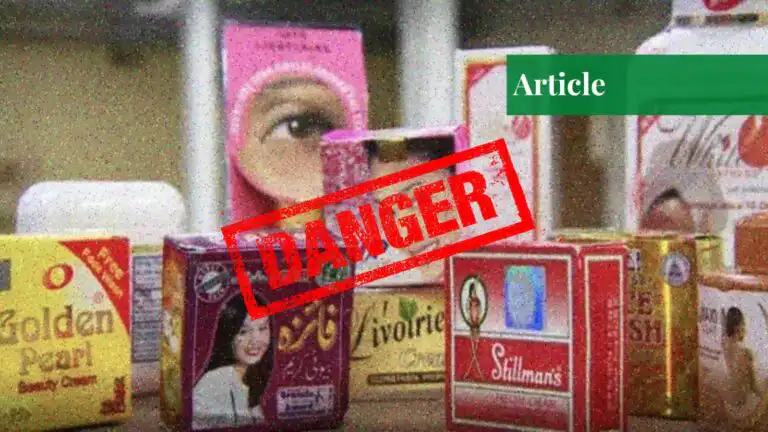
The most profitable subsection of this industry is still topical lightening creams. However, in contrast to the tightly regulated cosmetics industries in Europe or North America, body creams in Pakistan exist in an almost regulatory vacuum. Many of the ingredients in topical lightening creams are not simply outdated; they are ingredients banned altogether from use in developed markets.
- Hydroquinone, a powerful depigmenting agent, has been completely banned from cosmetic use across the EU for risks of carcinogenic potential since 2001.
- Topical corticosteroids like betamethasone, which are potent prescription-only drugs for eczema or autoimmune skin conditions, are infinitely mixed into “whitening cream” formulas, which are then sold for daily application directly from corner stores.
- Mercury, an extremely toxic heavy metal, persists in dozens of products despite WHO warnings and Pakistan’s obligations under the Minamata Convention. A scientific study tested 12 popular skin‑whitening creams from the market in Faisalabad. They found dangerously high concentrations of heavy metals (arsenic, cadmium, lead, mercury, chromium, nickel).
The reason often given for the use of these products is not merely a lack of knowledge by the consumer. The danger is, disturbingly, part of the charm. The creams produce an instantly visible change. The steroid-induced vasoconstriction reduces redness, the hydroquinone bleaches the melanocytes, and the mercury completely blocks melanin synthesis. In the end, the result is a sudden brightness, an artificial “glow” that consumers misinterpret as health. The glow from these creams is chemically induced and unsustainable biologically.
Once the skin has habituated to these chemical agents, the halting of use leads to a cascade of symptoms: rebound hyperpigmentation, severe acne, steroid-induced dermatitis, thinning of the skin, infections, and, in extreme cases, adrenal suppression.
This is why the whitening industry cannot simply be discussed as a cosmetic trend. It is an economic system of cycles, aspiration, damage, and re-purchase. A damaged skin barrier is not an externality of the industry; it is a model. “Quick results” are the bait, and the subsequent ruination is the guarantee of repeat customers.
The State’s Absence as a Business Model
The underlying question seems very simple: how does an industry that impacts the faces of millions go almost entirely uncontrolled?
It is worth noting that in this unregulated market, the evidence is neither anecdotal nor abstract. Laboratory studies in Lahore have documented that many locally manufactured whitening creams contain alarmingly high mercury levels, up to 240 ppm in some samples, vastly exceeding permissible safety thresholds. Other analyses, including those by civil society and regulatory agencies, suggest that a significant portion of such products violate basic packaging and ingredient‑disclosure norms.
Clinical research indicates a disturbing pattern of misuse of steroid-based fairness creams. In Karachi, an observational study at a hospital confirmed that 83.6 % of patients exposed to such agents developed steroid-induced acne, and many had been using the products every day for a few months before the acne developed, unaware of the risk. Regulatory documents from PSQCA further indicate that some skin creams sold in the market also contain corticosteroids.
These findings demonstrate one pattern: the regulatory deficiencies are not incidental; they are the economic infrastructure of the industry. Manufacturers use what is a definitional murkiness between “cosmetics” and “therapeutics,” and are incentivized to define their products with terms like cosmetic cream or skin polish, signifying to a buyer the product is legitimate, but avoiding any regulatory scrutiny placed on pharmaceuticals.
When Aesthetic Clinics Become Laboratories
The rapid emergence of aesthetic clinics in Pakistan’s urban centers has created an entirely novel space where medicine, aesthetic culture, and commerce intersect in a largely unregulated market. What are supposed to be clinical spaces governed by accepted medical ethical guidelines increasingly resemble experimental laboratories, except the experimental subjects are paying clients and not consenting research participants.
A commentary published in RCD alerts about the significant dermatological dangers of cosmetic procedures in Pakistan; it goes to the heart of the unregulated aesthetic boom. The commentary notes that even non-invasive procedures like Botox, microneedling, and chemical peels can pose significant risks if done by poorly trained providers or completed without stringent supervision (i.e., the safety of even a Botox injection might be in question). Allergic reactions, infection, scarring, and tissue necrosis aren’t simply framed as rare inconveniences; they are almost guaranteed, after one considers that the landscape looks more like a beauty parlor than a clinic.
Within a number of these clinics, lasers are not used as medical devices but as consumer gadgets. Laser machines are purchased secondhand from China, which have never even been calibrated or serviced, and are routinely used on people’s faces. We have chemical peels that are intended for clinical settings and are now applied in the back of a room with fluorescent lights and grocery store gloves on. Microneedling pens, which are designed to be sterile single-use devices, are sometimes used on multiple clients. We even have glutathione drips, which have no scientifically documented aesthetic benefits and are marketed with the vigor of a new miracle elixir that indicates gravity-defying effects, but which have been documented to carry risks from renal dysfunction to potential disruption of natural melanin pathways.
However, the problem is not only the procedures but the environment of ideas within which these procedures exist. Social media has produced a new authority in dermatology: the “skinfluencer.” On Instagram, young women without any medical training are applying chemical exfoliants, steroid creams, hydroquinone blends, microneedling rollers, and so on, as if it were the same as attempting to demonstrate a new lipstick. The skinfluencer’s authority is aesthetic, not clinical. They offer no expertise; instead, they offer proximity and the suggestion that if one engages in their routines, they might achieve their filtered skin. For many consumers, this is much more powerful than documented clinical information.
How Insecurity Becomes an Economic Resource
The Pakistani beauty industry is embedded in a sociological framework where fairness functions as currency and beauty as both a moral quality and economic resource. In a society where marriage depends on skin tone, upward mobility is constricted by gendered labor, and professional respectability is often visually policed, skin becomes a site of social negotiation. The need for skin whitening and brightening products is not merely a position of vanity; it is a matter of survival, developed through patriarchy, class access, and lingering colonial aesthetics of preference.
In the midst of this social situation, the industry profits by transforming gendered pressure into a commercial opportunity. They use fear of acne scarring, fear of tanning, fear of anti-aging, and stigma against “dusky” skin, which are not individual insecurities but socially constructed thresholds of acceptability. Each insecurity is created and exaggerated, only to be repackaged as a socially acceptable problem to solve. Capitalism does not just respond to its consumers’ emotional insecurities and vulnerabilities; it creates them, disciplines them, and then sells them back a temporary solution.
This mechanism indicates a deeper truth: beauty is recast as an individual responsibility rather than a societal demand. The burden of conformity is no longer an entire cultural structure imposed on the subject, but the individual with jars and serum purchases of discipline to affirm their social legitimacy. The industry thrives on the neoliberal privatization of aesthetic anxiety, promising empowerment while simultaneously promoting reliance on solutions that are chemically interesting yet socially weak. In this context, skincare becomes less about health in the way that makeup frames beauty and more about operating the body as an economic project that must be improved, corrected, and surveilled constantly.
Toward a Rights-based Regime of Beauty
To meaningfully reform the industry, Pakistan must treat skincare as a public health domain, not a lifestyle category. Concrete solutions include:
- Mandatory Pre-market Safety Testing and Ingredient Transparency
All products, both local and imported, that are advertised for skin lightening or skin care purposes must be registered with DRAP or any empowered cosmetic authority for sale. Registration should be contingent upon independent laboratory verification of chemical composition (e.g., heavy metals, steroids, and bleaching agents). Labels must include all ingredients and concentrations, batch number, expiration dates, and manufacturer contact information. Enforcement must use random audits of markets and e-commerce testing to ensure compliance with the law. Ingredient disclosure must be mandated rather than optional.
- Regulation of Digital Sales and Influencer Marketing
E-commerce platforms and social media channels engaged in commerce of cosmetic products must verify sellers, require product registration numbers, and ensure toxicology compliance prior to allowing sales. Social media influencers promoting skincare or skin whitening products must also disclose if they are certified and provide a warning if it contains ingredients that have documented issues.
E-commerce platforms involved in the sale of unregistered or unsafe products must be sanctioned with financial penalties, suspension or removal of products, or potential liability for causing harm. There is also the opportunity to do online consumer education campaigns about the toxicity of steroid creams, mercury-based formulations, and unregulated forms of glutathione.
- Gender-sensitive Public Health and Social Campaigns
Government interventions must also tackle the cultural causes of demand. For example, schools in Pakistan could add anti-colorism chapters to their curricula and initiate funding media campaigns that challenge the ideals of fairness in employment and marriage. Regulations can be tied to consumer protection statutes so that those harmed by unsafe cosmetic products can seek legal accountability, while also defining skin-lightening as a public health concern rather than entirely a personal choice.
Conclusion
The Pakistani skincare industry crisis is not just a crisis of the safety of products, but a crisis of governance, public health, and cultural ideology. It reveals a more significant truth about how beauty is constructed, promoted, and commodified in states that lack regulation and where inequality is preferred.
While glimmering radiance may cause chemical harm, it is not simply a fashion choice. It is a structural failure framed as a personal choice, an attractive economy built on regulatory complicit silence, a political intertwining that reminds us in Pakistan, beauty is not innocent nor personal, it always has political undertones.
If you want to submit your articles and/or research papers, please visit the Submissions page.
To stay updated with the latest jobs, CSS news, internships, scholarships, and current affairs articles, join our Community Forum!
The views and opinions expressed in this article/paper are the author’s own and do not necessarily reflect the editorial position of Paradigm Shift.