
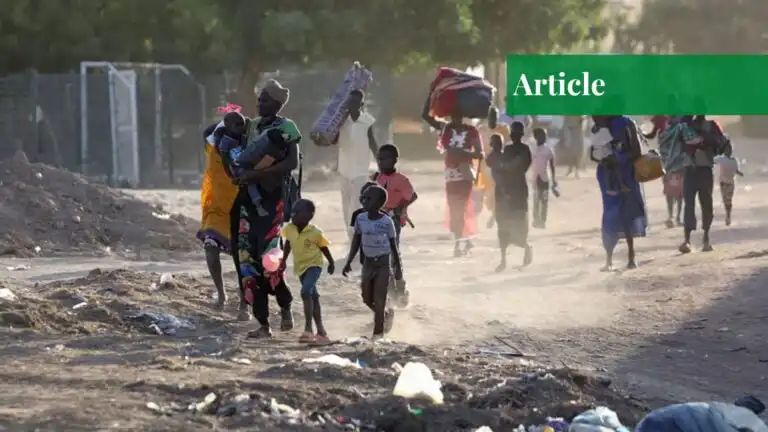
A decades-long political crisis and ethnic divide in Sudan has led to the nation’s most devastating humanitarian disaster, where large-scale killings supply a backdrop to widespread starvation. Since April 2023, the Sudanese Armed Forces (SAF) have joined forces with the paramilitary Rapid Support Forces (RSF) for bitter combat, which resulted in massive fatalities and grievous injuries totaling in the millions.
This power confrontation between opposing forces has created national disorder, which involves ethnic breakups, fighting offences, and economic degradation. Because of civilian suffering, the continuous warfare pushed Sudan onto a growing list of majority-Muslim regions that includes Palestine, along with Iraq and Syria, Yemen, Burma, and Lebanon. The prolonged conflict has far-reaching consequences for security and stability in the Horn of Africa and elsewhere.
Ethnic Killings Amid Power Struggles
AWAP news sources indicate that the strategic city’s recapture by SAF forces is now facing accusations of ethnic cleansing. Human Rights Watch (HRW) observers have documented streets full of dead bodies during this chaotic process since minority populations faced specific targeting. Multiple studies show that the ethnic cleansing that took place in Darfur matches the forms of violence occurring now in Sudan’s history, according to reports from Human Rights Watch in December 2024.
Interracial fighting has worsened since conflict recommenced, which has created a lethal pattern of assaults and population relocation for residents. UNHCR (December 2024) reports that the Sudanese refugee count in this region exceeds 1.4 million while continuous population movement continues to lift total displacement numbers.

Find more statistics at Statista
Rooking settlements have scraped multiple villages to bare earth as commercial facilities vanish and citizens confront destitution via joblessness and starvation. The ethnic-based targeting of groups during the ongoing conflict establishes multiple infringements of human rights that qualify as a grievance against humanity while exposing fundamental cultural rifts across the battle zone. This crisis in Sudan continues to deepen as the situation unfolds.
Gender-Based Violence and War Crimes Against Women and Girls
These vile human rights violations extend past mere acts of murder combined with property destruction. The weaponization of sexual assaults against women and girls destroys any ethical framework families and countries ought to host.
Muslim believers have abandoned every rule of their religion, and our duty remains to resist oppression, yet the oppressor’s life shows no interest in protecting innocent people from harm. Through detailed investigations, Human Rights Watch has showcased how fighting groups seize women to rape them before turning them into sexual prisoners someday after conflicting artists endure insufferable conditions beyond description. Conflict survivors encounter extended emotional wounds in settings that discourage victims from sharing abuse experiences or expressing their victimization despite cultural shaming.
US intelligence officials attributed two chemical weapon incidents to Sudanese forces, which reportedly represent the most abhorrent threat to human security. These crimes against humanity that break international law continue to harm innocent civilians they target while revealing the complete absence of human kindness among fighting forces. The continued fighting exacerbates the humanitarian catastrophe, while UNICEF reports on the devastating impact on children caught up in the conflict. This issue is worsening, resulting in extensive damage. The incident is an extreme example of how global wars are getting out of hand in places like Sudan.
Strategic Infrastructure and Economic Fallout
The South’s attack on northern infrastructure reflects the financial costs of the protracted conflict as they try to seize crucial facilities around Khartoum. The economic backbone of Sudan, which depended on oil profits, now fuels the ongoing war and enables rulers to use such revenue to maintain oppressive control. The economy faces collapse after needed facilities are destroyed. At the same time, price inflation becomes extreme due to the seizure of basic goods whose delivery has become restricted to millions of citizens, forcing vulnerable populations to starvation as reported by Arab News in January 2025.
This developing conflict has a significant influence on Sudan’s economic stability, with UNHCR reporting extensive displacement. The humanitarian crisis worsens as the conflict progresses, with serious ramifications for the region’s long-term stability. UNICEF emphasizes the severe impact on children, while the global conflict tracker places Sudan on the rising list of conflicts threatening world security.
Regional Implications of the Sudanese Humanitarian Crisis
The ongoing struggle in Sudan continues to pour across its international borders. South Sudan suspended social media operations for a limited period to suppress misinformation while stopping potential border conflicts. The Horn of Africa faces escalating instability because of the ongoing civil war in Ethiopia and Somali insurgencies. However, its turmoil will likely intensify if Sudan fails to control its domestic conflict.
A Pattern in the Muslim World
The crisis in Sudan demonstrates how national issues echo broader problems that Muslim nations currently face. Muslim-majority nations face ongoing political turmoil along with global indifference after suffering through the Palestinian occupation and Iraq sectarian conflict, as well as the Syrian War and Yemen famine, plus Afghanistan destruction.
The ethnic and tribal divisions driving Sudanese violence show parallels with Syria’s sectarian battles and Iraq’s ethnic disputes. During the Syrian War in Aleppo, doctors faced extreme medical circumstances similar to those currently being encountered at Al-Fisher. According to projections, Sudan should suffer a split similar to the expected Syria partition while the current territorial manipulation continues to create a bloodbath whose horrors remain unknown.
Global Inaction to the Sudan Crisis
The enormous multidimensional disaster has received ineffective responses from the international community alongside the Muslim community. The humanitarian appeal from the United Nations for $2.6 billion to support Sudan received only half of this amount, according to UN OCHA (December 2024). The SAF and RSF forces restrict aid due to the limited access to affected zones. Israel uses identical methods to block aid reaching Palestine while simultaneously suffocating the Palestinian population.
The International Criminal Court (ICC) launched an investigation into war crimes in Sudan, yet enforcement difficulties linked to increased conflict blocked productive outcomes. World powers remain disinterested in pushing Sudan’s warring factions to establish peace terms, which shows a hidden purpose while deepening the human crisis (ICC, December 2024).
The Path Forward
Addressing Sudan’s dilemma demands immediate and concerted action.
- Ceasefire Agreements: Arranged through the African Union, or IGAD, the SAF and RSF should establish a ceasefire to restore peace.
- Humanitarian Access: International aid organizations should receive complete access to region checkpoints to provide essential emergency relief to vulnerable communities while preventing human casualties in areas facing starvation.
- Accountability Mechanisms: War crime investigators should prioritize identifying true offenders punishable by justice. A plethora of international support exists for the ICC to prosecute wrongdoers. The historical records lack any demonstrable case of complete justice for those who have suffered oppression. I wish to let the reading audience draw their conclusion.
- Addressing the Root Causes: A sustainable solution requires addressing ethnic diversity, ensuring resource equality and right distribution, and restoring trust via inclusive governmental systems.
Conclusion
The war in Sudan is not an isolated tragedy but part of a larger pattern affecting the Muslim world. The international community and the Organization of Islamic Cooperation (OIC) must take decisive action to prevent further bloodshed and address the structural problems driving these conflicts, lest their indifference to this atrocity, as it has done in Yemen, Gaza, and Syria in the past and present, make them even more suspicious. Without intervention, Sudan risks becoming another forgotten chapter in the long history of suffering in Muslim-majority countries. The world cannot afford to ignore this unfolding catastrophe as another nation collapses under the weight of violence and neglect.
If you want to submit your articles and/or research papers, please check the Submissions page.
The views and opinions expressed in this article/paper are the author’s own and do not necessarily reflect the editorial position of Paradigm Shift.

Syed Salman Mehdi is a seasoned freelance writer and investigative journalist with a strong foundation in IT and software technology. Renowned for his in-depth explorations of governance, regional conflicts, and socio-political transformations, he focuses on South Asia and the Middle East. Salman’s rigorous research and unflinching analysis have earned him bylines in esteemed international platforms such as Global Voices, CounterPunch, Dissident Voice, Tolerance Canada, and Paradigm Shift. Blending technical expertise with a relentless pursuit of truth, he brings a sharp, critical perspective to today’s most pressing geopolitical narratives.