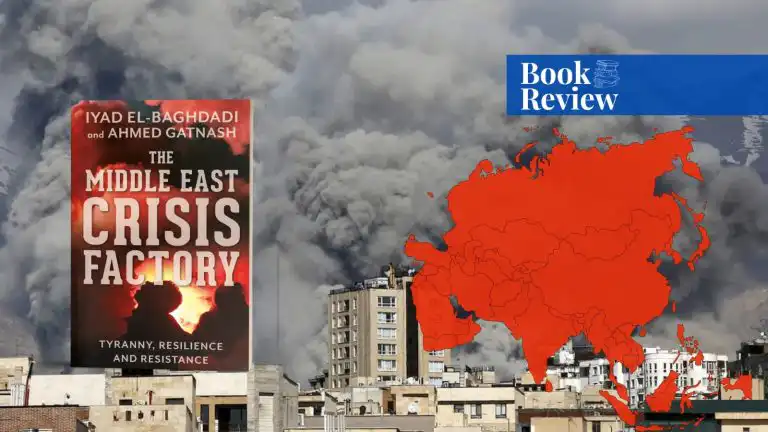
“The origin of the uprising is not mobilization—that comes rather late in the process. Rather, the origin of the uprising is a broken social contract,” write two self-described activists, a stateless Palestinian now based in Oslo and a British Libyan citizen, Iyad El-Baghdadi and Ahmed Gatnash, respectively. Their book “The Middle East Crisis Factory: Tyranny, Resilience, and Resistance” sets out to offer a critical account of the interplay between authoritarianism, foreign interventions, and violent terrorist movements across the Middle East since the Arab Spring.
The Mechanics of the “Crisis Factory”
The authors examine how these forces of oppression work in a vicious triangle, perpetuating and sustaining one another, all while keeping the society crushed and impoverished. They push back against the popular views that narrow down the instability in the region to a few single causes, dictatorship or Western intervention, and provide simple solutions such as elections or Western intervention again. For Baghdadi and Gatnash, neither foreign military intervention nor accommodation to authoritarian regimes offers a viable way forward, as it intensifies resentment, destabilizes, and suppresses legitimate grievances.
The Middle East Crisis Factory is structured into two sections: the opening segment delves into the historical factors that examine the region’s messed-up state as a result of decades of broken promises. The subsequent section, designated as the “horizon,” offers comprehensive solutions aimed at dealing with dictators and empowering the societies within the region.
The authors argue that since gaining independence from Europeans, Middle Eastern politics has revolved around dictators deriving their legitimacy by promising certain social contracts. Post-colonial Arab regimes used threats of Western dominance and romantic dreams of Arab nationalism as the key element of their social contract but only delivered defeat and humiliation in the form of the 1967 Arab-Israeli War.
After the oil boom in the 1970s, the region’s social contract shifted from nationalism to economic welfare, only to end up with the complete expropriation of political and social rights. In the first decade of the 21st century, the dictators were running out of legitimacy once again until the US “War on Terror” presented them with the perfect opportunity to adapt the fight against terrorism as the new pillar of international and domestic legitimacy.
The Arab Spring: Awakening, Backlash, and Resilience
The resilience of authoritarians has been aided greatly by the interplay of their regimes and the external world. The power structure, as the authors assert, was not only comprised of tyrants but also of foreign governments and violent terrorist movements. For the people, there is no choice between them because supporting one will lead to the other two. The author further notes that by the end of 2010, the largest number of mass protests in the Arab world started. Many dictators were ousted, and each country took its own political path.
The barrier of fear had been broken; people discovered a new sense of purpose, unity, solidarity, and dignity. However, this awakening was followed by civil wars, defeats, traumas, and exiles by dictators. While discussing the counterrevolutionary efforts by local autocrats, the author highlights that they branded themselves as reformists, visionaries, and tolerant leaders while deploying financial resources to stop democracy at any price, out of fear that it might reach their doorsteps.
The authors acknowledge that despite the high unemployment rates and political repression, the region has seen significant change over the past decade. Young people are now more aware of their rights, and there is also a rise in civil society activism, which is working in furtherance of their cause. However, their efforts are often threatened by dictatorial regimes.
Beyond Foreign Bombs and Backroom Deals
The authors criticize the West’s failed attempts to deal with the authoritarian regimes in Iran and Iraq, highlighting the counterproductive outcomes of sanctions and military interventions. They propose strategies to destabilize dictators without causing societal collapse, such as implementing smart sanctions, empowering whistleblowers to name and shame them, granting universal jurisdiction, disrupting propaganda, and restricting tyrants’ social media access. They argue that empowering independent civil society is crucial in combating authoritarian regimes by facilitating special travel visas, offering educational and investment opportunities, and elevating activists’ profiles globally, rather than choosing between bombs or backroom meetings.
The murder of Jamal Khashoggi is seen as a turning point, as the authors argue that the attitudes towards these counter-revolutionary regimes are shifting. These regimes are in an existential crisis; while their collapse is inevitable, the transition to democracy will be catastrophic. The next twenty years, as noted by the authors, are likely to be a continuation of political stagnation, authoritarian consolidations, uprisings, both failed and successful revolutions, and interrupted transitions. Despite the current turmoil, the authors remain optimistic about the future led by the new generation in the MENA region. However, their tone is cautionary rather than fatalistic.
Critical Evaluation
The Middle East Crisis Factory provides a thorough assessment of the region’s past and future, highlighting that while tyranny remains pervasive post Arab Spring, there is also resistance and resilience. However, the policy recommendations to destabilize authoritarian regimes struggle with what should happen and what is politically feasible given Western political agendas. Strategies, as recommended by authors ranging from expanding smart sanctions against dictators to providing opportunities to activists, rely heavily on Western countries or Western-dominated organizations.
The question here should be, “Why hasn’t this happened already?” It’s because these are the same states that are partly responsible for the current situation of the MENA region—from colonialism to supporting dictators to direct military interventions. If the West were to solve the problems of the region, they could’ve done so from the very start instead of doing the naked theft of the region’s resources while killing millions of innocent civilians. This critique reveals a paradox in the suggested solutions where the very entities expected to facilitate resolution are responsible for contributing to the region’s sufferings, thus highlighting the complexity and entanglement of geopolitical dynamics in the Middle East.
If you want to submit your articles and/or research papers, please visit the Submissions page.
To stay updated with the latest jobs, CSS news, internships, scholarships, and current affairs articles, join our Community Forum!
The views and opinions expressed in this article/paper are the author’s own and do not necessarily reflect the editorial position of Paradigm Shift.

Ms Atiqa Tariq is pursuing a bachelor's degree in International Relations from International Islamic University Islamabad.