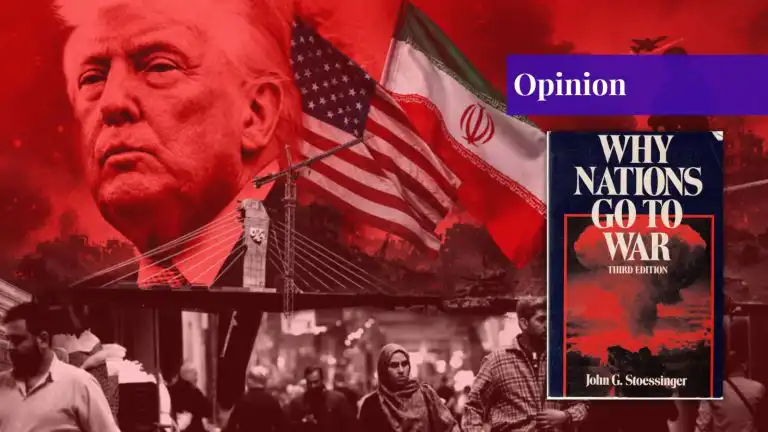
In his book Why Nations Go to War, John G. Stoessinger has contested the traditional explanation of war. Many factors, such as ideology, military might, territorial disputes, and economic interests, undeniably contribute to conflict. Stoessinger has debated that wars are shaped by the decisions of leaders. He further argues that political leaders usually engage in conflicts not because war is inevitable, but owing to their misperception of the opponents’ intentions, capabilities, and resolve. Other factors, such as overconfidence, pride, and incorrect assumptions, often lead leaders to believe they can achieve victory, and it ultimately transforms the manageable crisis into costly wars. His thesis remains highly applicable in analyzing contemporary international conflicts, including the ongoing tensions between the United States, Israel, and Iran.
The war between these countries showed that military strength was not always the decisive factor and that power did not always mean victory. Apparently, it was assumed that the joint advanced military might of the US and Israel would crush the smaller opponent in a short period of time. However, these assumptions demonstrated the popular belief in international politics regarding the force as a guarantor of achieving the desired political interests. On the other hand, the trajectory of the conflict proved considerably more complex.
Instead of giving up under pressure, Iran proved to be resilient. By adapting to changing circumstances, it also worked to absorb the impact of sanctions. The counter-defensive approach by Iran proved the conflict to be a contest of resilience, political will, and strategic calculation. It again supports the notion of Stoessinger: due to their misperception, leaders tend to overestimate their ability to control events and undervalue their rivals.
The eventual return to diplomatic engagement is another interesting aspect of the conflict. Despite Trump’s threatening political rhetoric, the possession of advanced military technology alone proved inadequate and ineffective to bring the adversaries to a political settlement. Dialogue and negotiations again proved to be essential components of conflict management. Again, the willingness of the parties to negotiate and pursue dialogue demonstrates the constraints of force as a policy instrument.
The current agreement for negotiations also highlights the importance of prior talks surrounding Iran’s nuclear program. Through the Joint Comprehensive Plan of Action (JCPOA) in 2015, the then-President of the United States attempted to overcome tensions through diplomatic efforts rather than confrontation. Although Donald Trump denounced the plan in 2018, the lesson remains pertinent: complex international disputes often require a durable way forward like diplomacy alongside deterrence.

Stoessinger’s analysis helps us understand this complexity as he provides examples of some twentieth-century wars to support his arguments. After examining conflicts of the Vietnam War and the First World War, he argues that misperceptions on the leaders’ side and undervaluing the adversaries drove the nations to war with no desired outcome. Before World War I, the leaders of both fronts had assumed that war would be temporary, controlled, and in their favor. However, the assumptions proved false, and it became modern-day history’s most destructive conflict. A similar result can be seen in the Vietnam War because of the miscalculation of policymakers on both sides; the war continued for a prolonged period without achieving the intended objective.
The contemporary conflict between the United States, Israel, and Iran is also demonstrating many of the same patterns. The policymakers of militarily advanced nations, such as the United States and Israel, miscalculated that their use of force would achieve the desired outcome. However, the conflict also revealed Iran’s resilience and endurance in the face of external pressure.
Moreover, the foreign policy decisions are sometimes influenced by the domestic political environment. History is rich with such examples of leaders who have used international crises to strengthen their own political power at home. With American elections approaching, the president of the United States has adopted the strategy of peace and managing the conflict through diplomatic channels. Nonetheless, there are significant consequences of such decisions. When a conflict starts, it develops its own momentum and renders results that are opposite to the original political purpose.
Eventually, the thesis of Stoessinger serves as a harbinger for the political leadership that misjudges reality and assumes military capability as an all-powerful force to dominate in international politics. And finally, it is not only the leaders who bear the costs of their own misperceptions, but the ordinary citizens of the states also have to face the consequences.
To wrap up, the conflict of the United States, Israel, and Iran is another example of how leadership’s misperception can determine the direction of war and its outcome. History has shown us that wars seldom proceed as calculated by their pioneers. Therefore, policymakers must understand the limits of power and dangers of misperception to avoid repeating past mistakes.
If you want to submit your articles and/or research papers, please visit the Submissions page.
To stay updated with the latest jobs, CSS news, internships, scholarships, and current affairs articles, join our Community Forum!
The views and opinions expressed in this article/paper are the author’s own and do not necessarily reflect the editorial position of Paradigm Shift.

Rehman Yar is a student of public policy and governance at Government College University Lahore.