
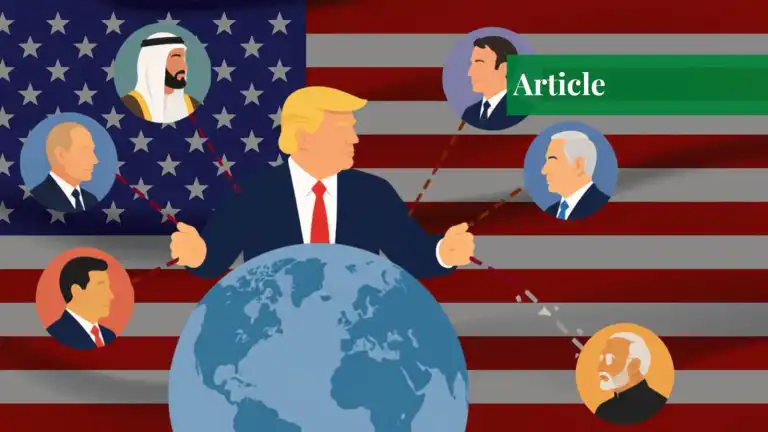
The defining features of Trump’s foreign policy are unpredictability and sidestepping from diplomatic institutions, making it a personality-driven enterprise. In the past, a complex network of diplomats, strategic institutions, intelligence evaluations, and alliance procedures was all essential to traditional American foreign policy. However, under Trump, foreign policy seems to be focused on a small group of family members, loyalists, and unofficial envoys, bypassing the institutional framework that has characterized American diplomacy in the past.
Trump’s administration is pulling back career diplomats, leaving 115 ambassador posts unfulfilled in countries like Saudi Arabia, the United Arab Emirates, Egypt, and Ukraine. Steve Witkoff, Trump’s lifelong golf partner, and Jared Kushner, his son-in-law, are dealmakers in the Middle East. Massad Boulos, Tiffany Trump’s father-in-law, oversees the administration’s policy for Africa. Tom Barrack, Trump’s close friend and confidant of thirty years, serves as his ambassador to Turkey along with handling a broad Middle East portfolio, mediating ceasefire negotiations in Lebanon, and collaborating with Syria’s transitional government.
Personalization of diplomacy has resulted in a foreign policy that is highly fluctuating, reactive, and contradictory. This discrepancy can be best explained by Trump’s stance on the crisis between Russia and Ukraine. In his election campaigns, he stated that once he returned to office, the war would end in a day. Contrary to rhetoric, the crisis persists without any significant diplomatic progress. Russia has maintained its aggressive posture. This diplomatic failure shows the gap between President Trump’s political rhetoric and the prevailing geopolitical realities. The incapacity of the US to broker a deal has faded the perceptions of America as a power capable of achieving its desired outcomes at the negotiation table.
Washington’s policy towards Iran is switching between abrupt calls for negotiations and threats of conflict. This unpredictability has generated strategic uncertainty for allies as well as adversaries. During negotiations with Iran, Trump made several calls this past week for more nations to participate in the 2020 Abraham Accords. At one juncture, he stated that he was “mandatorily requesting” countries such as Saudi Arabia, Qatar, and Pakistan to establish normalized relations with Israel. President Trump also threatened to bomb Oman if it participated in any initiative to regulate the Strait of Hormuz alongside Iran. This capricious approach undermines the diplomatic predictability of international relations. Global powers may put up with aggressive posturing, but they are unable to form long-lasting alliances based on ambiguity and impulsive signals.
A similar pattern of mere rhetoric in foreign policy can be observed in the Palestinian peace process. The decisions regarding a technocratic government and peace board formation for Palestine have observed a diplomatic stagnation. The lack of consistent institutional involvement has hindered any significant advancement toward a reliable solution. The issue is restricted to political messaging instead of substantive diplomatic efforts.
Tensions between the US and its longstanding European allies have also increased because of Trump’s foreign policy. The strategic gap between Washington and European capitals has widened as a result of his aggressive criticism of NATO members. Trump’s transactional approach to alliances and confrontational rhetoric have made these relations more strained. European countries’ efforts for strategic autonomy and autonomous security arrangements have made the transatlantic alliance less united than it has been in recent decades. The European countries are diversifying their alliances with a significant engagement with China. American diplomacy is gradually encouraging allies to diversify their strategic dependencies instead of consolidating decades-old alliances.
Trump’s expansionist policies, ranging from remarks about Greenland to more extensive involvement in Latin America, especially Venezuela, have strengthened perceptions of an increasingly unilateral and coercive American posture. These policies represent a strategic overreach of President Trump.
Insignificant outcomes from the US-China May summit show a failure of Trump’s foreign policy in gaining substantive strategic achievements. The summit failed to produce any fruitful results in managing growing tensions in the fields of trade and technology. The talks on sensitive issues, including Taiwan, the Middle East, and regional influence in the Indo-Pacific, remain vague. The visit appeared only as a successful media event rather than a meaningful diplomatic event.
These erratic and unpredictable policies have a cumulative effect that goes beyond immediate geopolitical conflicts. First, America’s global credibility has become skeptical as allies have become cautious of the reliability of U.S. commitments. Further, institutional diplomacy has weakened, creating confusion within both allies and adversaries regarding Washington’s actual strategic intentions. The Emerging powers, such as China and Russia, have benefited from the situation and presented themselves as comparatively stable strategic allies. Lastly, the erosion of diplomatic professionalism risks transforming foreign policy into a short-term domestic political instrument.
The Great powers cannot sustain influence through personalities alone. Institutions, continuity, and strategic discipline ensure their influence. Diplomacy built around individual impulses rarely produces lasting geopolitical stability. Institutions must prevail over personalities if a global leadership like the US wants to remain credible in an increasingly multipolar world.

If you want to submit your articles and/or research papers, please visit the Submissions page.
To stay updated with the latest jobs, CSS news, internships, scholarships, and current affairs articles, join our Community Forum!
The views and opinions expressed in this article/paper are the author’s own and do not necessarily reflect the editorial position of Paradigm Shift.

Arooj Aftab holds an M.Phil in Phytomedicine with distinction from Government College University Faisalabad (GCUF) and is a CSS 2024 qualifier. She is an aspiring civil servant and has a keen interest in research works, policy analysis, defence and strategic studies.