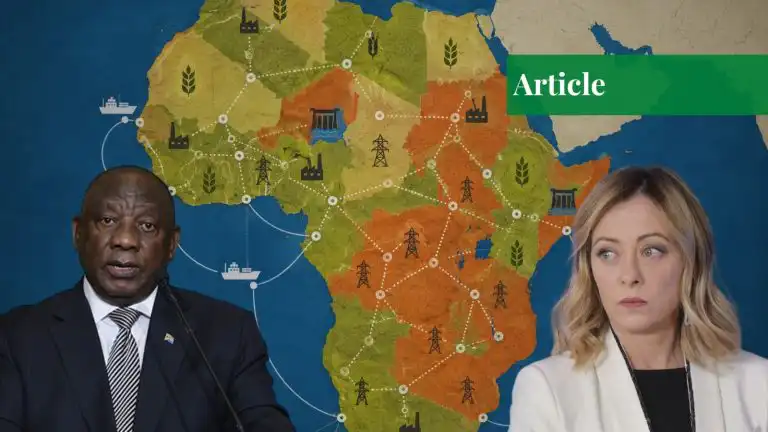
The Second Italy-Africa Summit was convened for the first time on African soil on 13 February 2026 in Addis Ababa, Ethiopia, a strategically significant venue selection by Italy. Originally Italy’s political and development initiative for Africa, the project is gradually developing into a more comprehensive geopolitical framework. The Mattei Plan has strengthened energy ties with Algeria and increased involvement in the Sahel through initiatives like the Lobito Corridor. The plan currently resides at the nexus of strategic competitiveness, energy safety, and vital minerals. However, concerns remain over whether the initiative’s “non-predatory partnership” policy can transcend conventional extractive methods of involvement, even as it obtains backing from the US, the EU, and Gulf states.
From National Initiative to Multilateral Strategy
Over the past year, the Mattei Plan has shifted from a largely domestic policy framework into a more dispersed, multilateral configuration. Italian officials have described this transition as an “internationalization phase,” although in practice it reflects a deeper embedding of the initiative within broader geopolitical and economic agendas.
At the 2025 Rome Summit, the Lobito Corridor received €320 million from Italy, and the European Union and the United States contributed support through the Partnership for Global Infrastructure and Investment (PGII). The $5 billion railway project aims to link Zambia’s copper belt along the Democratic Republic of Congo to Angola’s Port of Lobito, with starting operations expected in late 2026. This initiative establishes a Western-oriented export pathway for essential minerals. Supply chains controlled by China continue to prevail in processing. Both systems function concurrently. The initiative is framed as a cooperation; it faces criticism as a Western endeavor to undermine China’s Belt and Road Initiative and to safeguard essential mineral supply chains. Despite this, now, implementation does not mirror prior Western extraction practices.
At the Critical Minerals Ministerial in Washington (2026), attended by more than 50 countries, Italy’s Foreign Minister Antonio Tajani stated that the Mattei Plan is a key element for the financial security of the West. Cooperation with African producers, infrastructure development, and continued access to resources were cited as key measures to challenge China’s dominance in the refining and extraction of cobalt, lithium, and rare earth elements, which account for two-thirds of global capacity.
The plan’s global presence has expanded beyond previous expectations. Italy has initiated conversations with Japan and South Korea over cooperation frameworks; also, the European Union’s Global Gateway has collaborated with Italy to allocate €1.2 billion for Mattei-flagship projects.
The Sahel: A Security and Credibility Test
The Sahel has become the most politically sensitive arena for the Mattei Plan. It is also where its claims of credibility are most directly tested. Nigeria represents a further dimension of complexity to Italy’s African strategy. Despite the withdrawal of French and American forces following the 2023 coup in Niger, Italy remains present on the ground, not reduced, not withdrawn. Instead, Italy expanded to around 300 personnel at Base 101. Italy continued its mission even after Islamic State-linked militants targeted Niamey airport and nearby installations in January 2026. This presence is rather politically significant in a shrinking Western footprint.
This decision carried weight beyond operational necessity. In the Sahel, Western military withdrawal has become the norm; Italy’s continued presence signals a different approach, one that is less conditional and more operational in nature. Since 2009, jihadist groups such as Boko Haram and Islamic State West Africa Province (ISWAP) have led to more than 350,000 casualties in Northeast Nigeria. In this environment, security cooperation and economic engagement cannot be separated in this region. Both operate together in practice.
Energy Interdependence and the Algerian Partnership
Energy remains the backbone of Italy’s Africa strategy. The Italy-Algeria Business Forum in 2025 reinforced Algeria’s position as Italy’s main gas supplier by delivering 41 percent of Italy’s natural gas imports. This relationship is not new. But it is becoming denser and more strategic. The long-standing production agreements between ENI (Ente Nazionale Idrocarburi) and Sonatrach began in 1959. But the major shift lies in scale and urgency, shaped heavily by Europe’s post-Ukraine energy reconfiguration.
Besides energy projects, both states advanced several infrastructure programs throughout 2025. The South2Corridor project is designed to link North Africa with Italy, Austria, and Germany and is projected to conclude by 2030. A €420 investment is being made in the agricultural sector in Timimoune, Algeria, which covers around 36,000 hectares of arid land and is projected to employ approximately 6,700 people. The objective is increased food production in Algeria and reduced import dependence. In return, cooperation between Algeria and Italy on migration control and counter-terrorism has also expanded. The exchange is direct. The underlying principle is mutual dependence framed as a partnership.
Structural Tensions Beneath the Model
Despite institutional expansion, the Mattei Plan continues to face unresolved contradictions. The Lobito Corridor illustrates this clearly. Without serious investment in local processing capacity, the railway may function largely as a conduit for raw copper and cobalt exports from Central Africa to coastal terminals, designed to handle 75,000 tonnes of copper and 25,000 tonnes of cobalt on an annual basis by 2027. This raises the question whether value addition will remain within Africa or not.
This issue becomes more pronounced when placed against regulatory moves in countries such as the Democratic Republic of Congo, Zimbabwe, and Namibia, all of which have imposed restrictions on the export of unprocessed minerals in order to retain domestic value chains. This weakens the broader narrative of local industrial development that backs the corridor.
There is also a broader imbalance that cannot be ignored. ENI’s €24 billion investment plan (2025-2028) in Egypt, Libya, and Algeria vastly exceeds the Mattei Plan’s €5.5 billion total. The gap matters. It raises a structural issue. Where does state development policy end and corporate energy strategy begin? The distinction is no longer clear.
The Test of Coherence
As the Addis Ababa summit advances in 2026, the Mattei Plan is more institutionally embedded than before. The African Development Bank has increased its financial role. The European Union and the United States are also co-investing in infrastructure linked to the framework.
Yet the question remains open. The plan exists. It operates. It has political visibility. But whether it can sustain coherence across competing interests is still uncertain. Its credibility will not depend on announcements or funding volumes alone. It will depend on how African partners ultimately interpret it—as a shift towards genuine co-development or as a refined version of older strategic competition under a new discourse.
If you want to submit your articles and/or research papers, please visit the Submissions page.
To stay updated with the latest jobs, CSS news, internships, scholarships, and current affairs articles, join our Community Forum!
The views and opinions expressed in this article/paper are the author’s own and do not necessarily reflect the editorial position of Paradigm Shift.

Maryam Iftikhar completed her degree in International Relations at Kinnaird College for Women University, Lahore and is passionate about global politics, international law, and climate justice.