
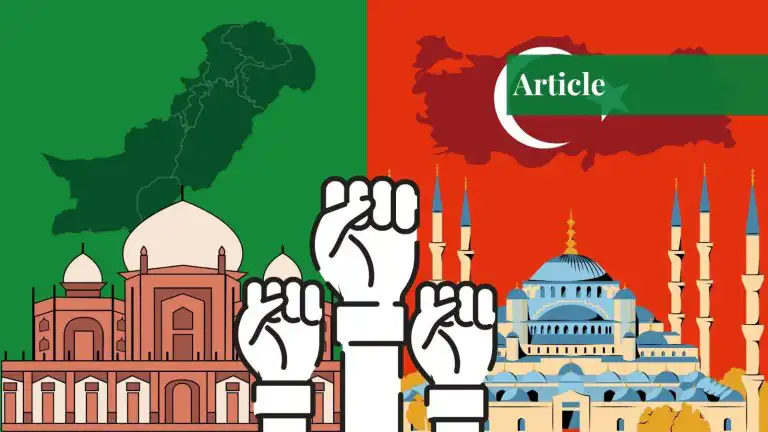
Both events, on 15 July 2016 in Türkiye and 9 May 2023 in Pakistan, were significant political crises in which governments’ legitimacy was severely challenged and, subsequently, broad state responses were directed at individuals and political actors perceived to be close to the crisis.
At first glance, the two episodes seem similar due to mass arrests, limitations on political freedom, high polarization of the public, high involvement of law enforcement institutions, and the subsequent legal proceedings against numerous individuals. Both responses have been primarily along the lines of safeguarding constitutional order, public security, and national stability.
However, caution must be taken when making the comparison. In July 2016, there was an attempted military coup in Türkiye, and in May 2023, there was political unrest and violent protests in Pakistan after the arrest of the former prime minister, Imran Khan. The incident in Turkey was a coordinated coup attempt by some members of the army to take control of the state, even storming the Parliament and other important institutions. The Pakistani incident, however, was of the supporters of a political party protesting violently with attacks on government and military-related installations. Still, it was not an attempted seizure of governmental power by an organized military faction.
A comparison is therefore more useful when focusing on the reaction of the states to political violence when it is perceived as a threat to constitutional and institutional order, on the use of extraordinary legal mechanisms, and on how states’ relations with political opposition are affected after the occurrence of such crises.
The Nature of These Two Crises
Elements of the Turkish armed forces tried to change the elected government on the night of 15-16 July 2016. The military had taken up strategic positions in airports, bridges, etc., and fighter aircraft and helicopters were attacking state institutions. The Turkish Grand National Assembly was bombed, and the headquarters of some state institutions were attacked. Over 250 people were killed and thousands more injured in the attempted coup.
The political reaction was exceptionally widespread. Both the governing Justice and Development Party (AKP) and the Republican People’s Party (CHP), the pro-Kurdish Peoples’ Democratic Party (HDP), and the Nationalist Movement Party (MHP) publicly denounced the coup attempt. Parliament met during the crisis, and a joint declaration was issued, defending the constitutional order.
The situation that led to the crisis in Pakistan on 9 May 2023 was far different. Former Prime Minister Imran Khan was arrested in a corruption case. When he was arrested, people protested nationwide. Some protests turned violent, in which protesters attacked police, set fires to public property, and entered sensitive military and government installations. The government then made thousands of arrests and started criminal investigations.
So, the first threat appraisal was very different. The state in Türkiye faced an armed challenge to the government. In Pakistan, the State faced a politically organized protest, which quickly turned violent and attacked State property.
The State’s Immediate Response
Although the nature of the crises varied, one thing was clear: both had led to a quick response from state machinery.
In Turkey, the authorities started to immediately launch criminal investigations against those who are suspected of being involved in the coup. On 16 July, prosecutors started their investigations, and the judicial authorities acted quickly against judges, prosecutors, military personnel, and others who were suspected to be affiliated with the coup’s perpetrators, as the Turkish government had determined.
A state of emergency was then declared by the Turkish government on 21st July 2016. The emergency decrees gave the government a wide range of powers to dismiss public officials, to shut down organizations and to limit certain rights. The emergency regime remained in place until July 2018.
Pakistan has not termed a national state of emergency on 9 May. Provincial and federal authorities, instead, mainly appealed to the already existing criminal, anti-terrorism and public-order legislation. The Pakistani government reported to the UN mechanisms that 430 criminal cases were filed in the aftermath of the violence across jurisdictions.
The Pakistani military has also been summoned to help put out the chaos. This is significant because the deployment of the armed forces cannot be read as an indication that the military institution was directing the entire political response. The formal response was one of civilian governments, police, prosecutors, courts, and other state institutions, as well as the application of military assistance to the maintenance of public order.
From Individual Criminal Responsibility to Wider Institutional Purges
A major distinction between the two cases has to do with the scope and breadth of the response that followed.
In Türkiye, the post-coup response quickly transcended the scope of those accused of being involved in the coup. The government deemed the Gülen movement the organization behind the attempted coup and started a broader assault on those it believed related to it.
The impact was felt across the state machine. As of early 2018, over 150,000 people had been arrested, and around 78,000 individuals had been charged with a terrorism offense. Over 110,000 public officials had lost their jobs, such as judges, prosecutors, teachers, police, academics, and others.
The judiciary was severely impacted. According to the European Court of Human Rights, 2,735 judges and prosecutors were suspended right after the attempted coup; thousands more were removed. This had changed the Turkish response, from a limited targeting of those who tried to make a coup, to a wider institutional restructuring and political-security consolidation programme.
International institutions then expressed grave doubts on the proportionality and collective nature of such measures. The European Commission said the level of dismissals, arrests and detentions exceeded what was easily defensible as a current security threat and that judicial review and procedural protections were of concern.
Pakistan’s reply was big but narrow at the institutional level. The number of people arrested after the May violence — which included PTI activists and political leaders — was in the thousands. By 20 May, over 4,000 people had been detained, and the government prosecuted people under criminal, anti-terrorism and public order laws, Human Rights Watch reported.
Pakistan’s state was also actively seeking to prosecute people who attacked designated military facilities. The prosecution of some civilians before military courts was a particularly controversial development. The Supreme Court record reported that the decision came on the back of a meeting of the Corps Commanders on 15 May, a meeting of the National Security Committee on 16 May, the endorsement of the federal cabinet on 19 May, and a resolution in the National Assembly on 22 May. That’s the sequence that shows that it was not a single institution that responded to this but many state institutions.
The Role of Political Institutions
Another significant comparison is the behavior of political institutions toward the reaction. Parliament in Türkiye had a symbolic and institutional presence at the time of the coup. As the building was under attack, members from the major political parties were in Parliament. The four main parliamentary parties issued a joint statement condemning the coup attempt and the legitimacy of the elected legislature.
This was a unique occasion of institutional unity across the parties. But political pluralism was not to be the legacy of the immediate aftermath of the coup. In the years that followed, anti-government activists, the media, academics, and civil society groups were subjected to the general security apparatus set in place after the coup. Concern was then voiced in the European Parliament about the arrest of opposition lawmakers and the undermining of parliamentary oversight.
The institutional response in Pakistan was more disorganized. Polarization of the political system was already high prior to May 2023. PTI and its supporters saw the arrest as politically motivated, while the government said the criminal charges were for allegations that had to be decided by the judiciary.
The violence, however, led to a consensus that attacks on the state’s sensitive and public installations could not simply be considered as political protest. The pivotal institutional issue that followed was who should prosecute the violence, rather than whether anyone should, and how and under what safeguards.
The Judiciary as an Arena of Contestation
In both instances, the judiciary was a significant but separate entity. In Türkiye, the judiciary itself was one of the main objects of post-coup restructuring. Thousands of judges and prosecutors were discharged or suspended, raising questions of judicial independence. The European Commission later said the dismissals had significantly impacted the institutional capacity and independence of the judiciary.
Pakistan took a different path. The lawfulness of the state’s answer became an issue for the judiciary. All the way to the Supreme Court, the issue of military trials of civilians was brought up. The Supreme Court in October 2023 ruled that the trial of civilians in military courts is unconstitutional, but this decision was suspended, and the case was still to undergo further court deliberation.
This illustrates an important difference: In Türkiye, the post-coup crisis had a significant impact on the judiciary itself. In Pakistan, one of the key battlegrounds over the legality of the post-May-9 response went through the judiciary.
National Security as the Dominant Legal and Political Narrative
The other point of resemblance is that the language of justification for exceptional measures is the same for both. In both countries, the state described the crisis as nothing more than routine political opposition, and in both instances as a challenge to the constitutional and national order.
In Türkiye, the government has characterized the coup attempt as an existential threat to democracy and the state and the Gülen network as a terrorist organization that attacked state institutions. This emergency was invoked to eradicate this threat.
In Pakistan, the government presented the violence that occurred in May as an assault on the state institutions and national security. The military installations were different from political demonstrations, as they were restricted and sensitive locations in terms of the attacks.
The difference is crucial, as political protest is constitutionally protected, but violence, arson, assault, and attacks on restricted state installations are criminal offences. The question for a democratic government is then how to draw a line between them, not to label an entire political movement as criminal because some of its members were guilty of criminal acts.
The Problem of Collective Responsibility
The greatest conceptual overlap between the two cases is the threat of shifting from individual criminal responsibility to collective political responsibility. A democratic legal system ought to make responsible accountable based on individual conduct and evidence.
The state has a legitimate basis to prosecute if a person has been involved in violence, attacked a public building, damaged property, or assaulted law-enforcement personnel. However, a person’s party membership alone does not constitute criminal guilt.
This distinction became more significant in Pakistan as arrests were made not only of people who were visibly involved in the violence, but also of non-violent people acting under the influence of it. Human Rights Watch voiced concern that there was also arbitrary arrest of members of political parties and peaceful protesters under general laws related to public order and crime.
A similar worry was felt in Türkiye, where the post-coup framework ultimately had an impact on people whose alleged association with the Gülen movement did not necessarily mean that the person was involved in the coup. European institutions decried the application of general criteria and administrative grouping.
It is not the case, then, that both states did the same thing. When the political crisis is extraordinary, there are incentives for states to broaden the definition of the threat beyond the ones that are directly responsible for violence.
The Military Question in Pakistan
The military institution in Pakistan is something to be considered with great care when making comparisons with Türkiye. The Turkish event itself was an attempted military coup: there were elements of the armed forces who tried to take over political power.
But the situation of 9 May in Pakistan was not like that. The violence was linked to supporters of a civilian political party whose leader had been arrested. The government then turned to the armed forces to help restore order, and the institutions of civil society (provincial governments, police, the prosecutor’s office, Parliament and courts) were involved in the legal and political response.
So it is inadequate to describe the Pakistani reaction as a “military crackdown. A better way of stating this is: The May 9 response was a state-wide coercive and legal response which engaged civilian governments, law-enforcement agencies, courts, Parliament and the armed forces in various capacities.
This does not free anyone of responsibility if it can be proved that an institution was responsible for wrongdoing, but it does not imply that an entire response is due to an institution if there is less evidence.
What the Comparison Actually Tells Us
The comparison shows three general points to be learned from states in extreme political crisis.
First, states tend to expand the security definition of a political crisis. If political violence is seen as an existential threat, then there are strong incentives for governments to expand investigations and preventive measures. This was dramatically so in Türkiye and in small institutional proportion also in Pakistan.
Secondly, the initial state response is not necessarily the legitimate response. Türkiye’s failed coup was a valid assault on the constitutional order. Similarly, the public and sensitive installations were attacked in Pakistan, which was used as a proper ground for criminal investigation and prosecution. Collective punishment, arbitrary detention, and restrictions on due process are not justified by the legitimacy of the prosecution of violence. This is an important distinction.
Third, for institutional resilience, the importance of institutional power is less important. A state can’t just be judged if it can restore order. It is also evaluated on its capacity to bring order in a foreseeable legal framework. The more the threat is perceived, the more significance is given to independent courts, to parliamentary control, to investigations that are transparent, and to individual criminal responsibility.
Conclusion
Türkiye’s 15 July 2016 coup attempt and Pakistan’s 9 May 2023 violence highlight the challenging dynamics between safeguarding the state and maintaining democratic and legal protections, even though they are fundamentally different crises. Türkiye faced an armed move to change the elected government, and Pakistan faced violent political unrest after the arrest of one of its political leaders. The nature of the threat is different for the two and should not be considered the same.
The more useful lesson is what came after. In both, the legitimacy of prosecuting violence was not sufficient to warrant any measure taken in its wake. There has to be a credible democratic response, and that response should be individual, based on the evidence, not collective, based on political affiliation or association. When there are extraordinary circumstances, it is well enough to be able to justify strong state action, but not so well as to justify deprivation of due process, judicial independence, parliamentary oversight and proportionality.
Finally, resilience should not be judged by a state’s capacity to restore order. It should also be judged on the legitimacy of its restoration of that order, its proportionality and its institutionalization. The differences between Türkiye and Pakistan are most instructive here, as the maintenance of constitutional order is a key component, but the means by which constitutional order is maintained can also have an impact on the quality and durability of democratic institutions.
If you want to submit your articles and/or research papers, please visit the Submissions page.
To stay updated with the latest jobs, CSS news, internships, scholarships, and current affairs articles, join our Community Forum!
Find our FREE quizzes and MCQs here!
The views and opinions expressed in this article/paper are the author’s own and do not necessarily reflect the editorial position of Paradigm Shift.