Pakistan’s Climate Crisis
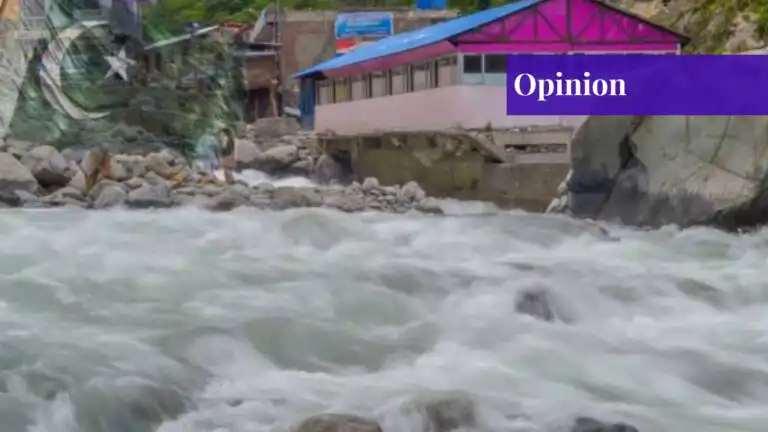
Pakistan, a country largely dependent on the Indus River for energy, agriculture, power, outreach, and water consumption, is at the edge of a growing regional threat that confronts traditional security frameworks. The effects of climate change are accelerating glacial melt across the Himalayas, Karakoram, and Hindu Kush mountain ranges as global temperatures continue to increase. The Indus River Basin is fed by these glaciers, a vital source for 220 million people for water across Pakistan. The country is facing not just environmental degradation but also a complex crisis that threatens the national, economic, and regional security because the cryosphere is weakening rapidly.
There has been an unprecedented rise in the quantity of glacial lake outburst floods (GLOFs), particularly in Gilgit-Baltistan and Khyber Pakhtunkhwa in recent years. Heavy floods imposing a severe threat to vulnerable communities, infrastructure, and local economies have become a new normal in the region. Furthermore, seasonal water flows have become increasingly erratic. Pakistan’s agrarian economy, which is heavily dependent on foreseeable water sequences, has been thrown into confusion. Traditional crop patterns are changing, irrigation schedules are being disrupted, and hydroelectric power generation is becoming more unpredictable—all of which are intensifying Pakistan’s already fragile economic and governance systems.
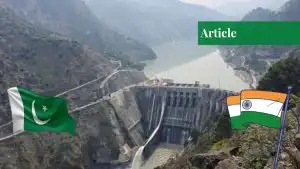
The growing strain on the 1960 Indus Water Treaty (IWT) between Pakistan and India is one of the most crucial parts of this crisis. Supported by the World Bank, the treaty allocates the control of the three western rivers, Indus, Chenab, and Jhelum, to Pakistan, while the three eastern rivers, Ravi, Beas, and Sutlej, to India. However, the treaty has suffered through years of conflict and political discord. It was planned under expectations of climatic stability and predictable water cycles. That theory no longer holds. Indian infrastructural enhancement on upstream waters, especially dams and barrages, has raised alarms in Pakistan about decreased water availability, mainly during the dry season.
As climate pressure affects both nations, the lack of a flexible, climate-sensitive outline within the agreement offers a serious risk to regional security. The agriculture sector of Pakistan serves almost half of the labor force and is now becoming increasingly vulnerable to water scarcity. According to the analysis by the World Bank, Pakistan could become the most water-scarce country in South Asia by 2040. These circumstances are caused by the mismanagement, declining water levels, old-school irrigation systems, and the carelessness of the government towards this issue. As the crops become hostile to irrigation in the countryside, people in groups migrate and face food insecurity, leading to public disappointment which creates solid grounds for chaos and riots. The effects of climate change are not only limited to the countryside but also extend far beyond to cities, industries, and overall economic progress.
Way Forward
Prominently, climate-triggered water security is not a challenge to be tackled by Pakistan alone. The transitional features of the Indus River Basin are in dire need of regional cooperation. Water security must be tackled via a multidimensional, climate-conscious approach and not purely through bilateral diplomacy. Joint coordinated conservation strategies, flood forecasting models, and regional stages for discourse among Pakistan, India, China, and Afghanistan must be developed in the concept of hydro-diplomacy. Only through such collective initiative can South Asia manage to avoid turning environmental vulnerability into geopolitical conflict and enjoy shared resources.
Strategic modification should be conducted at home to advocate for supportive action internationally to respond efficiently against this threat. Pakistan should invest in climate-robust infrastructure, upgraded systems for irrigation, modern reservoirs, and a disaster management mechanism. Modernization of water distribution is an important factor, as is enhancing the national policies dealing with maintenance, equitable distribution, and sustainability. Scientific alliance to monitor glacial protection and predict hydrological changes with accuracy. Revising the Indus Water Treaty to achieve more adaptive and strong water-sharing mechanisms, protecting both states from future shocks.
In conclusion, the water crisis in Pakistan cannot be viewed from a global climate perspective. The melting glaciers are not only a sign of environmental degradation but also signal emerging geopolitical fault lines. Traditional boundaries of security are changing with climate change, leaving rivers in barren sites and treaties in fragile documents. Both regional and domestic threats will evolve from ecological disruption to political and economic instability if decisive actions are not taken. This transformation must be recognized, and swift actions should be taken by Pakistan to reform its water policies with urgency, cooperation, and vision.
If you want to submit your articles and/or research papers, please visit the Submissions page.
To stay updated with the latest jobs, CSS news, internships, scholarships, and current affairs articles, join our Community Forum!
The views and opinions expressed in this article/paper are the author’s own and do not necessarily reflect the editorial position of Paradigm Shift.

Muhammad Bilal Khan is a journalist specializing in non-traditional security (NTS) threats. He is currently affiliated with the Institute of Strategic Studies Islamabad. He can be reached at mbkh0107@gmail.com.