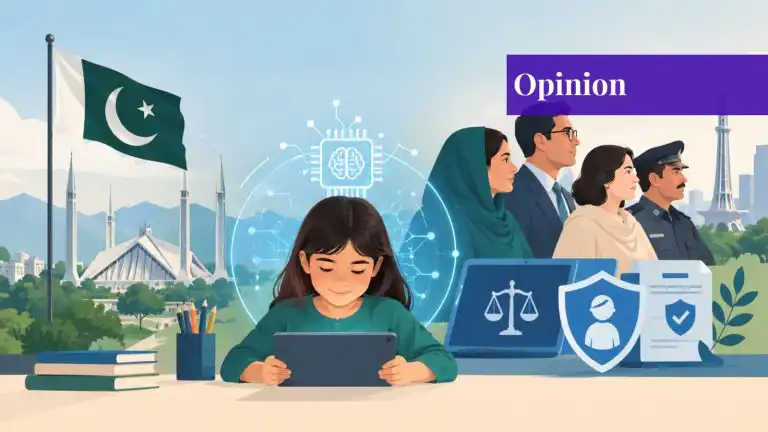
When a child opens an app, the first decision is often not made by the child at all. Before a teenager has watched a video, searched for homework help, or spoken to a friend, the platform has already made several choices. What to recommend, what to place at the top of the screen, when to send a notification, and what kind of content is most likely to keep that young user engaged.
That is why Pakistan’s growing debate on children and social media should not end with the question of age. The more important question is what kind of digital environment are we allowing children to enter?
On 1 September, the Punjab Assembly unanimously passed a resolution seeking restrictions on social media accounts for children under 16, subject to parental or guardian consent and reliable age verification. Only days earlier, on 26 August, a US court approved Meta’s major youth safety settlement.
The two developments are very different in legal character. Punjab’s resolution is not itself a nationwide ban. It calls for further legislation and implementation. The Meta settlement, meanwhile, emerged from litigation in the United States, but when they are placed side by side, they reveal something important.
Age verification may tell a platform that a user is a child. However, this does not make the platform safe for that child. The instinct behind age checks is understandable. If certain protections depend on age, platforms need some way of knowing who is a minor. The difficulty begins when we ask how that age will be established.
Will a child simply enter a date of birth? Will parents verify it? Will identity documents be required? Or will AI systems begin estimating age through appearance, behaviour, browsing patterns, or other signals? At that point, a tool designed to protect privacy becomes a reason to collect more personal information. That is the paradox policymakers should be careful not to miss.
Pakistan, in particular, should avoid creating a system in which children must surrender excessive amounts of data merely to prove that they deserve protection. The principle should be simple: “collect what is necessary,” use it for a clearly defined purpose, and do not retain it indefinitely.
America’s Children’s Online Privacy Protection Act (COPPA) reflects the idea that children should not be required to disclose more personal information than is reasonably necessary. That principle matters far beyond the American context. But perhaps the more interesting lesson comes from the Meta settlement itself.
Its headline financial figure attracted attention. Yet the more consequential part of the settlement lies in measures directed at the design of the service. It included stronger age assurance, default time limits for teenagers, restrictions on overnight use and notifications, and independent compliance auditing. This changes the regulatory conversation.
Instead of asking only whether a parent has consented or whether a child is old enough to open an account, it asks what responsibility a company has after that child enters the platform. Pakistan should move in the same direction.
The need is real. Research published in 2026 by UNICEF Innocenti, ECPAT International and INTERPOL found that nearly one in sixteen internet-using Pakistani children aged 12 to 17 had experienced at least one form of technology-facilitated sexual exploitation or abuse within a year.
That figure should not be stretched beyond what it proves. It does not mean that one in sixteen children suffered generic “social media harm”, nor does it establish that AI itself is responsible. But it is enough to show that digital child safety is not a distant or theoretical issue. At the same time, prohibition cannot become Pakistan’s default policy response.
Young people will increasingly use AI and digital platforms to learn, communicate, create, and work. Pakistan’s National AI Policy 2025 itself points towards greater AI adoption and skills development. We cannot encourage a digitally capable generation on one hand and treat technological exclusion as the main form of protection on the other. The better path is safer design.
High-risk platforms should be expected to introduce privacy-conscious age assurance, safer default settings, meaningful controls over personalised recommendations and simple ways to challenge an incorrect age assessment. Independent audits should examine whether engagement systems expose younger users to foreseeable risks.
Regulation should also recognise differences between technologies. An AI tutor helping a student understand mathematics is not the same as a platform constantly profiling a teenager’s interests to maximise screen time.
Good regulation notices that difference. Punjab has started an important conversation. But age verification should be the beginning of that conversation. The real question is not simply whether a child is old enough to enter a digital platform. It is whether the platform has been designed responsibly enough to receive that child.
If you want to submit your articles and/or research papers, please visit the Submissions page.
To stay updated with the latest jobs, CSS news, internships, scholarships, and current affairs articles, join our Community Forum!
The views and opinions expressed in this article/paper are the author’s own and do not necessarily reflect the editorial position of Paradigm Shift.

Emaan Fatima is a 4th-year LLB student at the University of Chakwal