


He is pursuing a BS in International Relations programme from International Islamic University, Islamabad and has a keen interest in research works, policy analysis, defence and strategic studies and conflict resolution.
Artificial Intelligence (AI) has revolutionized the world. Prior to AI, Photoshop was used to make fictional images and videos, which took a lot of time. However, in the 21st century, it is now possible to do this in just a few minutes or even seconds. From making facial alterations to voice cloning, AI has made the world do it in one click. The language comprehension and fluency characteristics of AI have also rendered it one of the most desirable and utilized platforms. Modern AI can now mimic the local dialects and accents of individuals with an accuracy of up to 85%. The creative fields of graphic design, painting, and writing have entered a new era of artificial intelligence, where output can be generated in just a few seconds. Now it is unthinkable what AI is accomplishing. That raises questions: Is AI dangerous?

AI has taken root in every area of human labor, from ethical to unethical standards. The globe is experiencing a new revolution. Artificial intelligence will soon influence every dimension of human life. In any field, from employment to education, politics, or military maneuvering, AI will undoubtedly bring about changes and radical paradigm shifts. Scholars and practitioners are of the view that AI won’t take your jobs, but a person mastering AI will. The emergence of AI, with the inclusion of language models such as OpenAI’s ChatGPT and other chatbots, has completely revitalized the tech world. This technological advancement brings both blessings and curses. As much as they offer innovation and information bulk, these AI-run platforms pose severe threats to the ethical, economic, social, and psychological well-being of individuals.
ChatGPT and AI
The AI developments have been there for an extremely long time. However, it gained tremendous popularity with the release of the public version of ChatGPT in November 2022. ChatGPT is an artificial intelligence model, also known as the Large Language Model (LLM). LLMs support an extremely impressive aspect: they mimic human accents and dialects with precision. ChatGPT has been trained to interact with people in the same way as they communicate with each other via messages, videos, and emails. ChatGPT was created by an American tech firm named OpenAI, with Sam Altman serving as its CEO. ChatGPT is currently the most popular and rapidly expanding online service globally. ChatGPT has reached the milestone of a one-million-user base in just five days. It is an adaptable and effective tool for a range of applications, including chatbots, customer service, and language translation, due to its numerous parameters, contextual generation, and open-domain training.
Four of the biggest versions of ChatGPT are GPT-3.5, GPT Plus, GPT-4, and GPT-4 Turbo. Out of these, only ChatGPT-3.5 is available for free, while the rest are paid versions that offer a much quicker response and chatting feature compared to the free one. The OpenAI Generative Pre-Training (GPT) model is trained through three primary phases: a pre-training (unsupervised) stage, a fine-tuning (supervised) stage, and a reinforcement learning with human feedback (RLHF) stage. GPT models are tasked with creating humanoid texts, providing speedy responses to any query, conducting content examination, translation, and grammatical services. Due to the extreme public usage and popularity of OpenAI’s GPT software, the world’s top-ranking tech enterprises have also launched their chatbots. These include Google’s Bard, Microsoft’s Bing AI, Snapchat’s My AI, and others. AI has also been integrated into forums on other websites, including Quora and Duolingo, among others.
Negative Impacts of ChatGPT and AI
Despite the wide user base and technological superiority of AI and ChatGPT, well-known global figures, such as Elon Musk and Steve Wozniak, are often demanding a halt to AI advancements, warning of drastic consequences.
- Unemployment
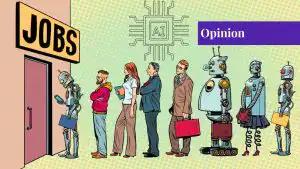
Job loss is among the most salient effects of the introduction of AI. The fact that AI can do many things at once, more accurately than human beings, has placed jobs at greater risk. History is evident that during periods of technological progress, the labor market is the foremost sector to be impacted. The introduction of smartphones put an end to landline operator occupations. Motor cars substituted the age-old tradition of animal usage for rides. AI has not only touched the middle-class profession but also ventured into the creative sectors of graphic design, music, etc. The Google music model ‘MusicLM’ is its best manifestation, where users can create, mix, and compose their own music compositions. As of 2020, the World Economic Forum released a report on the “Future of Jobs”, which announced that by 2025, approximately 85 million jobs will be lost around the world
- Education System
When ChatGPT-3.5 was made available to the public in 2022, students immediately used it for generating their assignments and for exam cheating. Excessive dependence on ChatGPT by the students may hinder their logical reasoning and problem-solving abilities. It can also impact students’ thoughts and writing skills because they totally rely on these GPT sites. Passivity and isolation are other disadvantages of AI. The students may prefer interacting with such GPT models more than with their peers and teachers, hindering their communication and psychological abilities. In academic writing and research, the danger of plagiarism will be evident, and AI content will gain prominence, resulting in academic cheating.
- Political Propaganda
“Artificial Intelligence can save democracy, unless it destroys it first.” (Slava Polonski, PhD)
The most perilous application of AI is its integration into political domains. Governments are now employing AI for analyzing public opinion, attracting their support through social media strategies integrated with AI. In 2016, when AI was not so prevalent, machine learning was applied in the Facebook-Cambridge Analytica data scandal. A large chunk of data on Facebook via machine learning was utilized to send various messages to various voters. Individuals were judged by their likes and dislikes, and the advertisements that locals could view were tailored to their personality. The 2016 US presidential elections, when Donald Trump was elected, and the Brexit referendum held in the UK were the most impressive examples of the first application of AI in politics.
- Misinformation and Deep Fakes
States, non-state actors, and even individuals are currently using AI platforms to mount false flag social media information campaigns, such as fake news articles, deep fake scripts, etc. As of 2025, India has produced numerous AI-generated images and videos of casualties assigned to Pakistan. Ever since the Pahalgam attack, to create a powerful narrative against Pakistan, Indian social media websites have posted false videos of humanitarian losses and blamed Pakistan for these atrocities. The EU Disinfo Lab Report (2020) is its strongest manifestation, which clearly revealed a 15-year-long media operation carried out by India against Pakistan by opening around 750 false media channels in 119 nations, defaming Pakistan worldwide.
- Ethical and Privacy Concerns
One of the most significant drawbacks of AI and GPT models is the misuse of these websites. A person with an anonymous identity can make a message, tweet, or video of a reasonable governmental figure, businessman, etc., to spread misinformation and emotionally charge individuals. As of 2025, amid tensions between Iran and Israel, a fake AI-generated video of US President Donald Trump saying that Pakistan will destroy Israel if Israel attacks Iran was shared on social media. Later, fact-checkers revealed that it was an AI-generated video of a Trump economics speech from 2016.
- Military Threat
Militaries of the world are now deploying AI-controlled conventional capabilities, which include targeting accurately with facial and body type recognition. All these military applications of AI are posing a severe threat to humanity. If malfunctions and errors happen, the AI platform may target innocents, resulting in a severe humanitarian crisis. As of 2024-2025, Israel has implemented AI military weapons in Palestine, particularly in Gaza and East Jerusalem. These consist of highly advanced AI systems, i.e., Gospel, Lavender, GPT, monitoring equipment, and AI-based drone mapping to track down Hamas operators in the region. These AI systems have slaughtered thousands of innocent Palestinians as a result of their flaws and malfunctions in clearly identifying Hamas operators and locals.
The use of AI and ChatGPT has been extremely helpful to humanity. But the darker side of GPT models could not be overlooked. As soon as possible, people should be made aware of AI. People must be taught about AI and its ethical and unethical applications. Not just hackers and spammers, but even known organizations might utilize these AI platforms to illegally make money. AI is the focus of the twenty-first century, and the future of politics, economics, and security depends on how quickly and steadily AI develops.
If you want to submit your articles and/or research papers, please visit the Submissions page.
To stay updated with the latest jobs, CSS news, internships, scholarships, and current affairs articles, join our Community Forum!
The views and opinions expressed in this article/paper are the author’s own and do not necessarily reflect the editorial position of Paradigm Shift.