
The 21st century is dominated by non-traditional warfare between nation-states. These tactics are transnational in nature in terms of their origins, conceptions, and effects. They include information warfare, propaganda, cyberattacks, and artificial intelligence (AI). These modern tools can alter and manipulate the public opinion and international prestige of one state over another. This is proven by the use of AI by Indian News Media operations.
In the context of South Asia, the regional hegemon, India, has now procured advanced and lethal technologies from the West, especially Israel. India’s conglomeration of conventional and non-traditional warfare tactics is a serious threat to South Asian security and stability. Following the current tensions between the two nuclear powers of the region, India is pursuing a policy of hybrid warfare against Pakistan. This hybrid strategy refers to the mixture of conventional and non-conventional warfare tactics, in which sometimes indirect violence is carried out against the adversary to sabotage the enemy’s weaknesses, while sometimes direct attacks are carried out. The use of AI and propaganda by Indian news networks has been raising red flags for quite some time now.
Historical Perspective: India as a Propaganda Expert
In the context of Pakistan and India, information warfare is not a new phenomenon. India has always used propaganda to gather immediate gain and support from the public against Pakistan and to create a sense of insecurity in the Pakistani public. During the 1965, 1971, and 1999 Indo-Pakistani wars, India had used radio broadcasts, television channels, and press briefings to depict a negative image of Pakistan. It declared its victory over Pakistan in the conflict.
The Indian film industry has always acted as a front warrior in this regard. Indian films and movies, including LOC: Kargil, Gadar: Eik Prem Katha, URI: The Surgical Strike, Shershah, Hindustan Ki Qasam, and Bell Bottom, are among the top listed pictures that were created to spread a completely false narrative amongst the Indian public against Pakistan. These films were centered around the ideas of Indian patriotism, Akhand Bharat, and exaggerated narratives against Pakistan. The fundamental idea behind such false media operations is to gather maximum public support in the name of patriotism, arousing public emotions and sentiments against Pakistan.
In addition to this, news broadcasting is one of the major sources of determining as well as manipulating public perception. In the meantime, India, especially under the administration of Prime Minister Narendra Modi, had launched various pro-BJP channels that work for religiously motivated content and in times of crisis, spreading false information and claims regarding Pakistan. The most prominent news channels include Republic TV, Zee News, Times Now, India TV, and FIRSTPOST.
Artificial Intelligence: A Part of Operation Sindoor
On 11 February 2025, Indian PM Narendra Modi, while addressing the AI Action Summit, stated, “AI is at the core of India’s vision for sustainable and equitable development. We intend to use AI not only for economic growth but also to boost our national security and digital infrastructure.”
This statement mentions the significance of AI for India’s national security. Following the alleged terrorist attack in Pahalgam, Indian-Occupied Kashmir, India accused Pakistan blatantly and immediately launched “Operation Sindoor” against Pakistan. India is executing this operation under its Land-Warfare Doctrine (2018), and the most important feature of this doctrine is the hybrid warfare against Pakistan. The use of non-traditional means of warfare, i.e., cyber threats, artificial intelligence, and propaganda settings, is at the core of modern Indian strategic thinking.

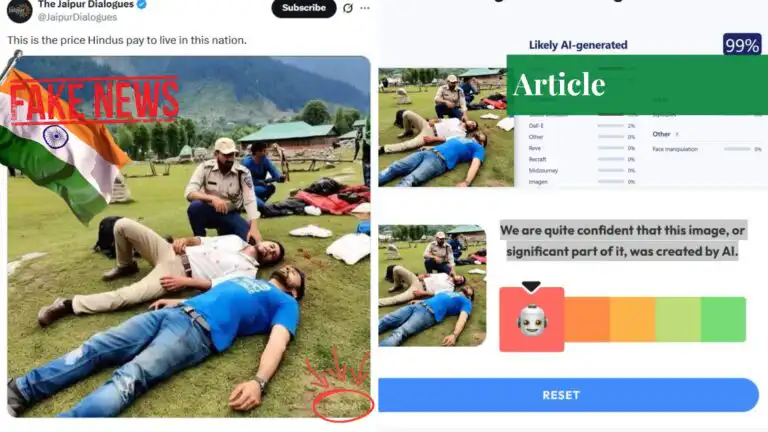
Along with the conventional attacks against Pakistan, India has created various AI-generated images and videos of casualties attributed to Pakistan. Following the Pahalgam attack, in order to generate a strong narrative against Pakistan, Indian social media platforms uploaded a dancing video of a couple and falsely linked it to its Naval Officer Vinay Narwal, who was portrayed to be killed by terrorists. Similarly, in the context of Operation Sindoor, various social media posts were showing an Indian attack on Pakistani-administered Kashmir and other territories, which were later declared fake.
Additionally, the Indian administration claimed that it had attacked terrorist camps in Pakistani-administered Kashmir. On 7 May, a video was shared on social media showing four major Indian attacks on Pakistani soil. Later on, it was confirmed that the video was actually of Israeli strikes on Gaza in October 2023. Moreover, to arouse the emotions of the Sikh population against Pakistan, Indian channels uploaded a fake video depicting attacks on Amritsar by Pakistan. Later, it was unveiled that the video was of a 2024 wildfire in Amritsar.
Dire Consequences of Information Warfare

Counter-Measures
Fact-Check Institutions

The states must establish robust fact-verification organisations such as PIB (India) and ISPR (Pakistan). These institutions are masters in reverse image verification, AI detection, deep forensic analysis, and configuration, which could prove beneficial, lowering public resentment and psychological pressures.
Detection of Artificial Intelligence (AI)

States must use software like Deepfake detection software to verify the content and detect any manipulation and alteration in images and videos. As the 21st century is dominated by social media, the associated platforms, including X, WhatsApp, or Meta, must use these detection and verification tools and instruments to lessen the proliferation of false flag media operations.
Ethical Regulations
International institutions must strengthen the enforcement of ethical codes of conduct regarding AI and information warfare. States must strictly abide by the rules, and specific social platforms, such as X, WhatsApp, YouTube, etc., should themselves remove sensitive and unauthorized information.
Regional and International Collaborations
As AI intrusion in information and propaganda warfare has created serious implications, regional entities and international institutions must forge partnerships to combat the non-traditional nature and unethical use of artificial intelligence. There must be vibrant confidence-building measures between states to ensure immediate intelligence sharing and reporting of false media news.
Civil Awareness
There must be awareness programs on the ethical use of AI at the grassroots level. In South Asia, the demographic is mainly dominated by youth (below 35), with 25% of the world’s population residing there. The governments must promote knowledge regarding non-traditional warfare via special courses and subjects included in the education curriculum of students.
If you want to submit your articles and/or research papers, please visit the Submissions page.
To stay updated with the latest jobs, CSS news, internships, scholarships, and current affairs articles, join our Community Forum!
The views and opinions expressed in this article/paper are the author’s own and do not necessarily reflect the editorial position of Paradigm Shift.

Syed Hammad Ali is pursuing a BS in International Relations programme from the International Islamic University, Islamabad, and has a keen interest in research works, policy analysis, defence and strategic studies, and conflict resolution.