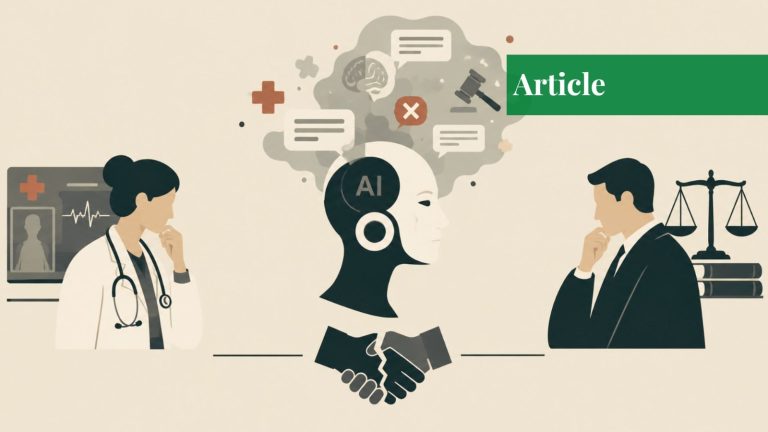
AI hallucinations are changing how we trust Google Search. Explore the risks of inaccurate AI answers in medical and legal queries and why verification matters.
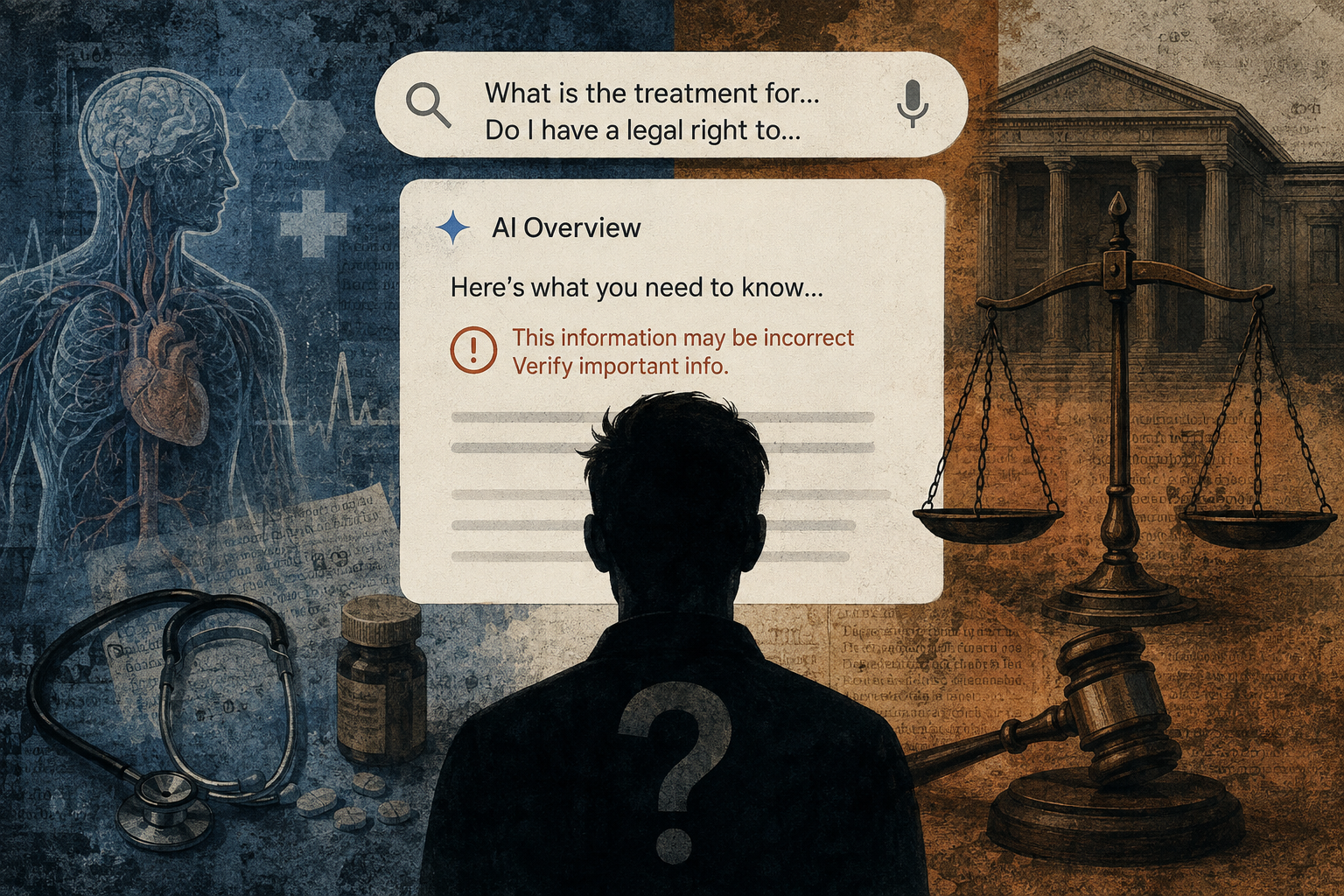
We have been hearing these two words for years: “Google it” has been one of the most common responses to uncertainty. Wherever and whenever we need to look something up, we use Google. Whether someone wants to look up the meaning of a word, find educational content, understand a medical symptom, check a legal term, find out what to do after an accident, or, in short, do anything, we can search on Google.
Google Search has become a gateway to information. Users get multiple website links, sources, and perspectives, and the responsibility of judging those sources largely remains with the reader.
However, Artificial Intelligence is now changing that relationship. At the top of many search results, Google’s AI Overviews place its AI-generated summary, while Google AI Mode makes that process easy and allows users to ask increasingly difficult questions and receive conversational answers. Besides these conveniences, Google itself acknowledges that these AI-generated summaries can make mistakes and advises users to verify important information through multiple sources.
In this situation, the problem is not that AI can be wrong, but humans can be wrong too. The way AI presents incorrect information in a confident, polished, and convincing way is a serious concern. When that happens in ordinary searches, the consequences may be insignificant. When the question concerns a diagnosis, medication, legal right, deadline, or court procedure, the consequences can be much more serious.
When an Answer Looks More Certain Than It Is
The technical term often used for these errors is “hallucination,” although the US National Institute of Standards and Technology uses the term “confabulation” to describe AI systems generating and confidently presenting false or erroneous information. NIST notes that such errors can be particularly dangerous in areas requiring substantial context and expertise, including healthcare and consequential decision-making.
This creates a subtle trust problem. A traditional Google search gives users a list of information to examine. An AI overview instead compresses that information into an answer. It is very easy to see why people love the convenience. However, I feel like something important gets lost along the way. We are losing the line between just finding facts and actually deciding what those facts mean to us. A user might read an AI-generated summary. Think that Google has already checked everything for them.
That assumption is risky.
A recent study in 2026 looked at more than 55,000 trending queries and 98,000 individual searches found in Google AI Overviews. The researchers found that 11% of the claims in the study were not actually supported by the pages cited next to them. Leaving out details was the most common problem. This finding does not mean that 11% of all Google answers are wrong. However, this finding shows a problem with thinking that a citation makes a Google AI-generated answer trustworthy right away.
Medicine Is Where the Cost of Being Wrong Becomes Personal
People mostly search for health-related sensitive issues when they are worried, confused, or unable to immediately access a healthcare professional.
In the age of Google AI Overviews, people get health information by developing mixed strategies using ChatGPT and Alexa.
Some users search their queries by including AI, while others prefer traditional results instead of AI and purposely skip Google’s AI Overviews. Users were especially worried about issues such as sourcing, trustworthiness, and the origins of information.
Moreover, some severe and concerning evidence has emerged from an audit of 1,508 pregnancy and baby-care queries published in 2025. Researchers found that information shown in Google’s AI Overviews and Featured Snippets was inconsistent in 33% of cases. Medical safeguards appeared in only 11% of AI overviews and 7% of featured snippets.
These findings matter because medical information rarely exists as a simple collection of isolated facts. I think advice can depend on a person’s age, their history, the medicines they take, the symptoms they have, when the symptoms started, and how bad the condition is. Advice that seems fine in one situation can become risky when the surrounding circumstances change.
In 2026, a Guardian investigation gave a real‑world example of this problem, showing that Google AI Overviews contained health information about blood tests, cancer‑related diet advice, and cancer screening, and that advice about health must be checked carefully. Google subsequently removed some health summaries following the investigation while maintaining that its systems were generally reliable and that improvements were ongoing.
The issue therefore extends beyond whether an AI answer contains a technically incorrect sentence. The larger question is whether a person can safely act on the answer without understanding what information is missing.
Even the World Health Organization (WHO) has already warned about the adverse effects of generative AI in healthcare on patients and public health, as it needs strong governance, human oversight, transparency, and attention to risks that could affect it.
Law Has a Different Kind of Problem
Legal searches create another form of risk because laws are not universal, permanent facts. These laws depend on jurisdiction, legislation, court decisions, dates, procedural rules, and the specific facts of a case.
A person searching “Can my landlord do this?” or “Do I have a right to appeal?” may receive an answer that sounds clear while overlooking the jurisdiction or an important exception. Google’s AI Overview can offer links. Someone who only reads the summary might never find the missing details.
Legal workers have already seen the results of relying on AI-generated information. In 2024, the American Bar Association released Formal Opinion 512, which says that lawyers using AI must know its limits and check AI-generated work for correctness. The advice clearly points out the danger of wrong legal sources.
The problem has not disappeared as AI systems have improved. A 2026 study examining legal hallucination detection identified more than 1,000 court filings containing fabricated citations and found that even newer AI systems continued to struggle with subtle categories of legal citation errors.
Google’s own AI search ecosystem has also become part of the legal accountability debate. In 2026, a German court made a ruling that Google is responsible for false statements made by AI Overviews. This happened because of a case where publishers were wrongly linked to fraud. This ruling is a deal for more than just this one fight. It makes people ask a bigger question. We need to know if an AI-generated statement should be treated differently than a search result when the search platform is the one making the AI-generated statement.
This is an important distinction. A traditional search engine can point users toward a false statement made somewhere on the internet. An AI overview can take information from several places, combine it, interpret it, and present a new statement in response to the user’s question.
The user may no longer feel that they are searching the web. They may feel that they are asking Google.
The Real Danger Is Not Hallucination Alone
It is tempting to treat hallucinations as a technical problem that engineers will eventually solve. Better models, better retrieval systems, stronger source ranking, and more effective verification can certainly reduce errors. However, accuracy alone cannot solve the trust problem.
A 2025 study on detecting AI hallucinations found that using web searches can help people find AI-generated information. However, the study also showed that how information looks can change how much people trust that information.
This means that the way a search experience is designed matters as much as the model itself.
If an answer shows up first, uses sure words, has many citations, and sits right inside Google Search, many users might think that answer is a final fact instead of looking for more details.
That is where the trust deficit begins.
Search Should Help Us Investigate, Not Decide for Us
Google has not hidden the limitations of AI Overviews. Its own guidance tells users that AI responses may contain mistakes and recommends checking important information in multiple places.
The problem is that a warning at the bottom of an answer may not be strong enough to counter the psychological effect of an answer appearing at the top.
The solution is not to reject AI search completely. AI can make complicated information easier to understand, help users identify useful sources, and make searching faster. The better approach is to change the role we give it.
For questions, information created by artificial intelligence should be seen as something to learn from at the beginning, not as a way to know what is wrong or what to do. For questions, it should be used to help someone understand words and know what to ask a real expert, not to find out about their rights or how to handle a legal problem.
The important thing is for people to ask a simple question before believing what an AI says: “What do I need to check before doing something based on this?”
That question shifts AI from an authority back into a tool. The future of search will not be defined only by how intelligent AI becomes. It will also be defined by whether people learn when not to trust it.
When the cost of a wrong answer is a missed deadline, a harmful medical decision, or a serious legal mistake, convenience is no longer the most important measure of a search engine.
Trust is.
If you want to submit your articles and/or research papers, please visit the Submissions page.
To stay updated with the latest jobs, CSS news, internships, scholarships, and current affairs articles, join our Community Forum!
The views and opinions expressed in this article/paper are the author’s own and do not necessarily reflect the editorial position of Paradigm Shift.

Hooria Akbar is an independent researcher and content writer with a strong interest in contemporary issues across AI, technology, society, and emerging trends. She writes research-informed articles, thought pieces, and blogs on a wide range of topics, aiming to present complex ideas clearly and engagingly for diverse audiences.