
How game modifications, software rebuilds, and agent-driven analysis are forcing a closer look at what protects a software product.
October 2026 has ignited curiosity in AI-enhanced reverse engineering, making the REA GitHub repository a hot topic for conversations regarding game modifications, application rebuilds, and particularly targeting software security. These projects raise a question that reaches beyond gaming: how much protection does a software product gain from the difficulty of understanding its implementation?
This article examines REA’s documented capabilities alongside a developer’s account of agent-driven game decompilation, the OpenCE Halo port, and PhotoCraft’s reimplementation of Photoshop-style functionality. It distinguishes verified project documentation from viral claims, particularly claims that unrelated projects were built using REA. The evidence supports a change in how software analysis and reconstruction can be organised, although it does not establish universal software cloning or the defeat of modern encryption. The paper argues that falling analysis costs could affect competition, maintenance and vulnerability discovery, with practical implications for Pakistan’s developers and institutions.
Why A Game Became A Bigger Question
“An AI did that.”
That is the appeal of the videos circulating around reverse engineering this October. Something familiar appears somewhere it should not: a game running on an unexpected platform, features borrowed from another title, an application resembling software people have paid to use for years.
The Halo–Modern Warfare 2 claim captures the reaction particularly well. Jaden Williams’s circulating video uses the prospect of Halo inside Modern Warfare 2 to move from excitement about games to anxiety about the software behind everyday life. His post is evidence of the conversation surrounding these projects. Establishing the technical details of the particular integration requires a developer’s account or inspectable implementation; the video’s argument cannot substitute for those records (Williams, n.d.).
Nonetheless, the question it presents calls for a genuine response. If agents are capable of assisting individuals in acquiring proficiency in proprietary software, what implications arise for products that previously required significant expertise for implementation?
REA, short for Reverse Engineer Anything, has become a recognizable name in that discussion. The name suggests a bold commitment. The more intriguing aspects lie beneath the surface: the tools it links, the information it provides, and the effort required to arrange everything.
The October wave deserves investigation on those terms. Dismissing it as another round of exaggerated demonstrations would miss the engineering taking place. Accepting every demonstration as proof that all software has become vulnerable would miss what the engineering actually shows.
Scope and Approach
This paper uses a qualitative documentary approach. It examines public project documentation available on 18 October 2026, including the original REA repository and its case studies, Maurice Heumann’s game-decompilation account, OpenCE’s documentation and PhotoCraft’s repository. OWASP guidance and the Advanced Encryption Standard provide technical reference points for the security discussion.
The cases were selected because they represent different activities being grouped together in the current debate: analysing existing software, reconstructing program behaviour, moving a game to new platforms and building an alternative application.
No independent benchmark or software audit was conducted. Project measurements remain their authors’ claims unless otherwise stated. Consequently, the paper evaluates what these records support rather than estimating a universal improvement in reverse-engineering speed.
What Rea Puts Within Reach
REA connects an agent to software-analysis tools through the Model Context Protocol. For native binaries, it can work with Hopper, Ghidra, or IDA. Its documentation also covers other targets, including JavaScript applications and .NET assemblies. The agent can request findings, follow references, and use the results to investigate behaviour or develop an implementation (Morluto, n.d.).
Consider a feature inside an unfamiliar desktop application. Finding the relevant code, tracing its callers and checking an interpretation can involve repeated movement between tools. REA provides an interface through which an agent can participate in that investigation. That makes the organisation of the work significant alongside the model’s ability to explain code.
Its published examples give this a concrete scale. One case reconstructs a sound-position calculation from the 1996 game DX-Ball, checking the resulting function against the original behaviour and its 63 compiled bytes. Another traces Notion’s clipboard handling through packaged JavaScript and interprocess communication. A third examines the calculation behind an aimed bullet ring in Touhou 4 (REA, n.d.).
These examples concern bounded questions. Their value is that a reader can see what was investigated and how the answer was checked.
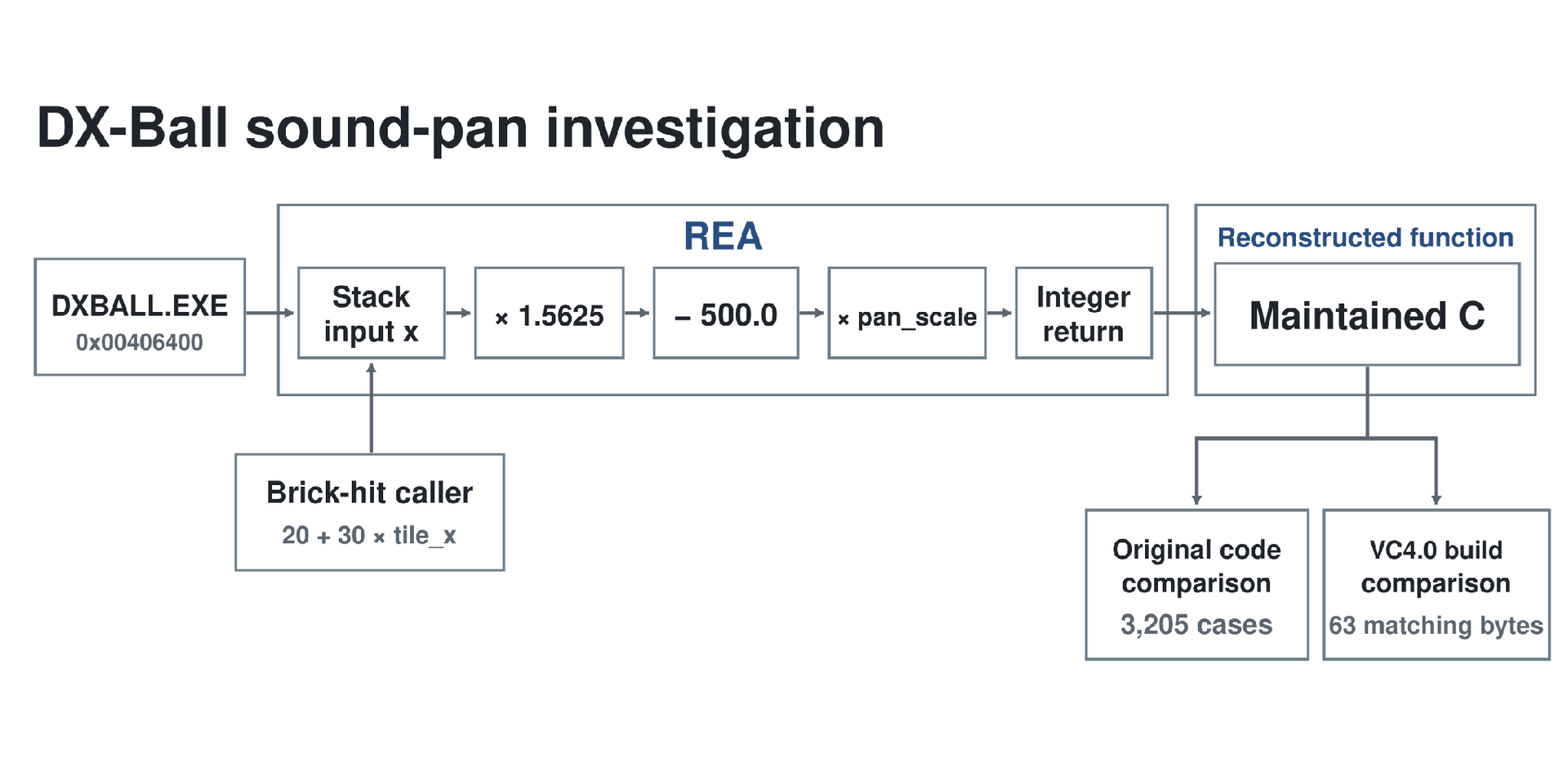
Source: REA / morluto, © 2026. DX-Ball case study · Project licence
They suggest a sensible change in the way economic analysis is done. Some of the trial and error can be shifted to tools by the developer, but they still have to select what to explore, and they have to assess whether it is trustworthy. Time savings depend on the program and the amount of corrections required. The existing examples do not offer a general rule for estimating the time reduction. This restriction is indicative of an important area for further research. Tasks that used to require lots of manual work can now be broken down into a series of uses of tools, hypotheses and automatic checks. In some cases, this could help make an otherwise impossible investigation more economical.
The Game That Ran Before It Was Right
Heumann’s account, published on 9 October, is especially useful because it describes failure alongside progress.
He reports spending approximately three months reconstructing a first-person shooter with agents using Claude Code and Codex. The analysis interface was Hex-Rays’ official ida-mcp, rather than REA. After the first month, the game could launch and load maps, yet the reconstructed code contained incorrect types, signatures, and invented logic.
The team introduced a comparison process using the original compiler to check reconstructed functions against the executable. Heumann eventually reported that 99% of functions were present and 83% were byte-exact. The code remains private, so those results cannot be independently reproduced from the published account (Heumann, 2026).
A game opening successfully is an impressive sight. It can also conceal a great deal. A working menu says little about whether an obscure calculation, unusual input or rarely used branch behaves correctly.
For the wider October discussion, this is an important finding. The achievement involved infrastructure, verification and repeated correction. Attribution matters here: assigning every October milestone to REA obscures the wider reality that multiple toolchains—including Hex-Rays’ ida-mcp and custom compiler-verification harnesses—are what actually enable agent-assisted reconstruction. The difficult question is becoming how to check their work at scale.
Halo And Adobe Belong In Different Parts Of The Argument
Halo provides a documented example through OpenCE. Its repository describes a port of a Halo: Combat Evolved decompilation to Windows, Linux, Android, and web browsers. It identifies the earlier projects from which that work descends and separates the program from the game data that users must supply (OpenCommunityEdition, n.d.).
That project demonstrates how reconstructed software can travel beyond its original platform. Its documentation also makes previous contributors visible. A browser window does not show that history, even though the result depends on it.
The options for preservation are many. Redesigning behavior is the ability for software programs to remain functional into the future when the environment may become inconvenient or unavailable. It can also make changes not seen by the original developer.
According to their website, PhotoCraft is an open-source Rust implementation of Photoshop-like functionality based on public specs and observed behaviour. Its library contains well-known editing tools and includes PSD support and clearly states that the application is still in the ‘early alpha’ phase and should not be used as a daily professional Photoshop application (storytold, n.d.).
The commercial question is nevertheless serious. Replacement software rarely has to match high-end studio standards on day one to siphon off market share. A university student touching up basic photos has fundamentally different demands than an agency delivering multi-layer print deliverables. Cheaper, agent-assisted builds naturally chip away at low-tier licenses first, even if enterprise clients stay put for support contracts, legacy compatibility, and institutional habit. Replicating behavior also leaves the legal hazard untouched. Generating functionally identical routines does not insulate a project from copyright disputes, since statutory protection covers non-literal expression, decompilation limits, and the provenance of the underlying source (World Intellectual Property Organization, n.d.).
Where The Security Argument Holds
The concern becomes more consequential when attention moves from creative software to services people cannot easily avoid.
A customer can stop playing a game. Losing access to a payment service, hospital appointment system, or public record can carry a different cost. It is reasonable to ask whether cheaper software analysis could make weaknesses easier to discover in those systems.
That concern does not require claiming that encryption has failed.
AES, for example, is specified in a public standard. Its design can be studied without giving the reader the secret key needed to decrypt protected information. Understanding an application’s instructions and recovering a cryptographic key are different technical accomplishments (National Institute of Standards and Technology, 2023).
The more immediate question concerns implementation. Where does a service decide that a user is allowed to perform an action? What happens if the request arrives through a modified client?
OWASP recommends checking permissions on every request and enforcing authorisation in a trusted location. A control that exists only in a user’s application cannot be relied upon to protect the underlying service (OWASP Foundation, n.d.).
Take a hypothetical payment application. Reproducing its screens would not entitle a person to transfer someone else’s money. A properly designed service would independently check the identity, permissions, and transaction. If it instead trusted a value supplied by the client, understanding that client could help expose the weakness.
The vulnerability would already exist. Faster analysis could reduce the time required to find it.
This is the security hypothesis worth testing. Researchers could compare how long human analysts, agents and combined teams take to identify known weaknesses in authorised test environments. They could record false findings, verification effort and the ability to reproduce results. That would produce more useful evidence than extrapolating from a game modification to the collapse of digital payments.
The benefits would also need measuring. Defenders can use analysis to investigate suspicious software, understand abandoned applications and locate defects. There is no reason to assume that improved tools help only attackers. Equally, access to a tool does not guarantee that defenders have the time or staff to act on its findings.
What Pakistan Should Take From October
For Pakistan, there are two practical questions: what can local developers build, and what can local institutions maintain?
The opportunity extends beyond producing copies of foreign applications. Understanding file formats and software behaviour could support compatibility tools, accessible interfaces, and applications designed around local users. A small team could target narrow, locally relevant workflows that large vendors ignore—such as reliable Urdu text shaping or performance on modest hardware—where real product viability depends on human testing rather than superficial interface cloning.
For educational institutions, the first useful exercise is not as drastic as purchasing another AI product. It’s all about setting up a system that can be fixed!
An organization should be able to determine who maintains an application, track its dependencies, and know where to look if a serious defect were found and how to fix it. Where those answers are missing, the difficulty of outside analysis offers little comfort. An institution that barely understands its own software is poorly placed to assess somebody else’s findings about it.
This is a proposed priority, rather than a finding that Pakistani institutions share one uniform weakness. A sector-specific study would be needed to establish the scale of maintenance problems.
Universities could contribute through authorised reconstruction and analysis projects. Students could investigate a bounded function, produce an implementation, and demonstrate how its behaviour was checked. Assessment would then reward evidence and technical judgement alongside the ability to operate an agent.
A stronger local software industry needs those skills. It needs people who can explain why a reconstruction is correct, identify where it remains uncertain and maintain it after the demonstration ends.
Conclusion
The REA discussion has drawn attention because its examples are easy to care about. People recognise the games. They recognise the editing tools. They can imagine what it would mean to change them without waiting for their owners. The broader irony of the present wave is that the digital companies that support rapid automation and staff reduction are not exempt from its structural consequences. The ability to reverse-engineer and rebuild software at machine speed commoditizes the application layer itself. The competitive advantage moves from merely possessing a closed-source interface to preserving dependability, backend trust, and user ecosystems that pure code generation cannot replicate when an AI can help replicate the very things that sponsored its creation. The available evidence supports several developments: agents participating in binary analysis, reconstructed games reaching new platforms, and alternative applications being built around familiar workflows. The methods and maturity differ. Treating them as one universal cloning achievement would make the research less accurate and the implications harder to understand.
The most defensible concern is that the cost of examining software may be falling for particular tasks. That could open projects previously beyond the resources of small teams. It could also expose businesses and institutions that have relied too heavily on other people finding their software difficult to understand.
October’s demonstrations have made that possibility visible. The next test is whether developers can reproduce the results, measure the effort, and turn the findings into software that survives ordinary use.
If you want to submit your articles and/or research papers, please visit the Submissions page.
To stay updated with the latest jobs, CSS news, internships, scholarships, and current affairs articles, join our Community Forum!
Find our FREE quizzes and MCQs here!
The views and opinions expressed in this article/paper are the author’s own and do not necessarily reflect the editorial position of Paradigm Shift.

Inayat Arshad is an AI researcher and engineer based in Islamabad, holding a BS in Computer and Information Sciences from PIEAS. Her work focuses on low-resource language technologies, where she develops open-source tools and foundational datasets to bridge critical digital divides for underserved communities, particularly Urdu-speaking populations. Additionally, she specializes in multilingual AI safety and explainable machine learning, working extensively to make modern AI systems equitable, transparent, and trustworthy. Outside of engineering, she is an avid reader of classical literature and existential philosophy.