The U.S. Commerce Department ordered Anthropic to terminate worldwide access to its two most sophisticated AI systems on 12 June 2026, citing national security concerns. The government stated these systems were too advanced and ran the risk of being exploited by foreign nationals employed by U.S. companies. Due to the absence of adequate tools to distinguish American customers using the product from other customers globally, both models were taken offline throughout the globe within a few hours after the order was received.
One day later, a relatively obscure Chinese company in the tech community but virtually unknown to the vast majority of the public released GLM-5.2, a rival to Anthropic’s technology, and made it publicly available, free of charge, along with the source code containing detailed technical specifications regarding the development of GLM-5.2. Eighteen days after the Anthropic models were deactivated, the United States government rescinded its order and allowed Anthropic’s advanced models back online.
One should take time to consider the eighteen days indicated above as a single event where nearly all of the issues involved in the US-China artificial intelligence competition occur. This does not just tell a story of which country has more advanced technology. Instead, it tells of the fundamentally divergent theories of how technology works and, at the same time, of the United States learning that there are limitations on its ability to set rules unilaterally.
Two Different Theories of Power
Measurement of the US-China AI competition has frequently relied upon counting. Examples include counting the number of advanced chips each country produces, data center size, or model scores on standardized tests. Based on all aspects of measurement cited here, the US continues to lead China. In addition, the US continues to dominate what is referred to as the Frontier — a small number of the highest-performing AI Models worldwide. A recent report from Epoch AI states that the US company Nvidia manufactures close to 50% of the world’s installed base of AI chips and approximately 65% of the usable computer capacity; in contrast, Huawei remains the closest competition to Nvidia among domestic Chinese chip manufacturers, yet lags with respect to raw performance and therefore must expend significantly greater amounts of energy than Nvidia.
When you consider the chips as the whole game, you are counting them as you count them. Many detailed analyses have been conducted and published up to June of 2026, including a very extensive analysis by the Brussels-based research and public policy center Bruegel, which shows that the competition is not just about hardware but also about the software layer that will allow anyone to use the hardware. Nvidia’s continued dominance in the marketplace stems from providing the software package CUDA as a free product, locking an entire generation of developers to their hardware platforms. On the other side of the coin is Huawei’s approach, which is the complete opposite of Nvidia’s; Huawei has developed and released its CANN software package as an open-source project and has also developed a plugin that allows developers to utilize their current development tools without interruption while switching to Huawei chips in the backend of their applications. Although this war is less expensive and has less visibility than the Chip War, it may have a greater impact because it will determine whether future generations of engineers from Lagos to Jakarta to Karachi will, by default, use either American or Chinese platforms as the basis for their work products.
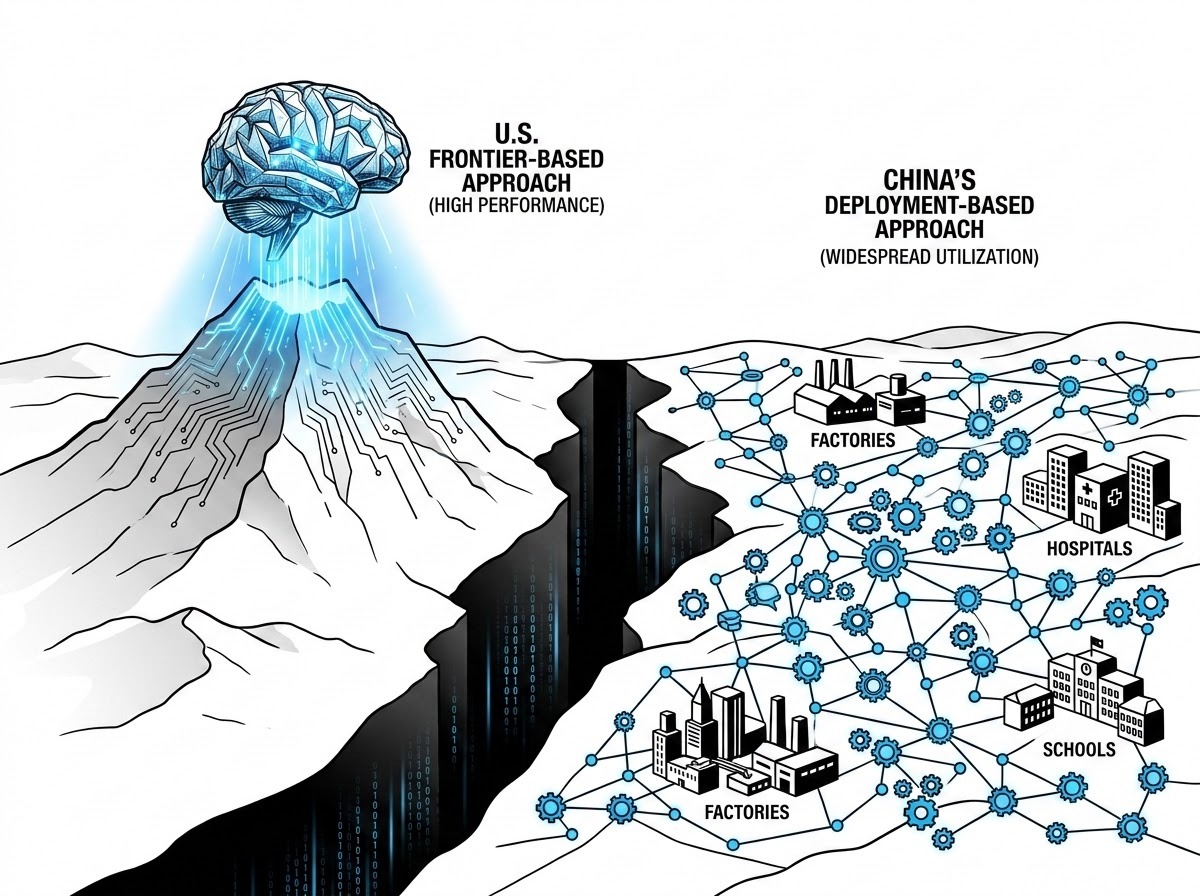
Separate from the terminology used to describe the distinction between “frontier” capabilities and “day-to-day” utilization of these frontiers (i.e., “transitional”), this distinction is the basis of the analyst’s assumption that two different methods will produce competing advantages in Washington’s “frontier-based” approach and Beijing’s “deployed-based” approach. Washington’s “frontier-based” approach advances the view that by attaining technological superiority, Washington will ultimately achieve a broader strategic advantage. In contrast, there is now an increasing number of analysts, such as Emanuele Rossi in recent articles published in India Narrative, who report that gainful deployments of adequate technological assets throughout factories, hospitals, universities, and governmental institutions will ultimately produce greater benefits than having the best technology in only select locations.
The Cheap and the Many
China’s strategy for advancing AI is mainly driven by financial motives rather than ideological motivations. After DeepSeek introduced its initial models, many Chinese companies adopted an approach centered on developing models that are sufficiently effective and priced so competitively that cost is no longer a decisive factor for most users.
Research by the Mercator Institute for China Studies (MERICS) indicates that, by late 2025, downloads of Chinese models on the open-source platform Hugging Face had surpassed those of American models. According to current data, seven out of the ten highest-rated models in the open-weight category (by performance) are from China. Some companies in Silicon Valley have been using Chinese models for simple, large-volume tasks, while American ones are used for difficult, low-volume work at significantly higher prices.
In conclusion, this method of operation does not primarily aim to achieve the best performance in benchmarking competitions but aims to obtain market share prior to making any profits (i.e., expecting to create a lasting market through extensive use). It is similar to how a currency develops significance based on whether or not it has widespread use, as opposed to intrinsic characteristics or who or what issues it.
The Case for Staying Closed
The main argument against the United States is based on the trade and security issues associated with these companies’ operations. Anthropic’s position paper states that limiting access to the most advanced AI systems is driven by safety rather than economic competition. Anthropic’s paper states that there is research showing that potential malicious requests for open-weight models from China outnumber requests for American models, especially when using techniques to circumvent security measures like jailbreaking. Once an AI model’s weights are made accessible to the public, anyone who downloads the model can bypass any pre-existing security measures and have access to significant technological capabilities as either a government or a non-governmental entity.
Nevertheless, an essential limitation is the need to recognize the fact that Anthropic is not a neutral or independent player in this scenario. Being an American company, Anthropic’s commercial interests are in keeping export controls in place, as well as maintaining an American-led global intelligence and defence system for AI technology.
The broad Export-control policy in the global market may hinder the ability of American technology to create innovative technologies, if they result in greater independent Chinese AI, as a result of excluding China from being a player in the American technology ecosystem (Nvidia’s Chief Executive Officer, Jensen Huang), stating that “the more you restrict China from participating in our ecosystem, the greater the opportunity you provide for them to create their own independent solutions..” The 18-day stop on the wall of Fable and Mythos gave added support to this position, as the removal of those two products allowed Chinese companies to demonstrate to potential customers the availability of American AI to a limited number of users, while Chinese AI can be made available to the entire globe. This message is particularly appealing to both low-budget developers and governments within the Global South who, by comparison, would have little chance of having access to the most-up-to-date American models or products.
An Old Question, Asked Again
In 1969, Joseph Needham raised the famous Needham Question to explain why Europe, not China, became the site of the Industrial Revolution, even though China was historically a leader in technological and scientific advancements. A contemporary academic investigation is now being conducted about how China is moving away from stagnation and into a period of renewed creativity. In the current context, researchers are attempting to understand how China has achieved its current growth rate and questioning the previously held belief that China’s growth was purely the product of adopting Western technology. It is important to understand that there is currently no evidence to suggest that there will be a predetermined victor in this competition at some point in time. In his influential historical work on imperial overstretch and the decline of great powers, Paul Kennedy provides valuable historical insights into the nature of declining great powers, which often result from domestic institutions’ inability to adjust to their respective societies’ changing expectations, rather than from external competition. As such, no long-term predictions can be made about either the United States or China experiencing failure. Thus, when making predictions about either country’s future path, it is also wise to consider each author’s level of expertise with regard to their respective research area.
If you want to submit your articles and/or research papers, please visit the Submissions page.
To stay updated with the latest jobs, CSS news, internships, scholarships, and current affairs articles, join our Community Forum!
The views and opinions expressed in this article/paper are the author’s own and do not necessarily reflect the editorial position of Paradigm Shift.
Talha Arshad is an undergraduate student of International Relations at the School of Politics and International Relations (SPIR), Quaid-i-Azam University, Islamabad. His writing focuses on great-power politics, with a current emphasis on the strategic dimensions of the US–China technology rivalry.