

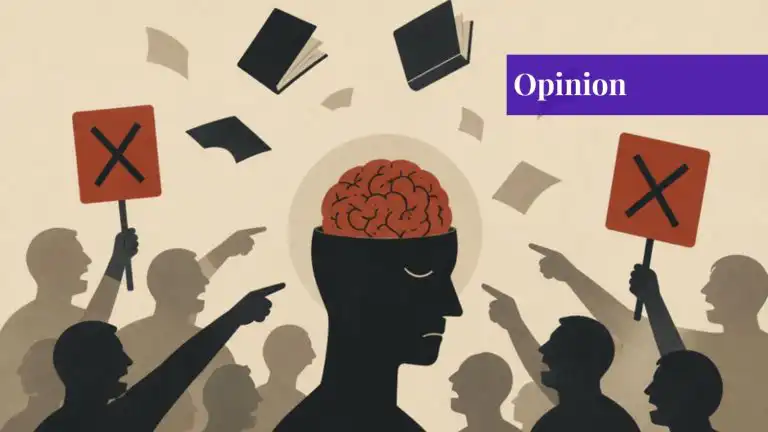
From the beginning of recorded history, there have been people who denied basic concepts like the earth revolving around the sun, or time being linear, or even the fact that a full day-night cycle is 24 hours. Different time periods classified these people into categories like cultists, extremists, wackos, philistines, illiterates, or—less formally—into wackos or nut-jobs. Now, in this day and age, there is a more centralized word for it—an anti-intellectual.
Renowned American author Richard Hofstadter describes anti-intellectualism as “a resentment and suspicion of the life of the mind and of those who are considered to represent it; and a disposition to constantly minimize the value of that life.” In simpler words, an anti-intellectual is a person who denies logic and champions common sense, with the notion of ignorance holding the same value as knowledge.
This notion is once again gaining traction as everything becomes accessible to the newer generations online. The younger generations are falling into the traps set by technological oligarchs, who continue to grow their wealth from the vulnerability of their youth—turning a blind eye to the massive adverse affects of the system they set up—including the misinformation being spread—leeching off of the dependence of vulnerable minds; similar to the forces mentioned in revolutionary dystopian works such as The Hunger Games trilogy by Suzanne Collins, and 1984 by George Orwell. In both of these works, one of the common themes is media censorship. We can already see this taking place in the real world, as 1984, which used to be required reading in many parts of the US, is now slowly being buried and banned in areas of the country. It doesn’t take a genius to put together why.
Speaking specifically about 1984, independent feminist associations and common people in general are also looking to ban which in my opinion is a pure by-product of anti-intellectualism at work. People choose to ignore the main—very progressive—theme and message of the book and focus on the fact that Winston, the main character, made misogynistic remarks about another prominent character, Julia. What irks me about this is that people are unintentionally applying the notion of “my ignorance trumps your logic, that is commonly seen in anti-intellectuals. Calling Orwell a misogynist because his character demeans a woman’s character in a political commentary not only sets feminists back since it portrays women as shallow and not intelligent enough to grasp the complexity of the book, but it also adds more substance to the plea of the right-wing dignitaries that want to ban the book altogether.
Moving forward, the anti-intellectualist mindset is also fed by the use of modern generative AI being available and promoted to children or teenagers who don’t know any better than to use it. It is very depressing that this has to be mentioned.

The very skill of critical thinking is depleting in humans worldwide, and the perpetrator at fault is no other than AI, and the tycoons behind it. “Why would anyone think for themselves when they have an unpaid service to do it for them, without any consequences in the foreseeable future?” This shallow thought is promoted in advertisements globally, but since when did any service come without its faults and flaws? Other than the significant effects on the environment and climate of the world, AI also harms people’s individual selves. Around 40% of the university graduates in the US—the most AI-dominated country in the world at the moment—remain unemployed since the job market continues to crash and prominent positions are given away to AI, creating resentment and, as a result, more and more people begin to go down the anti-intellectualist route, since knowledge and common sense seem futile and unfeasible. This thought creates the eventual feeling that logic in itself is the issue, that conventional logic is illogical. To the sane mind, this impression sounds erratic and the product of a crazed consciousness, but how do you teach logicality to a person who has given up intellection as a whole?
The lack of logic in a person can also stem from resentment of other kinds as well. People fear sociopaths, but they rarely try to think of what made the sociopath unfeeling. People judge the anti-intellectual, but they rarely try to put together what makes someone reject something that comes naturally to most. Anyone who doesn’t fit the boxes of what is considered normal is immediately kicked out of the circles of humanity, but who even gets to decide what is considered “normal” or not? Instead of re-assimilation, we choose to discard anyone who doesn’t check all our boxes. Is that blind ignorance not anti-intellectualism as well? Or is the concept of intellect to be decided by some elitists who don’t fit society’s boxes either, except they get a pass since they are the good kind of eccentric, the one that entertains the masses, who have nothing better to do but to watch. This tactic stems all the way back to ancient Rome, when Juvenal coined it as a metaphor satirically calling out the shallowness of both the common people and the emperors of Rome in the words, “Give them bread and circuses and they will never revolt.” The main phrase ‘panem et circenses’ went on to become a commonly known phrase and a metaphor for political manipulation through superficial pacification. Juvenal lamented that the Roman people, who previously held immense political power, had willingly abdicated their civic responsibilities in exchange for free grain and lavish entertainment.
Keeping all of these perspectives and points in mind, I must ultimately conclude this discourse. In the words of Dostoyevsky: “It takes something more than intelligence to act intelligently.” So, with that in mind, I urge you, dear reader, to act intelligently and not trip into the snares set by the Coriolanus Snows and Dr. Gauls of our generation.
If you want to submit your articles and/or research papers, please visit the Submissions page.
To stay updated with the latest jobs, CSS news, internships, scholarships, and current affairs articles, join our Community Forum!
The views and opinions expressed in this article/paper are the author’s own and do not necessarily reflect the editorial position of Paradigm Shift.
Maryam Razi is a 14-year-old girl studying in O levels. She likes reading about political fantasies, literary fiction, and historical fiction. She thinks it needs to be highlighted, especially to the youth.