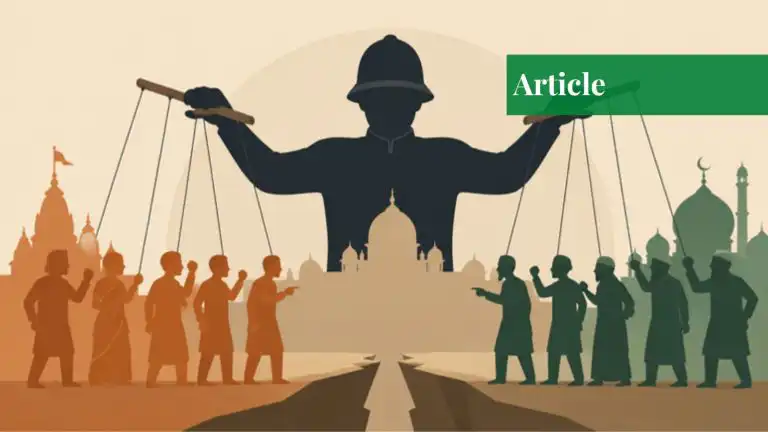
“The most potent weapon in the hands of the oppressor is the mind of the oppressed.”
– Steve Biko
Empires do not endure through brute force alone. They endure through something far more insidious — the art of making the subjugated destroy one another. Nowhere was this dark alchemy practiced with greater cold-blooded virtuosity than in colonial India, where the British Crown, confronted with a civilization too vast and too tenacious to hold by bayonet alone, chose instead to corrode it from within. What followed 1857 was not merely political administration. It was a calculated, decades-long psychological operation against an entire subcontinent.
The failure of the War of Independence left Hindus and Muslims disoriented — but not divided. That division had to be manufactured. And the British knew precisely how to manufacture it.
A Unity That Terrified the Empire
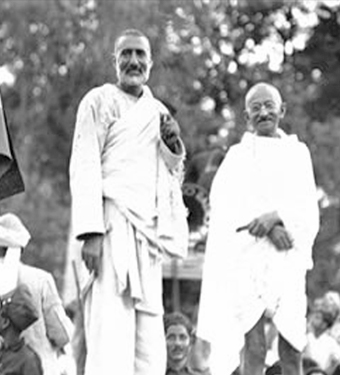
The proof of Hindu-Muslim solidarity lay not in sentiment but in action. When Bengali indigo farmers revolted in 1860 against the barbaric forced-labor system of plantation landlords, they did so together — Hindu and Muslim shoulder to shoulder, repelling hired thugs, routing police detachments, and ultimately bringing the entire indigo economy to its knees. The landlords capitulated. The factories shuttered. Peasants wrested themselves free from bonded servitude. To London, this spectacle was not inspiring. It was catastrophic. A unified peasantry had defeated imperial economic interests through sheer collective defiance. The lesson was absorbed at the highest levels: unity among Indians was an existential threat to British dominion. It had to be severed — permanently.
The formula was neither novel nor subtle. Convince each community that the other is its true adversary, its ancient robber, its existential menace. Let suspicion do what armies cannot. The British, however, faced a peculiar arithmetic: Hindus constituted a sweeping majority. Simply stoking present-day grievances was insufficient. The colonial strategists reached, instead, into history — and proceeded to mutilate it.
Forging a Counterfeit Past
Persian chronicles from the Mughal era were subjected to brazenly tendentious translations, riddled with interpolations and fabrications. Certain rulers — Aurangzeb above all — were selected for vilification, their records distorted into caricature. The History of India as Told by Its Own Historians, one of the period’s most widely circulated colonial texts, declared that Muslim rulers had enslaved Hindus en masse, imposed wholesale conversion, and reduced an ancient civilization to rubble.
It was a fiction of breathtaking audacity. As Bipan Chandra and his co-authors meticulously establish in India’s Struggle for Independence (1988), the reality was irreducibly complex. Muslim peasants were as destitute as Hindu peasants. Hindu and Muslim rulers coexisted across hundreds of princely states. The epoch was not a religious war — it was a political patchwork of competing kingdoms, alliances, and local loyalties. But the colonial historian demanded a simpler, more combustible narrative: all Muslims were oppressors, all Hindus their victims, and British rule a providential deliverance from centuries of bondage.
To mirror this provocation among Muslims, W.W. Hunter published The Indian Muslims in 1871 — ostensibly a sympathetic diagnosis of Muslim educational and economic backwardness, but in substance a calculated insinuation: that Hindus were advancing while Muslims were being left behind, that Muslim identity required defensive consolidation, and that alliance with the British was the only bulwark against Hindu dominance. Sympathy as a scalpel. Concern as a crowbar.
Literature in the Service of Sedition
Ideology required cultural amplification. The colonial project found its most potent literary instrument in Bankim Chandra Chatterjee’s Anandamath (1882) — a novel whose historical fabrications were as deliberate as its communal incitements. It depicted a Hindu militant fraternity waging war against a Muslim ruler in 18th-century Bengal, burning settlements, and chanting eliminationist slogans. The novel’s foundational premise was fraudulent: the Muslim ruler it portrays had died years before the novel’s supposed setting, and Bengal at that time was already governed by the East India Company. There was no Muslim administration left to revolt against.
But Anandamath’s most revealing passage was its ending — where a Hindu elder counsels his followers to cease resistance, embrace British governance, and wait until Hindus accumulate sufficient civilizational strength. The colonizer, in this text, was never the antagonist. The Muslim was. The novel, wittingly or otherwise, had internalized the British divide-and-rule blueprint so thoroughly that it advocated for British rule as the precondition for Hindu renaissance.
Its cultural legacy proved catastrophic. Right-wing formations hardened on both sides. Hindu extremists, absorbing the imperialist historical framework, began venerating foreign plunderers like Mahmud Ghaznavi and Ahmad Shah Abdali simply because Muslim counterparts, stung by the relentless demonization of their past, claimed the same figures defensively. A mirror-image lunacy consumed both communities.
Peaceful Movements Weaponized
The Arya Samaj’s Gauraksha campaign — originally a reformist, non-violent effort to protect cattle considered sacred in Hinduism — was progressively seized by hardliners after the death of its founding leader Dayananda Saraswati in 1883. Under the zealots Pandit Guru Dutt and Pandit Lekhram, it became a vehicle for communal provocation. Pointedly, the mass slaughter of cattle in British military cantonments attracted no agitation whatsoever. The campaign’s fury was reserved exclusively for Muslim communities that sacrificed cows. Muslim right-wingers, predictably, declared that any concession on the matter amounted to capitulation. The spiral of mutual provocation had its inevitable terminus in the riots of 1893 — erupting in Azamgarh, spreading from Bombay to Rangoon, consuming over a hundred lives, most of them blameless men and women with no stake in the ideological combat being prosecuted in their names.
The behavior of British administrators throughout these convulsions was striking in its studied negligence. Anti-colonial protests were crushed with immediate, ferocious severity. Communal carnage was permitted to burn. The asymmetry was not institutional incompetence. It was policy.
The Language Conspiracy
Even the quotidian act of writing was conscripted into division. Hindi and Urdu, mutually intelligible in speech across the North-Western Provinces, diverged only in script — Devanagari and Persian, respectively. The British declared Urdu the sole official language of the province, provoking furious Hindu mobilization for Devanagari recognition. When parity was eventually conceded, the damage was irreparable. Two scripts had been branded as the exclusive possessions of two religions. A linguistic inheritance shared across centuries was amputated along communal lines in a single administrative generation. The Supreme Court of India, dismissing a petition as recently as this decade demanding the removal of Urdu from a Maharashtra municipal signboard, was compelled to restate the obvious: Urdu is an Indo-Aryan language that evolved organically on Indian soil, indistinguishable in origin from Hindi and Marathi. The colonial wound, however, refuses to close.
The Indicted Real Criminal
While Hindus and Muslims bled each other over sacred animals, competing scripts, and falsified histories, the machinery of actual plunder ran unimpeded. Indian soldiers died in British wars across three continents, their campaigns financed from Indian revenues. Legislative assemblies were ornamental facades; real power resided with the colonial administration and its allied landlord class. The Indian economy was systematically cannibalized for metropolitan enrichment. None of this galvanized the communal factions, because their hatreds had been precisely calibrated — pointed inward, at each other, rather than upward, at the colonizer who had engineered those hatreds in the first place.
This is the testimony history bequeaths us: sectarian hatred is rarely spontaneous. It is cultivated. It is seeded in falsified textbooks, amplified through communal legislation, and harvested in blood by those who profit from the division of the dispossessed.
The subcontinent still lives inside this inheritance. Recognizing its architects is the beginning of escaping them.
“He who controls the past controls the future. He who controls the present controls the past.”
– George Orwell, 1984
If you want to submit your articles and/or research papers, please visit the Submissions page.
To stay updated with the latest jobs, CSS news, internships, scholarships, and current affairs articles, join our Community Forum!
The views and opinions expressed in this article/paper are the author’s own and do not necessarily reflect the editorial position of Paradigm Shift.

Mohamin Zeeshan is a scholar of International Relations at the National Defense University, Islamabad.