

Strip away the myth, the metaphor, and the centuries of longing written into our literature about the stars, and what remains is this: space is not hostile or indifferent in any poetic sense. It is something colder than hostile. It is physically, categorically unforgiving, a vacuum where thermal extremes and radiation define the environment, as NASA notes in its thermal-vacuum testing and space-physics explanations. The literary imagination has long tried to make sense of this ambition.
The void offers nothing (or it does, but let’s leave this for the future), yet it demands everything. To leave the cradle of Earth is to confront the stark, terrifying fragility of the human condition. We engineer machines of immense, violent power simply to keep our soft, breathing bodies alive in a space where life is an anomaly.
Jules Verne envisioned the moon long before human hands ever touched its dust. Conrad understood how any true voyage outward eventually becomes a journey inward. Space carries that exact weight for me. It represents a mirror for our ambition, our restraint, our search for meaning. The sky is entirely indifferent to us. We push upward because something restless inside us refuses to remain small.
Artemis II
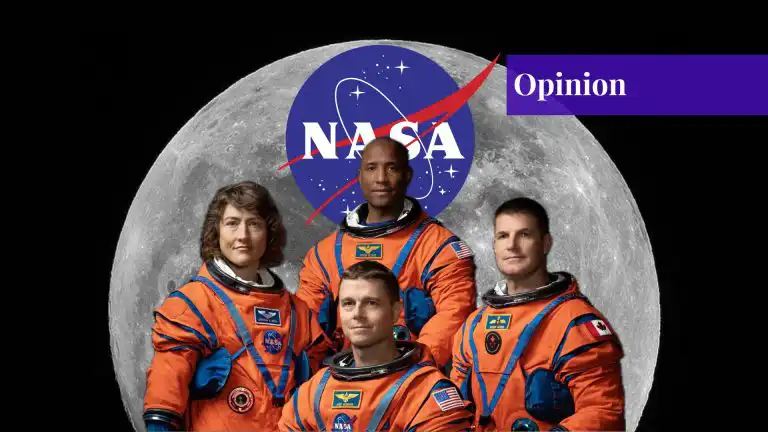
We see this forward motion now with Artemis II. NASA launched this ten-day lunar flyby from the Kennedy Space Center on April 1, 2026. Reid Wiseman, Victor Glover, Christina Koch, and Jeremy Hansen are currently out there, flying the first crewed mission of the SLS rocket and the Orion spacecraft. They are not dropping down to the surface. They are out there to prove a more fundamental reality. They are showing how human beings can survive, work, navigate the deep void, and safely return.
This separates Artemis from Apollo. The Apollo era spoke a language of conquest suited to a fading century. Artemis relies on patience, architecture, and careful rehearsal. We are moving past the fleeting triumph of flags and footprints. We are slowly engineering the conditions for a lasting return. By testing life support, thermal control, propulsion, and manual piloting, this crew lays the groundwork for our next great expansion into the dark.
The deeper story lives inside this quiet discipline. Artemis II steps away from the old, dramatic spectacle of exploration. It is technical, measured, and deeply humble. The future belongs to systems that refuse to fail and to machinery capable of holding human fragility in a vacuum where fragility should logically perish. This mission acts as our necessary bridge toward a sustained lunar presence, looking further out toward Mars, as claimed in the Washington Post.
The Planned Journey
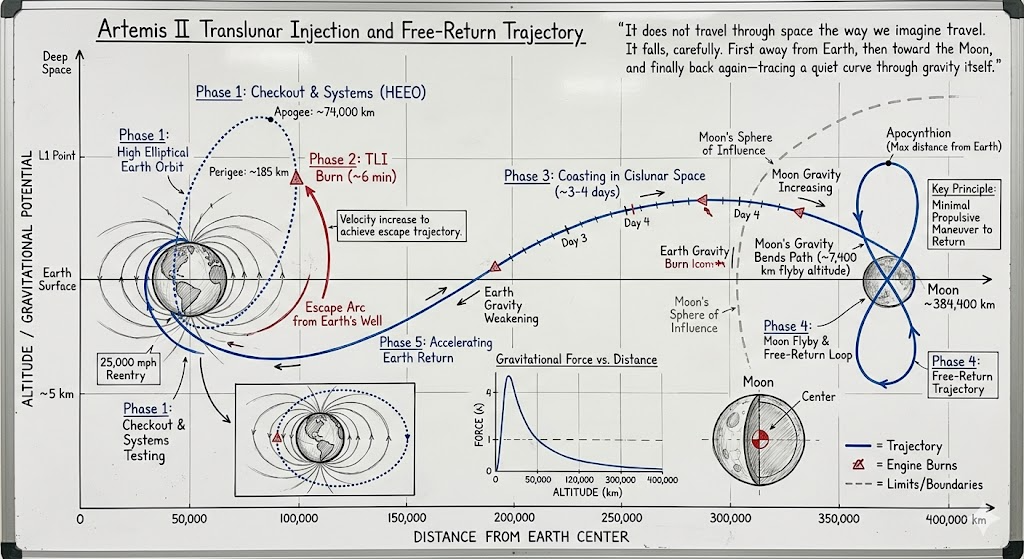
So, let’s understand how this mission will unfold. We look at the mechanics of the Artemis II flight path. It does not travel through space the way we imagine traditional travel. It falls, carefully. First away from Earth, then toward the Moon, and finally back again—tracing a quiet curve through gravity itself, as if the void were not empty but structured and waiting.
Phase 1: High Elliptical Earth Orbit (HEEO)
The journey begins with an elliptical orbit reaching about 46,000 miles. This isn’t just a holding pattern; contrarily, it is a vital checkout phase. Before the crew leaves Earth’s immediate grasp, they test the life support and communication systems that will soon be their only lifeline.
Phase 2: Translunar Injection (TLI)
To break away, the Orion spacecraft performs a roughly six-minute engine burn. The voyage does not go in a straight line, but rather it’s a curved escape arc. Think of it like being pushed out of a deep gravity well rather than being launched across a flat surface.
Phase 3: The Cislunar Coast
After the TLI, the engines go silent. For three to four days, the crew coasts through cislunar space. Here, the physics are governed by a delicate handoff: Earth’s gravity gradually weakens while the Moon’s gravity begins to take over. This is a long, stretched curve—a precisely calculated drift.
Phase 4: The Free-Return Trajectory
This is the most elegant part of the mission architecture. Orion follows a “figure-eight” path. It loops around the Moon, using lunar gravity to bend its path back toward Earth without needing a major engine burn. This is orbital mechanics used as a safety net. If a system fails, the physics of the universe itself ensures the crew returns home.
Phase 5: The Reentry
Earth’s gravity eventually draws the capsule home. Orion reenters at about 25,000 miles per hour, and the heat shield must withstand surface temperatures that can reach roughly 5,000°F, making this the final test of the spacecraft’s ability to protect the crew from reentry’s violent energy.
A quiet beauty exists in this method. Humanity is choosing the strict ethics of return over the mere romance of arrival. Humanity is trading the fantasy of escape for the heavy seriousness of preparation. Artemis II stands as a living proposition. It argues that humanity remains capable of monumental, enduring projects. We can still look past our immediate anxieties toward a vastly larger horizon. After centuries of silent observation, the Moon continues to teach us about discipline, courage, and the beautifully unfinished nature of our species.
If you want to submit your articles and/or research papers, please visit the Submissions page.
To stay updated with the latest jobs, CSS news, internships, scholarships, and current affairs articles, join our Community Forum!
The views and opinions expressed in this article/paper are the author’s own and do not necessarily reflect the editorial position of Paradigm Shift.

Mohammad Zain is an International Relations student at NUML, Islamabad. With an associate degree in English Literature and Linguistics and a BS in International Relations, he brings a unique blend of analytical and literary skills to his writing.