India’s Cautious Approach to China and Taiwan
Beijing’s readout that India’s external affairs minister told Wang Yi that “Taiwan is part of China” is best understood as pressure through narrative, not a genuine shift in Indian policy. New Delhi has cultivated deliberate ambiguity on One-China for fifteen years while tightening defense links with US partners in the Indo-Pacific. It will keep hedging: avoid public endorsement of Beijing’s formula, deepen security ties with Manila and others, maintain trade and quiet channels with China, and leave Washington’s containment debates to Washington.
China’s foreign ministry framed the July 2025 meeting in Beijing as a diplomatic gain, stating that Subrahmanyam Jaishankar affirmed Taiwan is part of China. Indian officials immediately said there was no change and pointed to the standard public line: India’s position remains consistent and requires no fresh reiteration on cue. As per contemporaneous reporting, New Delhi did not confirm Beijing’s phrasing. That contrast, familiar in India-China diplomacy, tells its own story.
History matters. Since December 2010, India has largely stopped writing explicit support for “One China” into joint statements, a quiet adjustment born of accumulating frictions on visas, the boundary, and Tibet. Indian outlets noted the omission at the time and have treated it as the new baseline rather than an aberration. In other words, India neither abandons its long-standing recognition policy nor gives Beijing an easy public endorsement for use against third parties.
This posture sits alongside cautious engagement with Taipei. India and Taiwan keep de facto offices, grow trade, and explore talent and technology links. Beijing protests even modest steps, such as the opening of an additional Taiwanese office in India. Yet there is no authoritative evidence that India has sold weapons to Taiwan. New Delhi has avoided that red line while letting economic and cultural ties thicken. According to Reuters, China continues to warn India to “handle Taiwan-related matters cautiously,” which only underscores how sensitive even low-key moves remain.
Building Alliances in the Indo-Pacific
Contrast that restraint with India’s defense ties to US allies and partners. Manila is the standout. The Philippines bought three BrahMos coastal batteries from India in 2022, received the first deliveries in 2024, and is taking subsequent tranches in 2025. Delhi and Manila have also discussed an Akash short-range air-defense package. This is not symbolism. It is an Indo-Pacific state under pressure, acquiring Indian kit to complicate PLA Navy planning in archipelagic waters.
Washington’s wider map explains why this matters. The United States shifted its vocabulary from “Asia-Pacific” to “Indo-Pacific,” renamed Pacific Command as Indo-Pacific Command in 2018, and embedded India near the center of its regional design. Official strategy documents put it plainly: support India’s continued rise and regional leadership. The 2017 US National Security Strategy welcomed India as a leading global power. None of this obliges New Delhi to align on every issue, but it creates consistent incentives for India to work with Japan, Australia, the US, and Southeast Asian partners where interests overlap.
The language itself has a prehistory. “Indo-Pacific” was not coined in Washington. Shinzo Abe popularized it in his 2007 “Confluence of the Two Seas” address to India’s Parliament, arguing that the Indian and Pacific Oceans form a single strategic theater. ASEAN then issued its own Outlook on the Indo-Pacific in 2019, signaling regional acceptance of the term on cooperative, inclusive grounds. The nomenclature is not a mere rebrand. It links sea lanes, chokepoints, and coalitions from Hormuz to the first island chain.
Reading Between the Lines
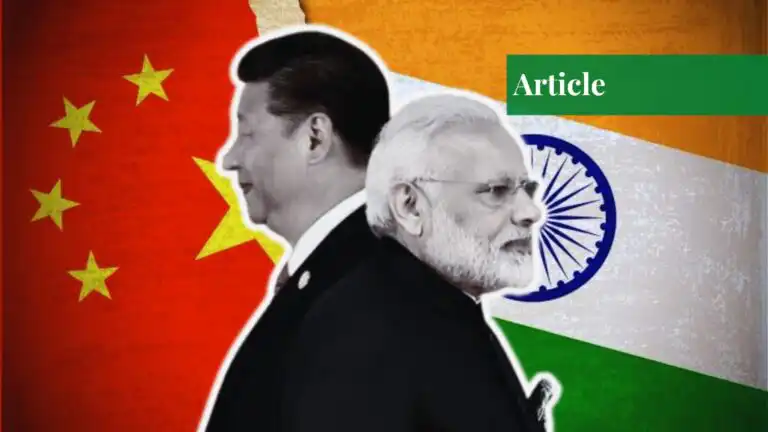
Against that canvas, the India–China track remains transactional. The foreign ministers’ meeting in July 2025 sat alongside slow-moving crisis management on the border and routine trade. New Delhi repeated that its Taiwan position had not changed, and Beijing repeated that it had. Each capital preserved leverage. India will not validate Beijing’s talking points while Chinese troops remain along a tense Line of Actual Control. China sees India as quietly leaning toward the US containment strategy. The ongoing deadlock isn’t a failure of diplomacy but a deliberate political choice.
Here, two points need clarity. First, India’s emergence as an arms exporter is now backed by hard numbers. The defense ministry reported record sales in FY2024–25, with both public and private firms playing their part. Deals with the Philippines are more a symbol than an outlier. For many in the region, Indian weapons offer solid performance, fewer political conditions, and training packages that are simpler than what Western suppliers usually provide.
Secondly, it must be observed that the term “containment” is of Washington’s coinage, not New Delhi’s. The American design is plainly to counterpoise the power of China through manifold alliances and partnerships, wherein India is raised to a place of especial regard. India partakes of the material fruits of this courtship, whether in the release of technology under the title of “major defense partner” or in the increasing intimacy of military exercises. Yet the spirit of Indian policy abides in autonomy of alignment, born of geography and bargaining leverage. It shall assay its options, diversify its sources of supply, and reserve to itself the liberty of striking an accord with Peking whenever the bargain proves advantageous.
So, where does that leave the Taiwan remark? Squarely in the battlefield of words. Beijing’s aim is to prove that even America’s partners echo its preferred language. India’s message is that it alone chooses the moment and manner of its speech. Manila’s goal is to demonstrate it can put hard power on the water with the backing of new friends. Washington, for its part, wants to show that its Indo-Pacific map is more than just talk. Each of them is succeeding, though only in part.
The deeper pattern is steady. India will keep arming countries like the Philippines that worry about coercion at sea. It will talk to Taiwan, but never in a way that has sparked a crisis. It will keep bargaining with China over the border while chasing small economic gains. It will work with the United States where it suits, without giving up its own choice. The claim that Jaishankar said “Taiwan is part of China” changes none of this. It only reminds us to read communiqués carefully and to watch what India is actually buying and selling on the water.
If you want to submit your articles and/or research papers, please visit the Submissions page.
To stay updated with the latest jobs, CSS news, internships, scholarships, and current affairs articles, join our Community Forum!
The views and opinions expressed in this article/paper are the author’s own and do not necessarily reflect the editorial position of Paradigm Shift!

Mohammad Zain is an International Relations student at NUML, Islamabad. With an associate degree in English Literature and Linguistics and a BS in International Relations, he brings a unique blend of analytical and literary skills to his writing.