
Introduction
Operation Epic Fury and the combined unilateral attack of the United States (U.S.) and Israel on Iran on February 28, 2026, have greatly disrupted international peace and security. Also, during Operation Midnight Hammer, the U.S. and Israel attacked Iran’s nuclear facilities last year. The outcome of the operation remains unclear. However, such unilateral military operations were not sanctioned by the United Nations Security Council and lacked international as well as regional support. So much so that Israel led an air attack in Doha, Qatar, while targeting the Hamas leadership on September 9, 2025. It is to be remembered here that in January 2026, the U.S. attacked Venezuela and arrested its president, Nicolás Maduro.
Such unilateral and illegal military operations have greatly invoked fear and a deep sense of insecurity among the nations of the world, especially the Gulf countries. Historically, the Gulf countries heavily relied on the U.S. for security purposes and paid heavy amounts of money for the said purpose. To overcome this sense of insecurity, the Gulf States have started looking towards collective defence and to benefit from the multipolar world.
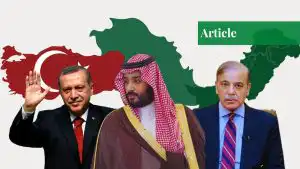
In September last year, Saudi Arabia and Pakistan signed the Strategic Mutual Defence Agreement (SMDA), as the Saudi leadership sought to establish deterrence against their threat spectrum and perception. The SMDA enabled Pakistan and Saudi Arabia to enhance interoperability and intelligence sharing between their respective armed forces. In August this year, Pakistan, Saudi Arabia, and Türkiye mutually signed the Mecca Defence Agreement to further enhance their collective defence capabilities and to invoke collective defence against enemies.
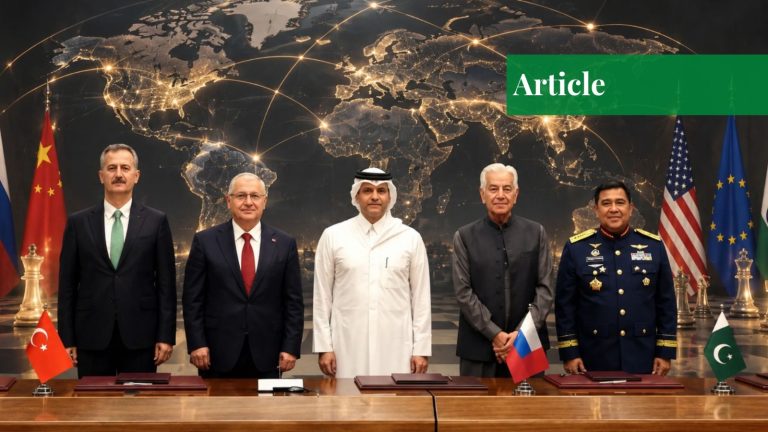
On October 21, 2026, Pakistan, Qatar, Indonesia, and Türkiye mutually signed the Badr Defence Pact in Doha, Qatar. Defence Minister Khawaja Asif from Pakistan, Defence Minister Yaşar Güler from Türkiye, Deputy Prime Minister and Minister of State for Defence Sheikh Saud bin Abdulrahman Al Thani from Qatar, and Deputy Minister of Defence Yusuf Jauhari from Indonesia signed the agreement.
Pakistan Defence Budget and Military Capabilities
According to Janes’ Defence, Pakistan has a defence budget of almost 10.8 billion USD and has a standing armed forces of almost 0.7 million active troops. It has vast experience in fighting conventional wars as well as combating terrorism. Pakistan’s defence cooperation with China has greatly strengthened its military capabilities, and it has the capability to conduct military operations across all the domains of war. Pakistan also possesses nuclear weapons and delivery vehicles covering the full spectrum of war.
Qatar Defence Budget and Military Capabilities
Qatar has a defence budget of almost 15 billion USD and around 65,000 active troops. It possesses French-built Rafale fighter aircraft, the EF-2000 Eurofighter Typhoon, and the F-15E Strike Eagle aircraft. It has several advanced weapon systems; however, it lacks combat experience.
Indonesia Defence Budget and Military Capabilities
Indonesia has a defence budget of almost 20 billion USD and has a total of almost 433000 active troops. Indonesia has generously contributed its troops to United Nations peacekeeping operations.
Türkiye Defence Budget and Military Capabilities
For the fiscal year 2026-2027, the defence budget of Türkiye will be around 44.5 billion USD, and it has increased its defence budget by 229% in a year. It has 481,000 active troops and possesses one of the most advanced armed forces in the world. Türkiye has significant experience in conducting military operations against conventional enemies as well as terrorists.
The Israeli Factor Behind the Badr Defence Pact
The collective defence budget of Pakistan, Qatar, Indonesia, and Türkiye amounts to more than 90 billion USD and almost 1.7 million active combat troops. All these four nations have tense relationships with Israel. Though Türkiye has diplomatic relations with Israel, due to Israel’s ongoing genocide in Palestine, the relations between the two are quite complicated.
Israel’s illegal military operations have sparked fear in the hearts and minds of the people of the world. It should be remembered here that Türkiye is a member of the North Atlantic Treaty Organization (NATO), and its leadership is not certain of any NATO military support in case of an armed conflict with Israel. The Turkish policymakers think that they will be denied any military assistance in case of Israeli aggression. This dilemma is likely to grow further, as the future of NATO is in great danger.
The Badr Defence Pact as the Epitome of a Multipolar World
The name Badr is derived from the Battle of Badr, which was the first military operation of Islam under Prophet Muhammad (PBUH). The name is highly symbolic and signifies the importance of the defence agreement. There is no doubt that Pakistan, Qatar, Indonesia, and Türkiye are very important members of the multipolar world and are benefiting from it to enhance their mutual security.
The need of the hour is to impose sanctions on Israel so that it abandons its aggression in the Gulf region. It is very unfortunate that President Donald Trump is constantly supporting Israel, and this support has emboldened Prime Minister Benjamin Netanyahu to dominate the region.
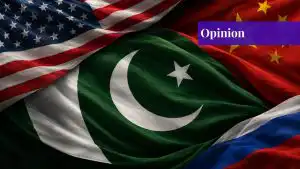
It is a good omen that Pakistan, Qatar, Indonesia, and Türkiye maintain good relations with the great powers, i.e., the U.S., Russia, and China. It reveals that the Badr Defence Pact is not against any specific country, but it is purely based on collective defence. As mentioned earlier, Israel’s military aggression has triggered fear in the Gulf region and has disturbed regional peace and security, and the Badr Defence Pact could ensure credible deterrence.
If you want to submit your articles and/or research papers, please visit the Submissions page.
To stay updated with the latest jobs, CSS news, internships, scholarships, and current affairs articles, join our Community Forum!
Find our FREE quizzes and MCQs here!
The views and opinions expressed in this article/paper are the author’s own and do not necessarily reflect the editorial position of Paradigm Shift.

Mr. Muhammad Ali Baig was serving as a research fellow (BPS-18) at the Institute of Strategic Studies Islamabad (ISSI), Pakistan. He is a doctoral candidate at the School of Politics and International Relations (SPIR) at Quaid-i-Azam University (QAU), Islamabad, Pakistan. Mr. Baig is a distinguished graduate of the National Defence University (NDU), Islamabad, Pakistan. He possesses an M.Phil. in international relations from NDU with distinction and a merit certificate from the president of the Islamic Republic of Pakistan. He also holds an M.Sc. in international relations (distinction) from NDU. Moreover, he holds master’s degrees in political science, English (linguistics and literature), and history. He co-authored the book Realism and Exceptionalism in U.S. Foreign Policy: From Kissinger to Kerry (2020). He also writes for The Nation, Daily Times, Pakistan Observer, Pakistan Today, Global Village Space, and Hilal Magazine. He can be contacted at mmab11@gmail.com and alibaig@issi.org.pk.