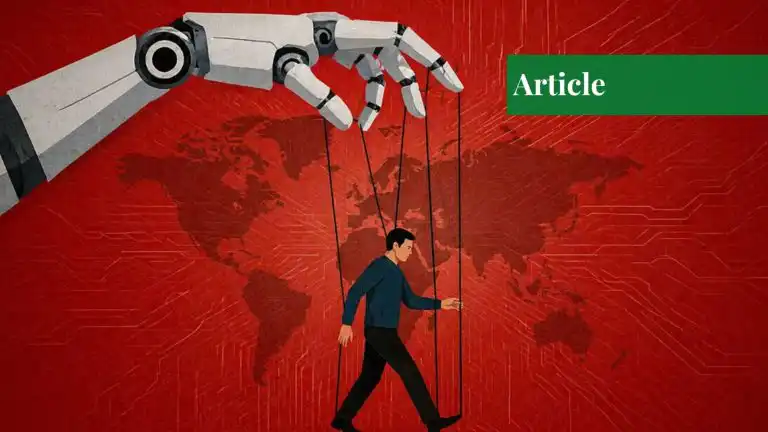
The European countries met in Berlin in 1884 and used a map to divide the African continent among themselves. They distributed the continent’s mineral wealth, labour, and land as if they had never belonged to anybody before. That moment’s arrogance has long been seen as the epitome of colonialism at its most blatant. Less frequently recognised is the fact that a more subdued but structurally comparable process is currently in progress, one that does not call for governors, gunboats, or treaties signed under duress. All you need is a smartphone, a platform, and an unreadable terms-of-service agreement. Nick Couldry and Ulises A. Mejias, two of the most important scholars working on the intersection of technology and power, gave this process its most precise name: data colonialism. “The old colonialism grabbed land, resources, and human labour,” they wrote. “The new one grabs us; the daily flow of our lives, in the abstract form of digital data.” It is important to take your time reading that phrase because it sums up what is currently happening to billions of people in the Global South on a scale that surpasses any prior extraction and with an invisibility that makes resistance exceedingly challenging.

We often hear that data is the new oil. The metaphor is largely deceptive and somewhat helpful. In geological formations, oil is a limited resource that can be measured, observed, and detected when it runs out. Every search, purchase, communication, and step tracked by a wearable gadget, and face scanned by a security camera are examples of the continual texture of everyday human existence from which data is collected. In theory, this data is limitless. The amount of data generated increases with the number of people who live, interact, and travel. The people of the Global South are not a market to be serviced, but rather a resource to be processed by the five big companies that collectively control the vast majority of the world’s digital infrastructure: Google, Meta, Amazon, Microsoft, and Apple.
Each of the four interconnected systems that make up the mechanics of data colonialism is both individually defensible and collectively destructive. The first is the process known as “platform capture,” which occurs when foreign digital platforms take over as the standard infrastructure for information, communication, commerce, and finance in nations with insufficient resources to develop domestic alternatives. As the Yale Review of International Studies observed, the data produced by Asian populations is “used to make money by Google, Meta, Amazon, and Microsoft in Silicon Valley or Tencent and Huawei in Shenzhen,” while governments that store their most sensitive information on Amazon Web Services or Microsoft Azure “effectively outsource a part of their sovereignty, relying on foreign corporations to guard their digital fortresses.” The infrastructure on the platform is not neutral. It’s jurisdiction. Its advertising logic, data retention policy, terms of service, and content moderation guidelines are all developed in corporate headquarters in California and applied to communities in Lagos, Karachi, and Nairobi without their input.
Dependency on infrastructure is the second mechanism. There is an unequal distribution of the physical cables, satellites, and server farms that transport the internet. The submarine cable map: a visualisation of the actual physical arteries of the global internet, reveals the architectural reality of digital power: cables converge on a handful of nodes in the Global North, meaning that data generated in Accra, Dhaka, or Bogotá must physically route through networks owned and controlled by foreign entities before it can travel anywhere, including to destinations within the same country. Because it is ingrained in the internet’s hardware, this generates a structural dependency that is difficult to overcome by regulatory reform. Google, Microsoft, and Meta are not engaging in philanthropy when they make large investments in new underwater cables, as they have all done recently. They are extending the scope of their own infrastructure for gathering data. They own the pipeline, which is represented by the cable.
The third mechanism is what Abeba Birhane, in her analysis of the algorithmic colonization of Africa, describes as the “Social Quantification Sector”: the conversion of every dimension of social life into data points that can be harvested, processed, and monetised. The most well-known examples of FinTech apps touted as financial inclusion tools in Kenya are Branch and Tala, both based in California. These apps gather contact lists, location information, SMS metadata, and browser history from borrowers’ phones in addition to repayment behaviour. Credit profiles are created using this information, and access to basic financial services is then determined. The California corporation obtains the profile and the profit, while the borrower supplies the data and the default risk. Although the transaction’s architecture is blatantly extractive, it is presented in terms of empowerment and development.
The fourth and most coercive mechanism is the biometric and surveillance infrastructure. A comprehensive 2025 study published by Wiley on government digital surveillance in Africa documents how foreign-supplied biometric identification systems, smart city surveillance contracts, and AI-powered facial recognition technology have been embedded into the governance infrastructure of African states in ways that simultaneously create data dependencies and transfer sensitive population data to foreign corporations and governments. For the Chinese AI business to train its facial recognition algorithms on African faces, Harare (Zimbabwe) had to provide biometric data of its residents as part of Zimbabwe’s 2018 CloudWalk agreement. The Zimbabwean government used the faces of its own citizens as payment for its own monitoring apparatus. Despite years of use, the system had not resulted in a single public criminal conviction, according to researcher L. Travers’s report published in the journal Transcience. However, it had developed a sizable database of Zimbabwean biometric profiles that was owned by a Chinese company.
The case studies below show that data colonialism is a tangible process with identifiable victims and benefits rather than just a concept. They also show the breadth of this extraction across location and industry.
Kenya has been referred to as the “Silicon Savannah” of Africa and a paradigm for digital innovation. Its 2007 debut of the M-Pesa mobile payment system is frequently used as proof that African nations can use digital technology to surpass traditional financial infrastructure. What the celebratory narrative tends to omit is that M-Pesa’s data; the transactional records of millions of Kenyan users, flows through infrastructure with complex ownership structures, and that the fintech lending applications built on top of mobile money infrastructure have generated what researchers Kevin Donovan and Emma Park called “perpetual debt in the Silicon Savannah”: a cycle of high-interest digital micro-loans that trap borrowers in dependency rather than lifting them out of poverty. Kenya’s attempt to implement a biometric national ID system was legally challenged because it would deny citizenship to ethnic and religious minorities who did not have the necessary papers. The program was postponed by the court, but the fundamental dynamics of Kenya’s digital economy: foreign technology, locally borne repercussions, and minimal local value from the data generated, remain.
The Latin American experience adds another dimension. A policy paper from the OCP Policy Centre in Rabat describes how data is “extracted from Southern populations, routed through infrastructures owned by Northern corporations, processed by algorithms trained on foreign datasets, and monetized abroad.” One of the most intriguing alternatives is Brazil’s PIX rapid payment system, which was created by the country’s central bank as a public utility rather than a private platform. For instance, a domestically constructed digital infrastructure that precludes foreign FinTech from monopolising payment data within the country’s borders. It’s informative to compare with Pakistan. Pakistan and Malaysia have both accepted Chinese-funded smart city projects that embed foreign surveillance infrastructure into their urban architecture, creating dependencies that will be politically and technically difficult to reverse. The smart city arrives as a gift. It stays as a landlord.
This extraction’s effects are tangible. They take the form of individual, institutional, and civilisational manifestations, and over time, they compound in ways that increase rather than narrow the divide between the Global North and the Global South.
The loss of informational self-determination, the ability to choose what information is known about you, by whom, and for what reason, is the most direct effect at the individual level. A 2026 peer-reviewed study in Development in Practice, drawing on evidence from Africa, Asia, and Latin America, found that while technology corporations generate massive profits from Global South data, “local populations capture minimal economic benefits and face new dependencies constraining autonomous development.” In the liberal notion of individual rights, this is more than just a privacy issue. Value is taken from communities that receive nothing in return, and the profiles created from their data are then used to determine their creditworthiness, employability, and service eligibility. These decisions are made by algorithms trained on data collected without meaningful consent, reflecting the biases of the societies in which those algorithms were developed. This is a structural economic problem.
Data colonisation undermines states’ ability to run their own societies at the institutional level. A government has outsourced the informational underpinnings of governance to organisations whose interests diverge from its own when its tax records are kept on Amazon Web Services, its citizens’ health data is processed by Microsoft Azure, and its urban infrastructure is managed through Chinese smart city contracts. African states, as Naked Capitalism’s review of 2025 research documented, have “unwittingly and severely compromised their sovereignty via entering into agreements for the use of citizen tax and health data with foreign providers.” According to the study, data currently serves the same purpose as population registrations and taxes did during colonial rule: it provides the data bearer with information about the population it describes and, consequently, control over it.
Data colonisation poses a danger to cultural and epistemic sovereignty at the civilisational level. The presumptions, prejudices, and worldviews of that cultural environment are incorporated into systems that are subsequently implemented worldwide by algorithms. What is acceptable speech in Nigeria is determined by content moderation decisions made in California. Communications in Swahili, Urdu, or Tagalog are distorted by translation technologies that were trained on Western linguistic corpora. AI systems designed for and from a different society are increasingly mediating access to healthcare, education, credit, and justice in the Global South. A Cambridge Core analysis of AI and digital colonialism in Africa documented how local developers and entrepreneurs must conform to “externally imposed standards, data policies and algorithmic biases,” while cultural homogenisation associated with Western-centric platforms leads to the marginalisation of local languages and the erosion of indigenous knowledge systems. Here, history serves as a helpful caution: the British East India Company did not arrive in South Asia primarily as a military force. It started as a business that provided services. It remained an empire.
The question of what can be done is neither straightforward nor hopeless. There is already opposition to data colonialism on several fronts, and some of it is succeeding. There are now many different regulatory frameworks in place. For example, the EU’s General Data Protection Regulation has established a global reference standard that compels Chinese and American companies to change their data procedures when conducting business in European countries. Each of the domestically built equivalents: Brazil’s LGPD, India’s DPDPA, and South Africa’s POPIA, represents a state’s claim that its residents’ data belongs to them and not to whoever can collect it most quickly. Lawyers from Kenya’s civil society have successfully contested biometric programs in court. In Nigeria, a Kenyan lawyer sued Meta and OpenAI, arguing that their data practices were exploitative. Indonesia banned TikTok’s commerce feature on data sovereignty grounds. These are individual victories, not a structural reversal, but they demonstrate that the legal and political tools for resistance exist.
Building the administrative, intellectual, and technical infrastructure necessary to achieve true digital sovereignty is a more basic challenge. This entails making investments in domestic cloud computing capacity, creating public-utility payment systems instead of outsourcing to private platforms, training data scientists and AI researchers at nearby universities, and creating data governance frameworks that grant communities, not governments or corporations, primary ownership of the data generated from their daily lives. The OCP Policy Centre’s analysis argues that resistance alone is insufficient, that a just digital order requires “proactive construction: a vision of inclusivity, fairness, accountability, and multipolarity, underpinned by institutions and policies capable of delivering it.” This is true, and it calls for both political will and resources, both of which are scarce. The alternative, however, is a digital architecture that permanently reproduces the economic geography of past colonialism: extraction moving from the South to the North, wealth accumulating in the hands of a few corporations with headquarters in Shenzhen and California, and the people of Asia, Latin America, and Africa producing the data and covering the expenses.
The absence of the people whose territory was being split made the Berlin Conference of 1884 conceivable. The digital counterpart is feasible today for the same reason: the Global South, which is home to the majority of the world’s internet users, is still minor in forums where the conditions of the global data economy are established, such as the WTO’s e-commerce discussions, ICANN, the OECD, and the G7. Therefore, demanding a place at the table where the rules are written is the first and most significant act of resistance. Data colonialism is not unavoidable. It is a decision that the governments that allow it and the corporations that extract it are currently making. It can be undone by a variety of decisions based on the understanding that the information derived from a human existence initially belongs to the individual who lived it.
If you want to submit your articles and/or research papers, please visit the Submissions page.
To stay updated with the latest jobs, CSS news, internships, scholarships, and current affairs articles, join our Community Forum!
The views and opinions expressed in this article/paper are the author’s own and do not necessarily reflect the editorial position of Paradigm Shift.

Abdul Basit | MS International Relations | Researching soft power, cultural diplomacy and global politics | Writing on geopolitics, foreign policy and defence affairs.