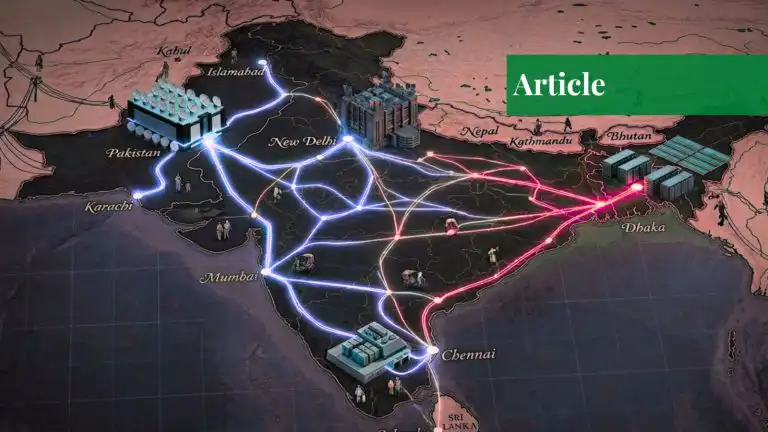
The following big geopolitical battle might not be based on the territory, trade routes, or even technology itself. It is also being contested more and more over the invisible architecture of data, and South Asia is not just a part of this contest. It is coming to be the landscape on which it takes place.

This distinction matters. None of them is a leading manufacturer of sophisticated digital technologies yet, nor does it set global standards for artificial intelligence or cloud in the world. However, the region is fast gaining strategic relevance due to its magnitude, structural loopholes, and the increasing incorporation in the external digital networks. What is becoming more apparent is a complex competition between national powers, as global actors are increasingly influencing the infrastructure, rules, and vulnerabilities that characterize the generation, control, and contestation of data.
The paradox of this transformation is in the middle. South Asia is closely connected and loosely exposed. According to the World Bank, 61 percent of individuals in the region reside within the coverage of mobile broadband networks and fail to use the internet, the highest in the world. Simultaneously, the economies of the region are quickly becoming digital and integrated into the global arena, and are also producing more and more data. This establishes a two-fold reality in that enormous pools of untapped digital potential exist alongside a prior overreliance on external technological systems.
In this regard, data is not just a product of connectivity. It is an asset of strategy that supports the economic life, the capacity of states, and the geopolitical power. United Nations Conference on Trade and Development underlines that the digital economy is becoming more material, and it needs enormous physical infrastructure, including data centers, fiber-optic cables, cooling systems, and energy supply. It estimates that data centers operating in isolation can consume up to 1,000 terawatt-hours of power in the world in 2026. Data control, consequently, cannot be detached from infrastructure control that makes it possible.
The vulnerabilities of South Asia are strategically important at this point. The digital infrastructure of the region is not even, disjointed, and in most instances externally reliant. This is the dynamic that is most evident in Pakistan. In the 2025 Pakistan Development Update published by the World Bank, it is stated that the number of people engaging in internet usage is only approximately one-third of the entire population, which is covered by mobile networks, and the number of towers is not that high, and the implementation of 5G networks is lacking, which restricts access and quality. Such limitations not only slow down the digital adoption, but they also determine the conditions under which it takes place.
When domestic infrastructure is insufficient, digital expansion tends to rely on external systems. This creates a kind of asymmetric integration: states can access global connectivity and services, but on terms that restrict their ability to control data flows and stores. This dilemma is reflected in the decision of Pakistan to permit Starlink to operate, as reported by The Diplomat in 2025. Satellite-based internet has the potential to fill connectivity gaps, especially in remote regions, although it also creates dependence on foreign-owned infrastructure in areas where important communication networks are required.
The outcome is the change in the experience of sovereignty in the digital era. The territory no longer becomes a guarantee of the control over the flows of information. Rather, sovereignty is conditional upon the power to control infrastructure, control platforms, and continue access. South Asian digital path can be seen, in this regard, not merely as a question of modernization, but as whether states can have any meaningful control over more and more externalized systems.
India has tried to overcome this difficulty by putting data governance in terms of strategic autonomy. Its focus on the concept of data sovereignty is an indication of fears of what policy makers have termed as data colonialism, which is the act of foreign companies taking advantage of domestic data without giving it back to the local community. This strategy aims at placing India as a participant of the global digital economy, but not as a follower in it.
But even the relative merits of India bring to light the constraints of sovereignty in an extremely globalized system. Although it has built extensive digital public infrastructure and has a massive domestic market, it is still involved in international supply chains of semiconductors, cloud services, and advanced technology. This is an expression of a larger structural fact: the sovereignty of the digital is not unconditioned. It is in a web of dependencies, which can be controlled, but not eradicated.
In South Asia, all these dependencies are further compounded by the political practices that directly influence the digital space. The utilization of internet shutdowns is one of the most far-reaching and yet neglected factors. Access Now also reports that in 2025, the Asia-Pacific region had registered 195 instances of internet shutdowns, with India and Pakistan being the most common. Although the reasons behind such shutdowns are often motivated by security reasons, the strategic consequences of such shutdowns go way beyond the immediate political situations.
Practically, the shutdowns are an indicator that the connectivity is conditional; it can be broken in case of instability, depending on the time when the digital infrastructure is required. This erodes confidence in the digital systems, deters future investment, and sustains the pillars of a stable digital economy. More to the point, it causes a structural vulnerability: in the event that domestic systems are viewed as untrustworthy, users and businesses will be more willing to resort to third-party platforms and other connectivity tools.
This dialectic puts forward an important though undervalued truth: the practices that are supposed to impose control over the digital space can actually externalize the latter. States can unwillingly drive the data flows, user behavior, and dependence on the Internet by disrupting domestic connectivity, strengthening the effects of external actors. Internet shutdowns are, in a way, not only instruments of control but also signs of strategic vulnerability.
These weaknesses are enhanced by the wider geopolitical background. South Asia is at the crossroads of rival digital ecosystems, especially those that are influenced by the United States and China. Both provide different models of technological development, investment in infrastructure, and regulatory models. The interaction with these models between access, control, and alignment is usually complicated by trade-offs between the countries in the region.
The strategy of China has been to invest in infrastructure such as telecommunication and data systems, and the United States and its partners have been investing in cloud services, digital trade, and regulatory standards. States in South Asia, which do not have fully-fledged domestic alternatives, tend to work on them at the same time. The outcome is a discontinuous digital topography where various layers of the ecosystem, such as hardware, software, connectivity, and governance, are shaped by various external forces.
This disintegration leads to the so-called stratified dependence. A nation might depend on a group of partners in terms of physical infrastructure, another group in terms of digital services, and another group in terms of regulation congruence. Although this may yield flexibility in the short run, it makes long-term strategic planning more complicated and puts the organization in a position of exposure to external pressure.
There is also a lack of coordinated approaches at the regional level, which also restricts strategic autonomy. South Asia does not have standardized data governance, transnational data movements, or online trade. Although the data protection laws and the digital policies have been put in place in individual countries, they are mostly nationwide. The patchwork of regulations that has arisen minimizes interoperability, adds costs, and undermines the collective bargaining capacity of the region in global digital negotiations.
Another aspect of the new competition is environmental constraints. The digital infrastructure development, as noted by UNCTAD, has high energy and water implications. South Asia, which is already energy-deficient and vulnerable to climate change, will have to compete with the material costs of digitalization. The region will otherwise end up consuming the environmental costs of the digital economy without receiving much of the value.
Put collectively, these forces indicate a paradigm change in the way power is exercised in the region. The geopolitics of data in South Asia is not characterized by one rivalry or even one technology. The interaction of the infrastructure gaps, the governance choices, political practices, and the external competition shapes it. This intersection is a very strategic location in the region.
To call South Asia a battleground is thus to acknowledge a particular type of struggle, the one that is diffuse, multi-layered, and usually indirect. It is not typified by blatant conflict but by the painting and development of systems, interdependencies, and standards. This is not done by controlling the territory but by having the capacity to define the way data is created, passed, stored, and managed.
The key concern is whether South Asia will continue to be the battleground or become a participant in the process of its formation. The solution will be based on a chain of interconnected decisions. Physical infrastructure investment, fiber networks, data centers, energy systems, etc., is necessary, but it has to be supported by coherent regulatory frameworks to improve transparency, interoperability, and trust.
It is also critical that the political practices that weaken digital confidence should be reevaluated. The lessening of dependency on internet blackouts and other problems of creating more stability in the connection is not just a matter of governance but rather a strategic necessity. In the digital economy, trust is a type of infrastructure by itself.
Another avenue that has not been utilized is regional cooperation. Coherent data governance, cybersecurity, and digital trade would increase resilience and decrease the reliance on external systems. Although political facts have traditionally curtailed this kind of collaboration, the increasing significance of digital structures can generate new motivations for convergence.
The interests are not limited to economics. The management of information and online infrastructure is becoming an influential factor in political independence, security, and international power. A territory that is reliant on external systems can have its strategic alternatives limited. On the other hand, a place that builds its own forces and synchronizes its policies can have a more significant impact on the conditions of digital interaction.
South Asia is at the crossroads in this matter. It will not be only technological adoption or market growth that will determine its digital future. It will be determined by the extent to which it manages to go through the relationship between dependency and autonomy, control and openness, fragmentation and coordination.
In case the current trends continue, the area will become a battlefield, where the data flows will be modified mainly by foreign forces, and the domestic apparatus will be limited. In case, though, South Asia can make its infrastructure development in line with a consistent policy and regional collaboration, it can become a more self-reliant and powerful actor in the global digital landscape.
The data politics are not a far-fetched concept. It is playing out live and changing the principles of power. That process is especially apparent in South Asia, not so much because the region is in the global vanguard of the digital, but because it demonstrates, in a rather disconcerting way, how digital power is produced, challenged, and dominated.
If you want to submit your articles and/or research papers, please visit the Submissions page.
To stay updated with the latest jobs, CSS news, internships, scholarships, and current affairs articles, join our Community Forum!
The views and opinions expressed in this article/paper are the author’s own and do not necessarily reflect the editorial position of Paradigm Shift.