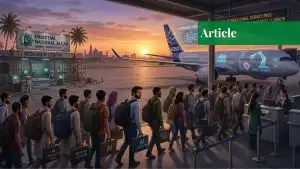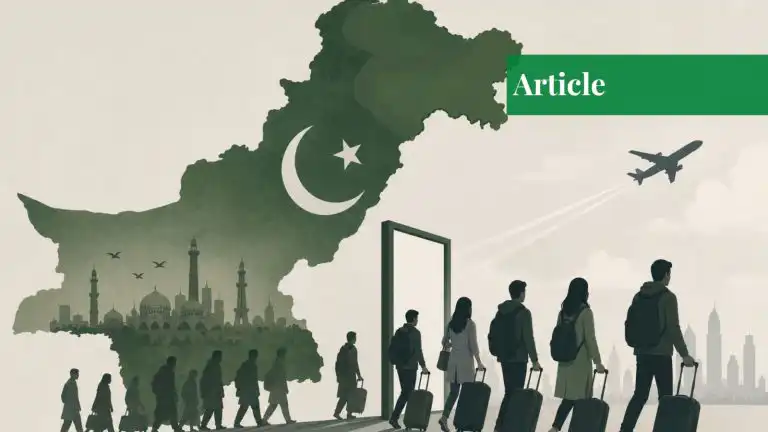
Pakistan’s brain drain numbers haven’t slowed down; they’ve picked up speed. As the country enters 2026, the total number of people who have left over the past two years is expected to cross 1.5 million. One columnist put it bluntly a few months back: this isn’t migration anymore; it’s “a vote of no confidence in the state.” That line has stuck around because it’s hard to argue with. What’s changed isn’t just the scale of people leaving; it is how openly everyone talks about it now.
There is a kind of dark joke circulating on Pakistani social media: the country itself is going nowhere, but its people are going everywhere. It is funny until you realize it’s not really a joke. The desire to leave used to be associated mostly with the poor or the unemployed. Not anymore. Commentary from this January described something closer to a national mood, including rich, poor, educated, uneducated; almost everyone wants out.
Maybe the most uncomfortable detail in all this is who’s choosing to stay abroad. Diplomats and government officials posted overseas people whose entire job is to represent the state, are quietly trying not to come home, even though there are formal rules meant to stop exactly that. When the people paid to believe in the country don’t want to live in it, that tells you something the GDP numbers can’t.
The Numbers Behind The Exit
None of this happened in a vacuum. 2023 was brutal: inflation hit 30 percent, unemployment hit a record 8.5 percent, and the rupee lost roughly a fifth of its value against the dollar, one of the worst currency performances in the world that year. So, it’s not surprising that emigration jumped the way it did. In 2021, fewer than 230,000 Pakistanis left for work abroad. By 2023, that number had ballooned to 862,625 in a single year. Zoom out further, and the number gets staggering: since official record-keeping began in 1971, more than 13.5 million Pakistanis have emigrated. There are now over nine million Pakistanis living abroad, making it the sixth-largest diaspora in the world.
Even global indices that try to measure this kind of thing put Pakistan well above average. One index that tracks human flight scored Pakistan at 5.5 out of a possible range in 2024, down slightly from 5.8 the year before, but still well above the worldwide average of 4.98. Pakistan’s own long-run average since 2007 sits at 7.01. So even the “improvement” isn’t really good news, just slightly less bad news.
From Labourers to Leaders
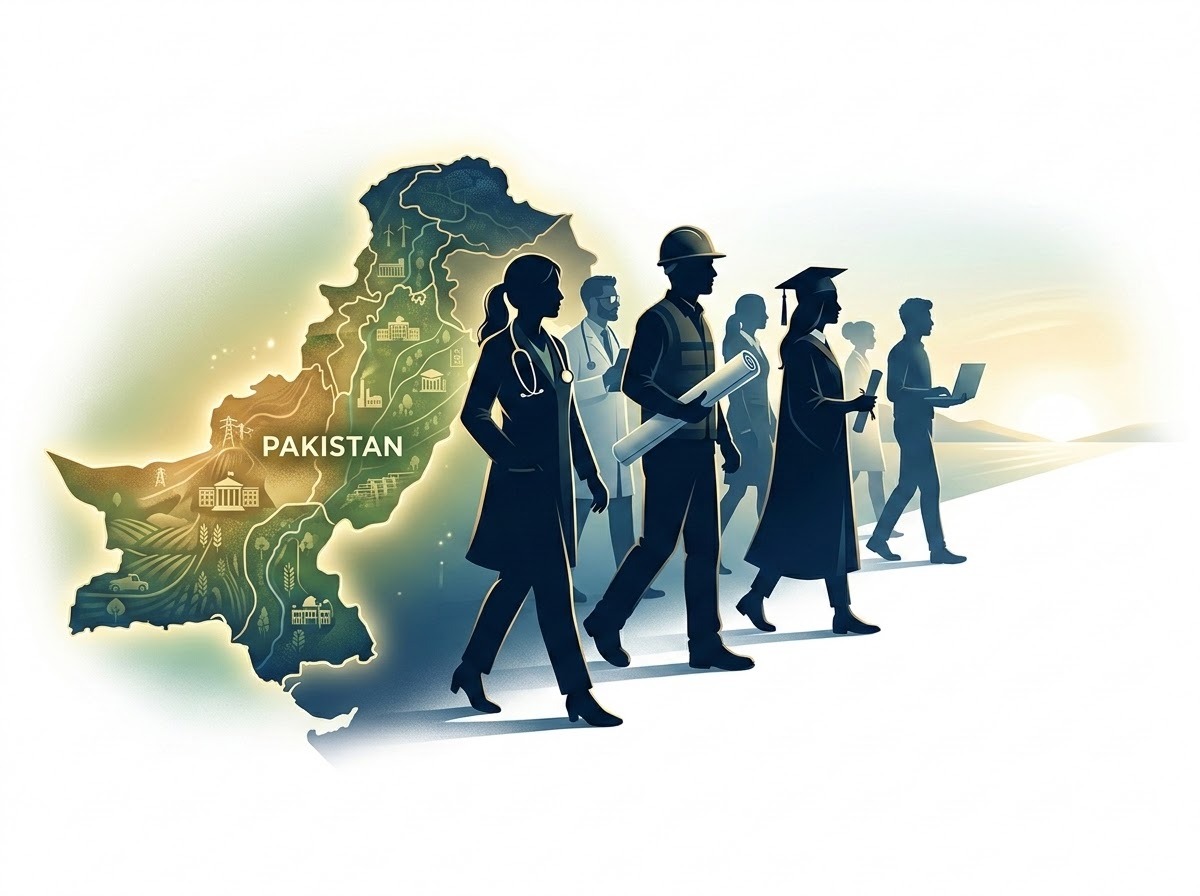
This used to be a story about unskilled labor heading to the Gulf. It is not that story anymore. Between 2011 and 2024, applications to emigrate jumped 151 percent among doctors, 172 percent among engineers, and almost unbelievably 990 percent among managers. In just the 2022–2023 window alone, highly qualified professional emigration rose by 26.6 percent, and the number of highly skilled people who left in those two years (around 107,000) was higher than the entire previous five years combined.
The damage is showing up in very specific ways. Nearly 2,500 doctors left the country in 2023 alone, and hospitals are feeling it. Education is being squeezed from both directions: experienced teachers are leaving, and so are the students who would eventually replace them. A 2024 survey found that over 45 percent of university students in Pakistan are already planning to leave after graduation. A separate government report found that nearly a third of graduates aged 25 to 35 are seriously considering migration, mostly because there’s nowhere good for them to go career-wise at home.
The numbers keep climbing. One recent report put last year’s skilled outflow at over 862,000 workers, including close to 46,000 doctors, engineers, and IT professionals, a noticeably higher figure than the 727,381 officially registered for 2024. Even the people tracking this can’t quite agree on the exact number, which says something on its own: this is moving too fast to pin down cleanly.
The Migration Nobody Counts
Not everyone leaving is doing it the official way, and the unofficial route is far more dangerous. Pakistani nationals are now one of the largest groups attempting irregular migration into Europe. Frontex, Europe border agency, has flagged Pakistani men as among the most common male victims of human trafficking into Europe, mostly funneled into forced labor in construction and farming. The routes run overland through Iran and Turkey, then either by boat across the Mediterranean or overland through the Balkans, run by smuggling networks that charge several thousand dollars a head. Families often borrow heavily to cover those fees, which means some migrants arrive already in debt bondage to the very people who smuggled them in. It’s the same desperation driving the white-collar exodus, just with none of the safety net.
Is It Really A Brain Drain Trap?
The scarier version of this story isn’t just that people keep leaving; it’s that the loss starts feeding on itself. There’s a term for that: the World Bank calls it a “brain drain trap,” a point at which a country has lost the exact people it would need to fix the system that made them leave. Once you are in the trap, getting out gets harder every year, not easier.
The day-to-day damage is already visible. Hospitals are short-staffed. Schools are short on experienced teachers. Tech companies cannot find senior engineers. Dr. Nadeem ul Haque, former Vice-Chancellor of the Pakistan Institute of Development Economics, has put it plainly: without real institutional reform, Pakistan will keep funding other countries’ growth while its own economy quietly falls apart.
And the money side of this only sounds reassuring at first glance. Remittances reportedly hit $38.5 billion recently, but the same analysis estimates the underlying productivity loss at $4.2 billion a year. Pakistan still ranks sixth globally for brain drain, and 92,000 university graduates left in 2022 alone, a loss that hollows out exactly the middle class that’s supposed to drive consumer spending and long-term growth.
Periphery Nation or Brain Circulation
There’s a real fork ahead. One path is the bleak one: Pakistan slowly becomes what some analysts call a “periphery country,” a place that trains talent for other countries to use. The other path is more hopeful: “brain circulation,” where people who leave eventually come back with money, skills, and global connections, but only if there’s actually something worth coming back to. That means real investment in startups, research infrastructure, and basic security.
It helps to look at neighbors. India still sends huge numbers of skilled professionals abroad, especially in tech and research, but it’s built stronger pathways for that talent and capital to circulate back. Bangladesh’s outflow, by contrast, has historically leaned more toward low-skilled labor heading to the Gulf. The lesson isn’t just about how many people leave; it is about who leaves and whether the system gives them any reason to come back.
Which path Pakistan ends up on depends on things that are entirely within its control right now: competitive pay for high-skill sectors and tax policy that doesn’t punish salaried professionals more than everyone else. One recent piece put the human cost of inaction about as well as anything I’ve read: Pakistan loses billions in talent every year, doctors treating patients in Manchester instead of Multan, engineers building skylines in Dubai while startups at home quietly die.
Conclusion
Pakistan keeps calling this “brain gain,” but the math tells a different story. Every doctor who leaves for London, every engineer who picks Dubai over Lahore, every diplomat who quietly stays abroad, they are not just numbers in a remittance report. They are votes. And right now, the country is losing the election against itself.
The uncomfortable truth is this: a nation can survive losing its money. It can survive losing its industries. What it cannot survive, long-term, is losing the very people who would have fought to fix it. That’s the real exodus, not just of talent but of hope. And hope, unlike remittances, does not wire itself back home. The question Pakistan keeps dodging isn’t whether it can afford to stop the bleeding. It’s whether there will be anyone left to stop it if it waits much longer to try.
If you want to submit your articles and/or research papers, please visit the Submissions page.
To stay updated with the latest jobs, CSS news, internships, scholarships, and current affairs articles, join our Community Forum!
The views and opinions expressed in this article/paper are the author’s own and do not necessarily reflect the editorial position of Paradigm Shift.

Maham Asif is a BS International Relations student at Government College University Lahore, with a research focus on geopolitical theory, nuclear strategy, and South Asian foreign.