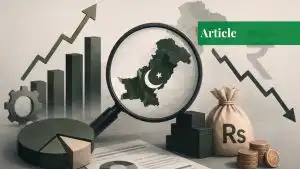
On June 10, Finance Minister Muhammad Aurangzeb presented the budget of 2025-26 in the National Assembly against a backdrop of soaring nationalism after the recent Pakistan-India skirmish. Against its grim background, the budget aims at a tricky balance: aggressive fiscal consolidation in line with IMF requirements, a little bit of middle-class tax relief, and an economic shift to growth. The stock market reacted with great gusto-PSX touched a new all-time high of over 124,000, as investors showed optimism in its core. However, is there more than a morale boost behind the figures?
Fiscal Consolidation Growth
At a glance, the FY26 budget is contrastingly different from the expansionary budget of last year. The gross expenditure has been cut by approximately 7 percent to Rs 17.573 trillion as compared to Rs 18.9 trillion. The fiscal deficit has now been limited to 3.9 percent of GDP it was 5.9 percent previously), and a primary surplus is estimated at 2.4 percent. This contractionary movement is a condition dominated by the IMF and is aimed at regaining macro stability.
In contrast, the previous year’s budget was severely criticized due to imposing heavy new taxes on consumers, including 18 percent GST on all agricultural produce of immediate need, rental income, seeds, and tractors. Despite the increased revenue, it put pressure on households and could not trigger sustainable growth. The budget 2025 appears to do an about-turn with a sense of relief, especially for the salary earners, but nonetheless squeezes the national financial machinery.
Salvation of the Salaried Class Harmonized with Limits
In an attempt to cushion the austerity measures, the government came up with a middle-income (Rs 600,000-1.2m) half-rate income tax band, lowered the surcharge on high-income earners, and declared that there will be no rise in capital gains tax-CGT. It will stay at 15 percent.
Investors liked these measures, as PSX reached new highs and workers, although the gains are modest so far. Although the tax relief is pro-consumption, critics say that it is shallow. It is apparent that the strategy of this budget is greatly dependent on the increase of revenue (FBR target: Rs 14.13 trillion, an increase of approximately 19%) that is based on the more comprehensive reform of agriculture, real estate, and retail. However, when only 1.3 percent of Pakistanis are paying their income tax in FY 25, these reforms might not be enough unless heavily enforced.
Defense Spending: The Elephant in the Room
The budget proposes a sharp 20 percent increase in defense outlay to Rs 2.55 trillion in response to the recent India conflict. Together with pensions, military expenditures today take up approximately 19-20% of the federal budget and almost 2.5% of GDP, which is equal to the regional peers. Part of this is funded by a reduction in interest payments (down 16%) as the central bank rates are reduced (from ~22% to 11%).
In 2016, defense was also notable but not in a spike. The adaptation to this increased burden is now the big question that may leave the sectors of development starving. Health, education, and infrastructure still remain second fiddle, an alarming indication of long-term human capital investment.
Industry Push and Structural Reform
To make up the fiscal deficits, the finance minister has announced bold tariff reforms. Customs duty has been reduced or eliminated in more than 4,000 tariff lines, covering raw materials and intermediates to make production cheaper and encourage exports. This is in line with the so-called East Asia moment, in the hope that Pakistan can follow the path of other export-led development models such as Vietnam or South Korea.
It also has real estate and construction incentives, low-cost housing tax breaks, and improvements in the public sector development program (PSDP). The IT industry will get about Rs 4.8 billion to gross up exports of US$3.1 billion to a target of 25 billion in five years. They are indicators of a more focused, future-oriented economic policy. But the package that passed last year (supply-side reforms without tax hikes) was not specific. The move to couple relief of obligations with industry assistance that is being attempted this year is more subtle but still depends on implementation.
Market Response and Sustainability Concerns
Markets clearly liked what they saw. The KSE‑100 index surged approximately 1.922 percent or more after the budget, and it ended at over 124,300. Stability in capital gains, favorable tax structures on mutual funds, and the absence of surprise taxes are some of the reasons attributed by analysts to explain the rising sentiment.
However, institutional confidence cannot just lead to results. The high projected growth rate of 4.2 percent GDP growth rate, which is expected to improve on the anticipated 2.7 percent growth in FY 25, which was itself revised downwards to 3.6 percent, already casts a doubtful eye. Last year, the agriculture and manufacturing sectors performed poorly, and structural bottlenecks need to be rewritten; otherwise, growth will remain unattained.
Last Word: Pare or Bluster?
Unlike the tax-heavy, expenditure-heavy budget of last year, the budget of FY 2025-26 claims a more balanced stance: fiscal tightening, tamed incentives, sectoral thrust, and strategic reforms. It gives a slight consolation to those who earn salaries and draws a reformist, export-led story. It can be reassuring to exporters, investors, and even expatriate Pakistanis overseas right now.
Yet to bring this about, three things are necessary:
- Discipline of Implementation: Expanding the tax net in agriculture, real estate, and retail, and delivering on tariff liberalization.
- Re-prioritization of Development: Reducing military and debt-service demands to create fiscal room to spend on health, education, and infrastructure.
- Structural efficiency: Simplifying industrial policy, giving a push to SMEs, increasing housing finance, and utilizing the IT boom.
Should Pakistan be able to perform in these areas, then this budget could well be the one that turns it around. Unless reforms are undertaken and austerity cuts are preceded by growth, it will be in danger of being no more than a financial Band-Aid: stabilizing, perhaps, but not transformative.
In the background of the domestic upheaval, IMF requirements, and geopolitical tension, a sensible change as opposed to a daring leap is all that the FY 2025-26 budget can be regarded as. Hopefully, its promise, which has been put to the test in the marketplace and other venues, is more than wishful thinking.
If you want to submit your articles and/or research papers, please visit the Submissions page.
To stay updated with the latest jobs, CSS news, internships, scholarships, and current affairs articles, join our Community Forum!
The views and opinions expressed in this article/paper are the author’s own and do not necessarily reflect the editorial position of Paradigm Shift.

Hamza Nasir is a graduate of economics from Balochistan University of Information Technology, Engineering and Management Sciences (BUITEMS). He currently serves as a researcher at the Balochistan Think Tank Network (BTTN), Quetta. His work focuses on political economy, economic resilience, and policy reform with a regional lens.