

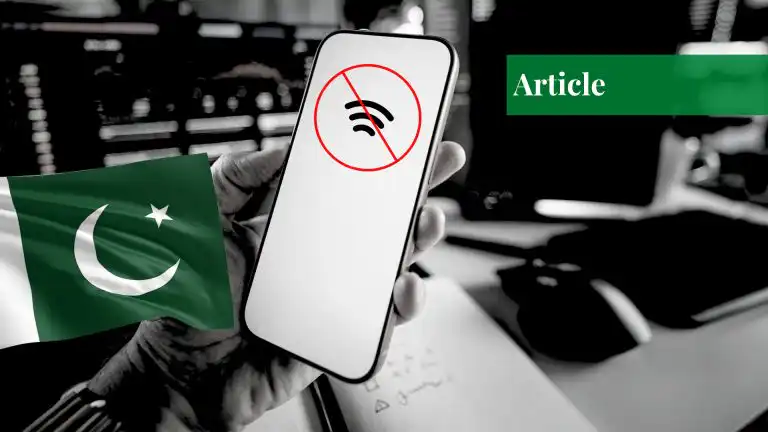
In 2024, Pakistan earned a distinction no government wants: it topped the world in economic losses caused by internet shutdowns. According to research by the Information Technology and Innovation Foundation, the country lost an estimated $1.62 billion from 9,735 hours of partial or complete internet shutdowns in a single year. That figure includes 84 days of complete blackouts and 322 days of social media restrictions — a scale of disruption that is difficult to fully comprehend until you consider what daily life in Pakistan increasingly depends on: a stable internet connection.
These restrictions did not just cost money. They changed how Pakistanis use the internet. And understanding that shift matters not just as a policy concern but as a window into how populations adapt when the digital infrastructure they rely on becomes unreliable by design.
What Actually Happened
The restrictions Pakistan’s citizens experienced in 2024 were not a single event but a sustained pattern. X (formerly Twitter) was blocked on February 17 without notice, shortly after disputed election results. Despite court orders demanding the ban be lifted, it remained in place for months. WhatsApp and Instagram experienced repeated disruptions throughout the year. Bandwidth was throttled on mobile networks during periods of political tension, and internet speeds fell to among the lowest 12 percent globally during these periods.
The government also moved against VPNs, which had become a widely used workaround for platform bans. Starting in late February 2024, VPN services were progressively blocked, and by year-end, a licensing system was announced that would require VPN providers to register with the state. The Pakistan Telecommunication Authority oversaw much of this, and reports emerged of a Chinese-style firewall being tested from July 2024, routing domestic traffic through centralised infrastructure rather than global CDN networks, which caused significant speed reductions for ordinary users.
The IT sector responded with alarm. Industry bodies warned of potential $300 million in annual losses and the possibility of companies leaving the country entirely if infrastructure reliability could not be guaranteed. For freelancers and remote workers — a growing share of Pakistan’s educated workforce — the disruptions were not abstract. They meant missed deadlines, lost clients, and reduced income.
How Users Adapted
When access to a platform becomes uncertain, users do not simply stop consuming content from it. They find ways to consume it that do not depend on live access. This is one of the clearest behavioural shifts that emerged from Pakistan’s sustained internet restrictions: a measurable move toward offline-first content consumption.
YouTube, which remained more accessible than social platforms during many of the restriction periods, saw a corresponding increase in demand for offline access tools. A YouTube video downloader allows a user to save a video to their device while connected, then watch it repeatedly without any internet required. For students following lecture series, professionals using tutorial content, or ordinary viewers who had learned the hard way that their connection might disappear mid-episode, this became a practical habit rather than an occasional convenience.
The shift is also visible in VPN adoption. Despite the government’s attempts to restrict them, VPN downloads in Pakistan surged during each major blocking event. Users were not accepting restricted access as the new normal; they were actively searching for alternatives. The throttling of these alternatives simply pushed users toward different workarounds.
The Structural Problem Behind the Behaviour
Understanding why Pakistani users adapted the way they did requires understanding the structural context. Pakistan has roughly 117 million internet users, the vast majority of whom access the internet through mobile devices. Mobile data, while cheaper than it was a decade ago, still represents a real cost for most households. The average user consumes around 8.4 GB per month on a bundle that costs Rs 250 to 350.
When internet speeds are throttled, streaming video becomes unusable before the connection is technically cut. A video that would ordinarily buffer in seconds takes minutes or fails entirely. Under these conditions, the rational response is to download content when the connection is functional and watch it when it is not. This is offline-first behaviour driven not by preference but by necessity.
The firewall infrastructure tested in 2024 added another layer to this. By routing traffic through centralised nodes rather than distributed CDN servers, the system introduced latency that affected all streaming, even when platforms were not explicitly blocked. Users experienced slower load times, lower resolution video, and more frequent buffering — all of which made the case for local downloads stronger.
The Broader Policy Failure
There is a recurring logic to the Pakistani government’s approach to internet restrictions: the assumption that limiting platform access will limit the spread of certain content or the coordination of certain activities. The evidence consistently suggests this assumption is wrong, or at least incomplete.
The X ban did not stop political discourse; it moved it to other platforms and to offline channels, including encrypted messaging groups. The VPN crackdowns did not reduce VPN usage; they accelerated it. The throttling of mobile networks during protests did not prevent protest coordination; it inconvenienced everyone, including people with no interest in politics, and cost the economy hundreds of millions of dollars in the process.
The Freedom House 2026 report on Pakistan gave the country a score that places it firmly in the “Not Free” category for internet access. The report cited content blocking, infrastructure interference, and legal vulnerabilities facing online users as the primary factors. That assessment reflects not just the scale of restriction but the degree to which those restrictions have been institutionalised rather than treated as temporary emergency measures.
What Comes Next
The behaviour patterns established during Pakistan’s period of sustained internet restriction are not going to reverse simply because restrictions ease. Users who learned to download content for offline viewing, to use VPNs as a default, or to reduce their dependence on live streaming have acquired habits that are likely to persist. In some respects, this represents a kind of digital resilience — the population has learned to function across a wider range of connectivity conditions than it previously had to.
But that resilience has come at a cost. The productivity losses, the reduced confidence of the IT sector, and the erosion of trust in digital infrastructure are not easily reversed. Countries that have built reputations as reliable digital economies took years to do so. Pakistan, which has genuine advantages in technical talent and a young population with high digital engagement, has spent considerable time moving in the opposite direction.
The throttling problem is ultimately a governance problem. The technology to restrict internet access exists, and Pakistan has demonstrated the willingness to use it. What remains absent is a framework that weighs the actual costs of those restrictions — economic, social, and reputational — against the stated justifications. Until that framework exists, Pakistani internet users will continue adapting to an infrastructure that was designed, at least in part, to limit what they can do with it.
If you want to submit your articles and/or research papers, please visit the Submissions page.
To stay updated with the latest jobs, CSS news, internships, scholarships, and current affairs articles, join our Community Forum!
Find our FREE quizzes and MCQs here!
The views and opinions expressed in this article/paper are the author’s own and do not necessarily reflect the editorial position of Paradigm Shift.

Paradigm Shift is an official staff account.