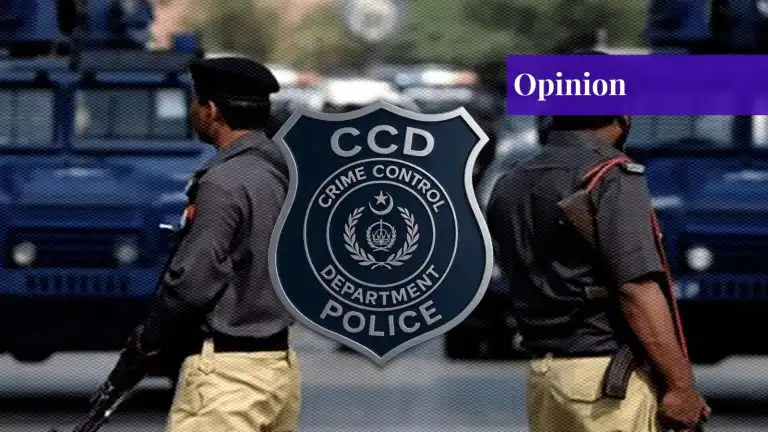
Punjab’s Crime Control Department was set up to fight crime. Its own record of alleged extrajudicial killings suggests it has started producing crime instead.
In February 2025, the Punjab government created a new police body, the Crime Control Department, or CCD, and presented it as a firm answer to crime. Less than a year later, it has become known for something else: a rising count of alleged extrajudicial killings that has drawn criticism from human rights groups and left an uncomfortable question hanging over the province: has the department built to control crime become one of the sources of it? Looking at its record so far, “Crime Committing Department” starts to sound less like a jab and more like a fair description.
The numbers are hard to get past. A fact-finding report by the Human Rights Commission of Pakistan (HRCP) found that at least 924 suspects were killed in alleged encounters carried out by the CCD between 15 April and 15 December 2025. Over the same stretch, only a handful of police officers died. That gap doesn’t look like the result of real gunfights. It looks like the product of staged confrontations and HRCP’s investigators say they found the same pattern repeating across districts, consistent enough to point to policy rather than coincidence.
None of this squares with the law. Extrajudicial killing isn’t some grey area in Pakistan’s legal system it’s flatly prohibited, no matter what someone stands accused of. One of the oldest principles of law, audi alteram partem, holds that no one should be condemned unheard: everyone accused of wrongdoing gets a fair chance to answer that accusation in court, not a bullet instead of a hearing. This isn’t an imported idea grafted onto Pakistani jurisprudence; it’s a principle Pakistani courts have recognised and applied for decades. Going by HRCP’s findings, the CCD isn’t bending this principle. It’s ignoring it.
The Constitution doesn’t leave much room for debate either. Article 9 guarantees the right to life, and Article 10-A guarantees the right to a fair trial and due process. Together they mean no one can be deprived of life or liberty except in accordance with law, and that phrase has a specific meaning. It means a trial before a competent court, where the accused actually gets heard. It doesn’t mean a verdict delivered on the spot by the same officers who made the arrest.
This isn’t a new or unusual standard, either. The US wrote due process into its Constitution through the Fifth Amendment in 1791 and extended it to the states through the Fourteenth Amendment in 1868, nearly two centuries built on the idea that the state shouldn’t get to be prosecutor, judge, and executioner all at once. Moreover, some parts of Pakistani society have responded to growing allegations of lawlessness in Punjab with applause rather than alarm, mistaking the absence of due process for efficiency.
Rule of law isn’t a phrase to invoke only when it’s convenient. A.V. Dicey’s classic definition of it, still the one lawyers and courts lean on, says no one can be punished or stripped of liberty except for a clear breach of law, established before an ordinary court, through ordinary legal process. A department that skips courts, trials and evidence in favour of encounters isn’t enforcing the rule of law. It’s replacing it with something else.
None of this denies that Punjab has a real crime problem, or that people understandably want results. But killing suspects before they’re tried isn’t justice. It’s the state borrowing the methods of the criminals it claims to be fighting, minus any of the accountability a court would bring. A conviction can be appealed, reviewed, and overturned if it’s wrong. A body can’t be undone.
Punjab’s government needs to decide, soon, whether it wants a department that actually controls crime or one that keeps making headlines for the wrong reasons. That means real oversight of CCD operations, independent investigation of every disputed encounter, and consequences for officers who act against the law. If the provincial government won’t impose these checks itself, the judiciary has both the mandate and the responsibility to step in before due process becomes, in Punjab, a right that exists only on paper.
If you want to submit your articles and/or research papers, please visit the Submissions page.
To stay updated with the latest jobs, CSS news, internships, scholarships, and current affairs articles, join our Community Forum!
The views and opinions expressed in this article/paper are the author’s own and do not necessarily reflect the editorial position of Paradigm Shift.

Subhan Ahmed is a corporate lawyer presently associated with JDW Group. He has a BA.LLB (Hons.) degree from Pakistan College of Law and has experience in corporate, commercial, banking, civil, and constitutional law, with a particular focus on litigation, legal research, and advisory matters.