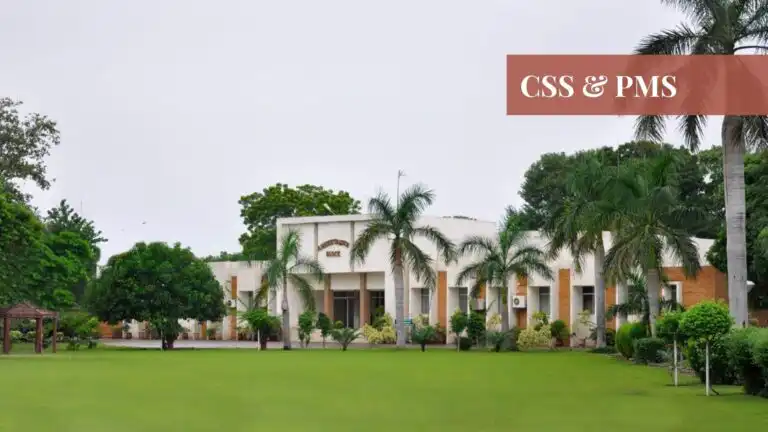
The Civil Service Academy (CSA) does an excellent job of training and educating new civil servants in Pakistan. As a premier coaching institute for Pakistan’s most prestigious examination, CSS, the Academy holds a significant position in our bureaucracy. The two main campuses of CSA, Walton Campus and Upper Mall Campus, are situated in Lahore. This institution, under the oversight of the National School of Public Policy (NSPP), aims to educate and prepare new and senior civil officials through a combination of theoretical and practical knowledge.
Bureaucracy serves as the foundational element of governmental operations, which consist of legislative, executive, and judiciary branches. These three branches are dependent on skilled, experienced and motivated civil servants. The CSS exam selects the vibrant academia of our country, whereas the CSA provides necessary training to these selected entrants, enabling them to enter the market with full zeal and zest. Thus, the CSA can be considered the final nourishing and finishing ground for newly selected civil servants, enabling them to give their utmost effort and contribution to their nation.
Historical Overview
Foundation (1948)
Initially, this institution was known as the Pakistan Administrative Academy. It was established in 1948 on the advice of the founder of our nation, Quaid-e-Azam Muhammad Ali Jinnah. Since there was a scarcity of bureaucrats immediately after independence, the Pakistan Administrative Academy was established promptly and served as the starting point for the training and probation of new civil servants in Pakistan.
Expansion of Scope (1963)
In 1963, during the reign of General Ayyub Khan, the Pakistan Administrative Academy was renamed the Civil Services Academy of Pakistan. Beyond this, the institutional structure was expanded with the inclusion of the Pakistan Foreign Service Sector. This newly inducted sector was responsible for training fresh entrants selected for the foreign services of Pakistan.
Restructuring (Post-1971)
After the separation of East Pakistan (Bangladesh), Pakistan lost its only crucial training institution for the police department, which was located in Rajshahi, Bangladesh. The country then required an immediate solution to this hindrance, which was resolved in 1972 by the installation of the Police Services of Pakistan (PSP) in the Academy.
Reforms (1973)
During the 1950s, the Government of Pakistan established the Finance Services Academy (FSA) as a distinguished institution for training new appointees in Financial Services. Subsequently, in 1973, Zulfiqar Ali Bhutto’s administration formally merged the FSA with the Civil Services Academy.
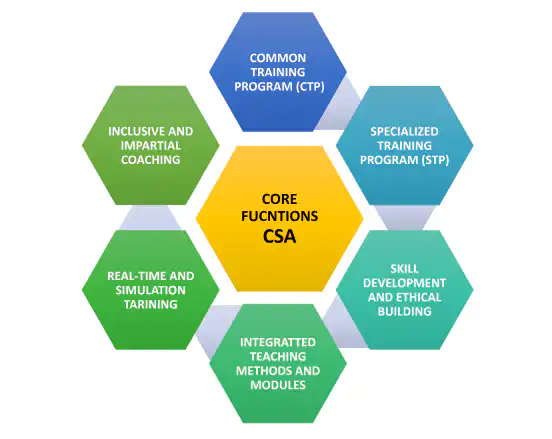
This institution was initially known as the “Academy for Administrative Training” (AAT), later renamed the Civil Services Academy. Moreover, a new coaching plan, named the Common Training Programme (CTP), was introduced for all newly appointed civil servants, providing the 12 distinguished occupational groups of the civil service with common teaching methods and modules.
Modern Advancement (Post-1981)
The CSA helped Pakistan’s bureaucracy become a well-equipped and skilled pillar in the post-1980s. For further improvements, in 1981, a specialized training program (STP) was launched to provide role-specific training to civil officials of the Pakistan Administrative Service (PAS), supplying the bureaucratic market with suitable personnel for the job.
Levels of Training
Pre-service, in-service, and foreign courses are the three major training modules offered by the Civil Services Academy. These three training programs equip our civil servants to contribute their efforts at the domestic, regional, and international levels.
Pre-Service Training
It is composed of a Common Training Program (CTP) and a Specialized Training Program (STP). The pre-service training is conducted before the formal induction of civil servants into the market. Typically, this training is a six- to nine-month coaching program that teaches trainees from all 12 occupational groupings, fundamental administrative rules, and regulations.
In-Service Training
This training program is designed for officials who are already serving to facilitate their upgradation and promotion. It consists of three significant courses for promotion to various grades, including the Mid-Career Management Course (MCMC) for BS-19, the Senior Management Course (SMC) for BS-20, and the National Management Course (NMC) for BS-21. These three courses fall under the jurisdiction of the National School of Public Policy (NSPP), providing senior civil servants with diverse exposure and content for their relevant upskilling.
Foreign Training
These trainings are not associated with any general upgradation. For wider exposure and learning, the Government of Pakistan or foreign organizations convene training workshops for newly appointed and senior civil servants. Such training provides civil officers with higher standards and skills by observing bureaucratic practices in the world’s most developed nations, such as the US, UK, and China.
| Workshops, Fellowships and Study Tours | Kinds | Rank | Purpose |
| Pre-Service | CTP and STP | BS-17 fresh appointees | Fundamental, basic, and task-oriented training |
| In-Service | MCMC, SMC and NMC | BS 18-20 Senior Civil Servants | Training for upgradation and promotion |
| Foreign Training | Workshops, Fellowships and Study tours | Selected officials | Observe and learn international bureaucratic practices. |
Modern Advancements in CSA
The CSA has undergone various revisionary processes, incorporating modern, practical, and non-traditional training methods and techniques. First and foremost, the CSA training program has now shifted from the old pattern of teaching and lecture delivery. This new aspect will provide fresh appointees with logical reasoning and skills, real-world problem-solving drills, group discussions, and critical thinking. Furthermore, the instigation of research projects focused on the Sustainable Development Goals (SDGs) has enhanced the traditional training method.
Secondly, the interpersonal development of civil servants is necessary for the smooth functioning of a state’s bureaucracy. For this, the CSA has installed various workshops in its training programs that focus on emotional intelligence, psychological build-up, public dealing, and stress reduction measures. Similarly, civil servants must be physically fit, and for this reason, CSA has started various sports and recreational activities to enhance the decision-making abilities of trainees.
Moreover, Khidmat-un-Nas (KUN) organizations have also become a significant part of the training sessions of CSA. These domestic organizations will provide young civil servants with an opportunity to engage with the social fabric of our society and lead various social projects, including educational programs, environmental projects etc., thus contributing to the welfare of our country. Last but not least, CSA has also collaborated with the Public School Attachment Programme. Under this program, civil officers will gain insightful experiences and encounter the challenges faced by our educational institutions. Through real-time observation, civil servants would be able to critically analyze the on-ground situation and develop targeted recommendations and plans of action.
Conclusion
The success of a state’s bureaucracy depends heavily on its training centers, such as the Civil Service Academy, where civil servants are trained to enter the service with effectiveness and feasibility. The evolution and transformation of the CSA have increased the traditional weightage of our civil services. To conclude, the Academy will remain a landmark institution in framing the overall structure and function of our bureaucracy. As civil servants are trained in the CSA, it will remain the most valuable and remarkable institution, providing the basic and foundational training platform to our bureaucrats.
If you want to submit your articles and/or research papers, please visit the Submissions page.
To stay updated with the latest jobs, CSS news, internships, scholarships, and current affairs articles, join our Community Forum!
The views and opinions expressed in this article/paper are the author’s own and do not necessarily reflect the editorial position of Paradigm Shift.

Syed Hammad Ali is pursuing a BS in International Relations programme from the International Islamic University, Islamabad, and has a keen interest in research works, policy analysis, defence and strategic studies, and conflict resolution.