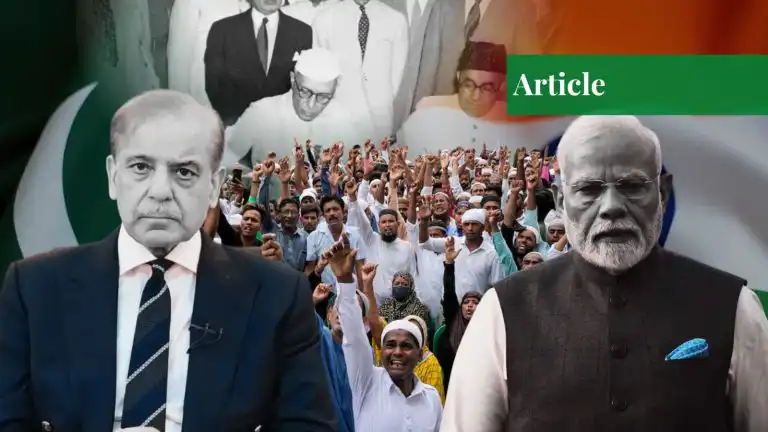
Both India and Pakistan have been in conflict with each other since the partition of the subcontinent. From domestic to external affairs, the policies of both states collide with each other, often creating uncertainty and chaos. With the seeds of enmity already sown during the time of partition, the initial years witnessed intense communal riots in the two countries. The partition of the subcontinent was already made in a hurry under Sir Cyril Radcliffe, handing over the territories that were already made part of Pakistan in the June 1947 partition plan.
Likewise, in the case of princely states, India coercively annexed those territories that were willing to join Pakistan, including Junagadh, Hyderabad, Jammu and Kashmir, etc. It seems like both countries were sitting on a powder keg ready to explode at the slightest flicker, which was proved by the 1950 communal riots. Minorities on both sides were viciously targeted. The governments of both states retreated to diplomatic resolution and signed the Liaquat-Nehru Pact or Delhi Pact in April 1950. In the short term, the agreement succeeded to some extent but lost its relevance in the long term.
What is the Pact?
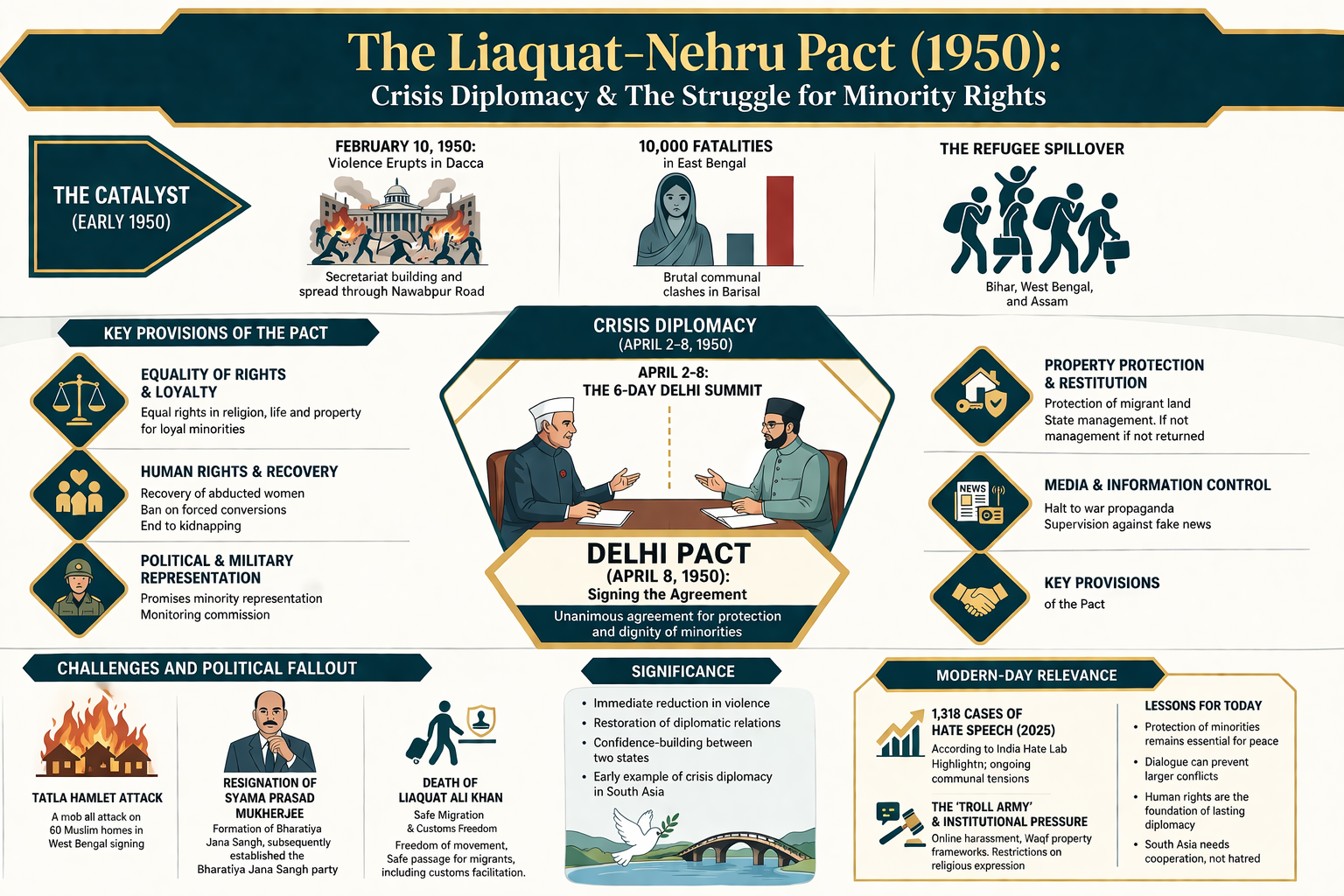
The escalating enmity towards the minorities compelled PM Liaquat Ali to take bold measures in a bid to resolve the problem. To solve the problem, the prime minister issued a statement that described the solution and proposed a meeting with his Indian counterpart. The two leaders had a meeting in Delhi on April 2, 1950. After six days, on April 8, 1950, they came to a unanimous agreement that was solely based on minority rights. As a result, the agreement was known as the Liaquat-Nehru agreement in diplomatic circles and commonly known as the Delhi Pact.
Why Was the Pact Signed?
The Liaquat-Nehru agreement was signed in a bid to protect the dignity, property, and lives of the various minority groups within their respective countries. They concluded that kidnapped women belonging to the minority group would be returned to their families and forced conversion was unacceptable. The spread of fake news and rumors posed a significant threat to both administrations even then. For this reason, the deal also included a clause requiring stringent supervision and immediate steps to stop the spread of misinformation and harmful views intended to incite communal fervor.
Background and Context
In Dacca, the Secretariat building witnessed violence on February 10, 1950. After the Jumma prayer, a conference was held with the Muslim clerics in the complex. The procession, later, marched down through Nawabpur Road, chanting anti-Hindu and anti-Indian slogans and robbing and looting the Hindu enterprises along the way. The violence did not take long to spread to the other districts. Barisal was probably the worst-affected area. Almost 2,500 individuals were murdered. It was believed that the riots in East Bengal resulted in around 10,000 fatalities overall.
This violence resulted in the spillover effect in neighboring India, in areas including Bihar, West Bengal, and Assam. A large number of people migrated from east to west and vice versa. Therefore, diplomatic efforts were started in Dacca to quell the fervent communalism and foster an environment conducive to the minorities’ reverse flow. On April 2, 1950, the two Prime Ministers held a lengthy discussion. The conference took place over six days. The agreement, later dubbed the Nehru-Liaquat Pact, was signed on 8 April 1950.
Key Provisions of the Pact
- All minority communities would enjoy equal rights with respect to religion, life, property, etc.
- Minorities must remain loyal to the government and the country in which they live.
- The people migrating due to the riots would be provided safe passage and freedom of movement.
- Migrants will not be harassed by the customs department.
- Protection of land and property of migrants would be ensured. If they return before the deadline, their property will be given back to them.
- In case of no return, the property of migrants will be managed by the government.
- Both governments agreed to halt the violence, recover the losses, and rescue abducted women.
- Strict actions would be taken against disinformation campaigns.
- Both countries would refrain from allowing war propaganda against each other.
- Minorities will be given political and military representation.
- A special commission would be set up to monitor the implementation of the pact.
Limitations and Violations
Soon after the pact was signed, its violations were reported on the Indian side, and the government failed to manage the chaos. A group of refugees from the Dhubulia Camp in West Bengal broke into the field of a nearby Muslim on April 26 in order to capture sheep. The latter fought back. This was followed by a mob of Hindus attacking and burning down the Muslim neighborhood of Tatla hamlet. Sixty homes were destroyed in the fire.
On 4 June, a gang of 100 Sahibnagar refugees attacked 14 Muslim families in the same village. The village was predominantly Muslim, with 200 families, of which the majority had moved to Pakistan. The Muslims’ homes were raided, and they were attacked. Furthermore, on August 24, 1950, a party of 30-40 Sondanga Hindu refugees frightened a group of Muslims and their families that had gone back to Sondanga in Pakistan and ransacked all their belongings before they could get into the village.
This was, however, a short-lived relief for the minorities, and only a year after the Delhi Pact was signed, Liaquat Ali Khan was shot dead during a public gathering in Rawalpindi. Since the first day, radical groups in India have been very much opposed to the agreement. As a way of protesting against the said treaty with Pakistan, Syama Prasad Mukherjee, who was a close political associate of Pandit Nehru, resigned from the cabinet of Nehru. He established his own political party, the Bharatiya Jana Sangh Party.
A Forgotten Pact?
The circumstance has reached a crisis point now. The BJP is in power in India. The Waqf properties owned by Indian Muslims are now under the control of the Modi administration. As a result, there is currently a legal foundation for appointing a non-Muslim as the head of an Indian Waqf organization. Likewise, there is an increase in hate speech against minorities in India. According to India Hate Lab, 1,318 cases of hate speech occurred in 2025. Individuals and organizations, especially Muslims, are often harassed by BJP-affiliated online ‘troll armies’ for expressing opinions that are critical of the administration or for engaging in conduct that is said to violate Hindu orthodoxy.
Conclusion
The Liaquat-Nehru pact, though forgotten, is one of the best examples of crisis diplomacy between India and Pakistan, under which the governments of the two nations agreed with each other on the protection and preservation of the rights of minorities. Nonetheless, lack of visionary leadership and national radicalization caused severe scratches in these fledgling diplomatic activities. From online trolling to a ban on the hijab, Muslims are under constant surveillance and restricted from fully enjoying their religious and cultural freedom under the BJP government. The historical and cultural heritage of Muslims of the subcontinent is under grave threat, with mosque demolitions becoming common in India. The circumstances have reached a point of no return, and the stubborn attitude of subsequent Indian governments has further made the reconciliatory efforts harder.
If you want to submit your articles and/or research papers, please visit the Submissions page.
To stay updated with the latest jobs, CSS news, internships, scholarships, and current affairs articles, join our Community Forum!
The views and opinions expressed in this article/paper are the author’s own and do not necessarily reflect the editorial position of Paradigm Shift.

Syed Hammad Ali is pursuing a BS in International Relations programme from the International Islamic University, Islamabad, and has a keen interest in research works, policy analysis, defence and strategic studies, and conflict resolution.