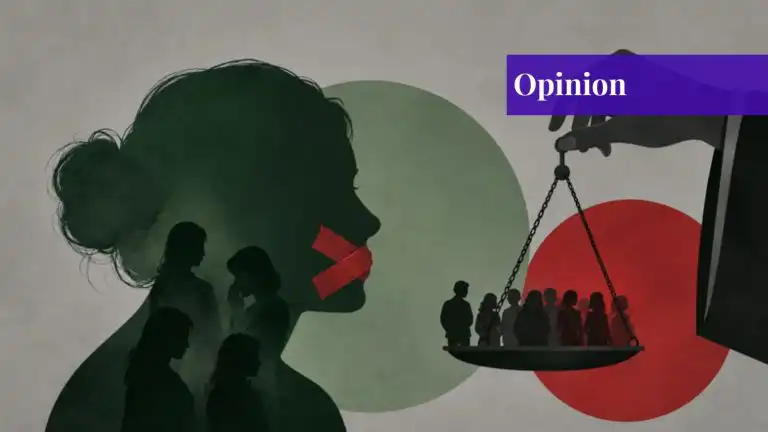
The fast growth of internet accessibility in Pakistan, in which the majority of the population has mobile broadband coverage, was assumed to lead to the democratization of access to justice. As for victims of gender-based violence, online platforms represent an outstanding opportunity to overcome traditional barriers set by patriarchy and announce their stories publicly. However, legal distortion has occurred. The legal system and judicial activity in Pakistan have turned the cybercrime and defamation legislative frameworks into a weapon of legal revenge. Using the so-called SLAPPs (Strategic Lawsuits Against Public Participation), perpetrators have been diverting the judiciary from dealing with sexual harassment cases to punishing the survivors for their stories. This article presents examples of how the laws aimed at protecting online environments are being manipulated to suppress victims through the analysis of constitutional disputes, changes in the police system, and important court rulings till 2026.
The government of Pakistan maintains a tight grip on online conversations through a mixed set of civil and criminal regulations. Introduced in 2016 after the Peshawar Army Public School attack, PECA (Prevention of Electronic Crimes Act) was originally devised as a measure for national security. Gradually, its application shifted towards facilitating the protection of public personalities and people who are charged with malpractices. Section 20 of PECA penalizes spreading known false information intentionally if such an act damages a person’s reputation or invades their personal privacy.
The PECA Amendment Act of 2025 brought the growth of digital law enforcement as it instituted four bodies of regulated enforcement, such as the National Cyber Crime Investigation Agency (NCCIA) and the Social Media Protection Agency. Section 26-A of the 2025 Act made it a crime to disseminate any fake news, with a possible punishment of three years of imprisonment and a fine of up to two million rupees. In July of 2026, the NCCIA revealed that a special section had been formed in Punjab to deal with crimes that were committed through cyber media against women and children. Nevertheless, there is a key contradiction in the structure of the legislation discussed by human rights activists: the NCCIA is using its digital forensic technologies against the victims of the crimes.
Provincial Overreach: The Punjab Defamation Act of 2024
The laws became harsher with the passing of the Punjab Defamation Act of 2024. The Act defines defamation simply as a civil offense. This means that there is no requirement to show any financial loss suffered because of defamation to get a hold of compensation for damages. The law provides for the creation of Defamation Tribunals, which are run by government officers. The tribunal works on summary procedures and requires defendants to seek leave to defend themselves within thirty days to avoid getting a preliminary decree.
The Lahore High Court witnessed the petition filed by some journalists and civil society organizations challenging the law. In March 2026, Justice Anwaar Hussain called the law officers to discuss the basic constitutional flaws in the petition filed by the counsels, Faisal Siddiqi and Asad Jamal. The petitioners argued that the provincial assembly did not have any constitutional mandate regarding social media and defamation, that the summary tribunal’s procedure violated the right to a fair trial guaranteed by Article 10-A, and that giving special protection to those holding constitutional positions results in the formation of a parallel judiciary in violation of the Constitution. In April 2026, Justice Hussain forwarded the combined petitions to the Chief Justice for setting up a wider bench, linking all ongoing proceedings related to defamation at the provincial level with the final decision in the case.
The implications of such laws are best illustrated by the famous legal battle between the singers Ali Zafar and Meesha Shafi, which can be termed Pakistan’s #MeToo case. In 2021, the Supreme Court allowed an appeal in the case for reconsidering this narrow definition.
Although an appeal was pending for Shafi’s principal claim in the Supreme Court, her civil case continued to proceed in the lower courts. Lahore Sessions Judge Asif Hayat ruled in favor of Zafar, awarding him five million rupees in damages along with issuing a permanent injunction prohibiting Shafi from making accusations against him through any medium. Shafi appealed the decision before the Lahore High Court. On May 4, 2026, Justices Ahmad Nadeem Arshad and Malik Waqar Haider Awan provisionally granted a stay against the monetary award, dependent upon securities and a cash deposit. However, the bench refused to lift the permanent injunction on the basis that there cannot be any repetition of the accusation during the process of appeal. By doing so, the ruling could be seen to have created a precedent wherein a survivor has been silenced while her primary abuse claim is pending judicial determination before the Supreme Court.
Evidentiary Barriers, Empirical Realities, and Reform
The concept of the perfect victim plays an instrumental role in the operation of law and impacts the pursuit of justice. In the courts, the criteria list includes the appearance of trauma, the expedient reporting of events, and the disconnection of any association with the perpetrator. Any deviation from this model is taken as a sign of malice. Although Section 509 of the PPC outlaws any form of insult to a woman’s modesty, the definition of the notion is left to the arbitrary interpretation of the mostly male gender. The situation becomes even more complicated because of defamation cases, where the burden of proof is actually reversed, shifting onto victims, who would need to prove all their allegations or pay a fine for misleading accusations.
To resolve this systemic contradiction, Pakistan needs to bring in prompt legal reforms. The Parliament must stop digital defamation from being illegal, and in the laws dealing with defamation, it must only be treated as a civil matter. The national and provincial assemblies must pass anti-SLAPP laws. The law would enable early dismissal of retaliatory claims against victims and offer complete protection in matters of safety and law enforcement. Lastly, the Workplace Harassment Act of 2010 needs to be amended to cover the protection of independent contractors, and judicial training institutes need to incorporate courses on how to deal with victims of gender-based violence.
If you want to submit your articles and/or research papers, please visit the Submissions page.
To stay updated with the latest jobs, CSS news, internships, scholarships, and current affairs articles, join our Community Forum!
The views and opinions expressed in this article/paper are the author’s own and do not necessarily reflect the editorial position of Paradigm Shift.
Dur-e-Adan is a dedicated International Relations student at Government College University Lahore with a keen interest in geopolitics and diplomacy. With strong writing skills, her academic pursuits are complemented by a commitment to critical thinking and analysis.