Putin’s Casus Belli: Rebuilding “Novorossiya” (New Russia)
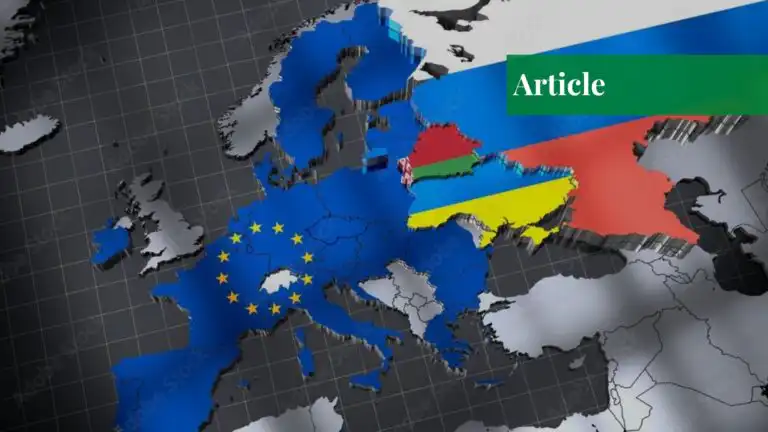
The perennial distrust of the West drives Russia’s strategic manoeuvres, the inveterate hostility towards these forces and the resentment harboured against them since the collapse of the Soviet Union. As a consequence of this historic debacle, the Russian mentality has become consumed by the obsession of reclaiming the Soviet empire and regaining the stature it once commanded. The “Putinesque” ideology is accentuated by this political zeal for imperial restoration and romanticisation of the “Russian Sphere of Influence,” lying at the heart of Putin’s unbridled ambitions for Russian supremacy which fueled the full-scale invasion of Ukraine in 2022. The EU gave a strategic response to the Russia-Ukraine conflict.
The Strategic Dilemma of the EU
The Russia-Ukraine war has significant implications for the policy formulation of the European Union. This has warranted a recalibration of its priorities, spanning across economic, political and security dimensions. The annexation of Crimea, military intervention in Ukraine by Russia, European sanctions on Russia and Russia’s counter-sanction responses, all have dragged the graph of relations between the EU and Russia to the lowest point. The focal point is Ukraine, but at stake is the European security order. Former US President Joe Biden and many other Western leaders have claimed that the war in Ukraine was the first step in Putin’s broader plan of European conquest. No issue created controversy or disparity among the members of the EU than Russia. The EU faces serious tensions in its neighbourhood policies directed towards the east and south. The conflict between Russia and the EU is strongly motivated by the lack of comprehension of dominant divergent narratives.
The roots of relations between the EU and Russia can be traced back to the fall of the Berlin Wall and the disintegration of the Soviet Union in 1991. European leaders inspired by Gorbachev’s idea of a “common European home” saw an opportunity for peace and cooperation with Russia through peace and shared prosperity. However, in Russia, terms like “betrayal” and “humiliation” became common given relations with the West. NATO intervention in Kosovo in 1999 and the inclusion of Hungary, Poland, and the Czech Republic that brought NATO to Russia deepened Russia’s mistrust towards the West and EU. “Eastern Partnership” launched by the EU in 2009 aimed at constructing stronger ties with Ukraine, Belarus, and Georgia interpreted as a threat by Russia and Russia formed the Eurasian Economic Union in response to building a similar economic bloc under Moscow’s leadership.
Navigating the Complex Geopolitical Landscape: European Union’s Policies and Actions to Counter Russia
Economic Resilience and Energy Restructuring
The intractable conflict has had overarching repercussions on the economic recovery and resilience of the European Union following the drastic COVID-19 pandemic. The European Commission’s 2021 Autumn Forecast predicted 2.5% growth for 2023, however, growth was registered at 0.5% in 2023. Another predicament was the enormity of the energy crisis in 2022, resulting in extortionate energy prices and high inflation figures. As a consequence, the European Union Central Bank embarked on a series of 10 consecutive interest rate increases owing to the energy crisis and now the inflation rate has returned closer to the 2% target. According to Eurostat, the euro inflation stood at 2.8%, as of January 2024.
The EU was reliant on Russian energy, with 24.4% of its total energy supplied by the aggressor, allowing it to wield energy as leverage to advance its military actions. The policy dilemma was aggravated as the confrontation with Russia escalated and became more pronounced, implying a stronger supply shock. Nevertheless, the European Union’s perseverance in the face of insurmountable adversity stands as a shining testament to its legitimacy as an institution. The European Union prepared contingency measures which reduced its heavy reliance on Russian energy imports which was initially at 45% in the year 2021. Subsequently, the EU banned Russian crude oil in December 2022, followed by diesel in 2023. The EU also reduced 15% of gas use relative to the previous 5-year consumption from August 2022 to March 2023. Moreover, the EU27 has employed a successful joint gas procurement strategy to constrain prices and strengthen the purchasing power of gas firms.
It is pertinent to highlight that the value of EU exports to Russia has now reduced by 59%. Moreover, the value of EU imports from Russia fell by 87% between the first quarter of 2022 and the second quarter of 2024. Under the Versailles Declaration, the EU countries managed to reduce their reliance on Russian oil, gas and coal under initiatives such as the RePowerEU. The EU leaders further endeavoured to reduce strategic dependencies through legislative proposals including the currently implemented European Chips Act (2022) and Critical Raw Materials Act (2023). In a concerted effort to secure strategic autonomy, a combination of effective strategies was implemented. Concerning this, the Important Projects of Common European Interest (IPCEIs) have played an integral role in generating conditions conducive to private investment and a thriving economy. The United States has also played a vital role in supplying liquefied natural gas (LNG) to the European Union with considerable exports to the member countries, amounting to a total of 68%. Furthermore, the World Trade Organization in conjunction with the EU had also denied preferential treatment/status to Russian products and services within the EU markets. Natural gas supplies have emerged as a weapon between Russia and Europe. The European Union has increased its purchase of Azeri oil to limit funding for Moscow’s war machine. EC signed a memorandum to double the Azeri imports of gas to at least 20 billion cubic metres by 2027. The Southern Gas Corridor transporting Azeri gas to Europe has been operational since 2020. It is also noteworthy to highlight that the EU continues to support Ukraine through the establishment of the Ukraine Facility which is a key instrument to tackle the multifaceted challenges confronting Ukraine and focuses on revitalising the Ukrainian economy through financial assistance.
Political Unity
Amid soaring tensions, Russia has remained a polarising issue for the EU. The Western and Southern states have sought to maintain cordial relations and cooperation while, on the contrary, the Northern and Eastern-European countries have compelled the EU to adopt an assertive stance and implement stringent measures. Nevertheless, the EU has demonstrated incredible resolve as a collective body. A crucial factor that underpinned this approach was the convergence of views among the EU member states and actors that has proven instrumental in strengthening the EU’s autonomy, and capacity to act and building cohesion in policy-making. As a result, in pursuance of its commitment to promoting the principles of territorial integrity, self-determination and sovereignty, the EU has ensured the binding nature of the imposed sanctions that are being implemented to deter Russian aggression. It has garnered support and mobilised into action by maintaining a united policy response as evinced by the “Sanctions Revolution” underscored by the unanimous consensus on 14 packages of sanctions against Russia, including the suspension of visa facilitation between Russia and the EU.
The EU has been actively engaging with European countries. In 2022, the European Political Community was established to foster cooperation with European states. In addition, Moldova and Ukraine were granted the status of EU candidate country, while Georgia was granted the status of potential candidate country to compete with Russia on the geopolitical front. As part of its “Sanction Diplomacy,” the EU has nominated David O’Sullivan as the first International Special Envoy for the Implementation of EU Sanctions and established the Sanctions Coordinators Forum to broaden the coalition and prevent circumvention of sanctions. The EU Crimes list comprises the violation of restrictive measures and its criminalisation including the severity of criminal offences and their appropriate penalties. Amongst the activities officially declared criminal offences, some constitute assisting citizens in bypassing EU travel bans and/or trading sanctioned goods.
Strengthening Security Architecture
Russia remains a primary threat to the EU, posing significant challenges in the conventional, nuclear, and hybrid realms. Russia’s blatant violation of the UN charter threatens global peace. Russia’s deployment in Ukraine in 2022 raised alarms towards European efforts to sustain peace. It remains a formidable military power and its modernization program initiated in 2000 continues to be a cause of concern. Russia often ignored its commitment under the Vienna Document and conducted long-scale military exercises. The Treaty on Conventional Armed Forces in Europe (CFE) which was negotiated in the final years of the Cold War and is considered the cornerstone of European security is no longer regulatory. Russia suspended its participation and withdrew in March 2015. In response to Russia’s fighter patrols making incursions in European airspace, the United States withdrew from the Open Skies Treaty in 2020. Russia’s strategic thinking is often motivated by its possession of nuclear weapons which compensate for its inferiority in conventional military power. Many analysts perceive the nuclear doctrine of Russia as lacking clarity. US Nuclear Posture Review, released in 2018, argued that Russia subscribes to the belief that the first use of nuclear weapons to “de-escalate” the conflict, actually “escalates to win” instead of “escalate to de-escalate.” Russia’s cross-domain strategy of coercion, often labelled as “hybrid warfare”, this “New Generation War” involves a nuclear dimension that could only be understood in the context of a holistic coercion campaign.
The EU has strongly coordinated its actions with allies including NATO, G7, UK, USA, Canada, Norway, and Australia. The EU has changed its cooperative system into a system of balance of power and containment. The European Union has continued its unwavering support to Ukraine which highlights the EU’s commitments to maintain transatlantic security structures. The European Peace Facility also plays a pivotal role in strengthening the European defence industry.
In retaliation to Russia’s aggravating brinkmanship, the European Union adopted the Strategic Compass for Security and Defence policy which outlines a consolidated approach to strengthening the EU’s defence and security policy by the year 2030. Defence spending has risen by 12%. It solidifies the commitment of the member states to achieving collective and cooperative security through substantial investments in defence capabilities, crisis management and development of resilience to ensure solidarity and mutual defence in the face of Russia’s belligerence. The EU established the European Union Military Assistance Mission in support of Ukraine which focuses on enhancing the military capabilities of Ukrainian forces and is currently operational with the budget €409 million allocated for the period from 14 November 2024 to 15 November 2026. Recently, the EU has also introduced a new sanctions framework called EU Russia Destabilisation Sanctions, which is aimed at targeting individuals and entities perpetrating hybrid activities that threaten the security of the EU and its member states and subvert its fundamental value system.
Hybrid methods of Russia are raising alarm bells for the EU members. The EU and its members have condemned many times the cyber-attacks, information manipulation, and interference campaigns, vandalism and sabotage, and other disruptive actions perpetrated by Russia. Keeping such bellicose activity into consideration, the EU has implemented a new legal framework of restrictive measures, under which, the EU queries those who are accountable for, implement, support, and benefit from Russia’s disrupting activities worldwide. The Hybrid CoE in Helsinki opened to both NATO and EU, has effectively enhanced the capabilities of member states to combat hybrid threats as well.
Conclusion
According to the analysis above, it is likely that Russia will prove to be a fatal disease for the EU and the situation is exacerbating as the Russia-Ukraine war has gained momentum. Support for Ukraine is significant to the validation of European security. With the Trump 2.0 era ushered in, the dynamics of global politics are swirling. The United States as guarantor of European security allocates a major budget to the defence system, however, with Trump’s America’s first policy, there are concerns over the possible withdrawal of the US from international organisations including the end of assistance to Ukraine, thus overburdening the European countries with the struggle to keep wolf (Russia) away from the door. Joseph Borrell, EU foreign policy chief, expressed his hope that EU member states could agree to allow Ukraine to use those arms to strike inside Russia. G7’s 50 billion dollars, together with the US, has been promised for Ukraine. Germany has also agreed to provide 200 million euros as humanitarian aid to Ukraine.
Nevertheless, the EU must assume greater responsibility to contribute to a transatlantic partnership that includes significantly strengthening NATO’s European pillar. Geography, force improvements, and an alliance system could give Russia an upper hand. US focus on China as a rising power in Asia-Pacific regions divides its attention between two major extremes: Europe to counter Russia and Asia-Pacific to counter China. This poses a risk that the US might struggle to maintain and uphold its commitments both in Europe and Asia. Thus, European countries must take a collective stand and take greater responsibility to deter Russian threats rather than relying heavily on the US as the hostility between Russia and the EU would consequently compound the current security dilemma and lead Ukraine to the brink of a deadly escalation which is detrimental to Europe, as a whole. Whether there will be peace, a ceasefire or a stalemate, the European Union’s legitimacy and credibility as an institution will ultimately play an instrumental role in deciding the fate of Ukraine and the rest of Europe.
If you want to submit your articles and/or research papers, please check the Submissions page.
The views and opinions expressed in this article/paper are the author’s own and do not necessarily reflect the editorial position of Paradigm Shift.

Eman Fatima is currently pursuing her Bachelor's degree in International Relations from Government College University Lahore. She has a keen interest in understanding the complexities of global politics and the dynamics that shape international interactions.

Zahra Zaman is an undergraduate student majoring in International Relations at the Department of Social Sciences, SZABIST University, Karachi. She has worked as a Research Intern at the Pakistan Institute of International Affairs and has also contributed to the European Center for Populism Studies.