
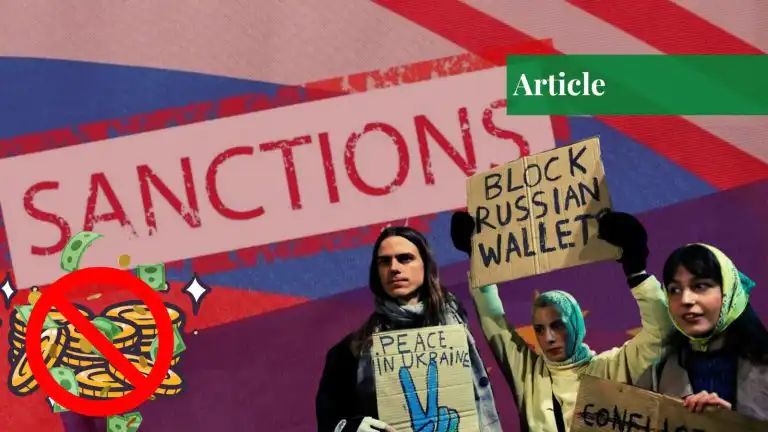
Every time a major international crisis erupts, the announcement follows within days, sometimes hours. A press conference. A podium. A row of flags. And then the words: ” We are imposing sanctions. It has become the default opening move of Western foreign policy, a signal that something is being done, that behavior will not go unpunished, that there are consequences.
In the aftermath of the Cold War, there has been an explosion of economic sanctions. The data collected by the Global Sanctions Database shows that, whereas 200 sanction programs were in existence in the previous decade, the figure has now grown to 600 sanction programs. About 12 percent of all existing country pairs and 27 percent of world trade are currently affected by some form of sanction. The United States alone has imposed three times more sanctions than any other country or international body, and the list of justifications keeps growing: terrorism, narcotics, human rights violations, weapons proliferation, election interference, and more.
But here is the question that rarely gets asked at those press conferences: Do they actually work? And if the evidence on that question is as mixed as it is, then who exactly is paying the price?
What Sanctions Actually Are And Why They Are So Appealing
In essence, economic sanctions are coercive foreign policy measures. There are many kinds of economic sanctions, such as trade sanctions, which prevent the inflow or outflow of trade products to and from other countries; financial sanctions, which target the freezing of assets of an offending nation and also prevent it from using global banking institutions; targeted or ‘smart’ sanctions, which specifically target individuals or organizations; and industry-specific sanctions.
Their political appeal is obvious. They occupy the space between doing nothing and going to war. They let a government demonstrate resolve, satisfy domestic audiences demanding action, and avoid the human and political costs of military intervention. As mentioned in one of the most widely read analyses in Foreign Affairs, this is exactly why sanctions have become such an easy way out, because “presidents are always eager to impose sanctions but wary of lifting them.” The mere imposition of sanctions represents strength, while their reversal represents weakness.
The sanctions that followed the Russian invasion of Ukraine in February 2022 perfectly exemplified this approach. Within several weeks after the invasion, the West managed to freeze more than $300 billion in Russian central bank reserves, barred Russia’s commercial banks from using SWIFT, slapped export controls, and sanctioned many individuals and entities. In terms of economic pressure tactics used, this was certainly unprecedented, according to the analysis by Chatham House. But would they make any difference?
The Leaders Stay. The People Pay.
The central problem with broad economic sanctions is a gap between design and reality. They are designed to pressure governments by making populations suffer enough to force a change in leadership or policy. An example of this phenomenon is Iran, which becomes increasingly evident every day, especially coming up to 2026. The sanctions by the U.S. and other countries against Iran had become much harsher after the launch of the ‘maximum pressure’ policy by the Trump administration in 2018, and when they were imposed again during the second term of President Trump in January 2025, they wrecked the lives of average Iranians without destabilizing the Islamic regime’s leaders.
The sanctions re-imposed by the United States on Iran in November 2018 led to a rise in the cost of imported medicines as Iran’s national currency declined by about 70 percent against the dollar. The average monthly salary had dropped to the equivalent of around $450, making even domestically manufactured drugs out of reach for ordinary people. By March 2026, the situation had deteriorated further still: the rial was trading at over 1 million to the dollar, less than half its value just nine months earlier, with inflation running at 49 percent even as Washington continued rolling out new Iran-related oil designations on a near-monthly basis throughout the year.
The humanitarian carve-outs that are supposed to exempt food and medicine from sanctions pressure have proven largely ineffective in practice. As PBS NewsHour reported, the UN Special Rapporteur on Unilateral Coercive Measures found that sanctions had affected Iran’s pharmaceutical and food production sectors, caused inflation and rising poverty, and depleted state resources for meeting the basic needs of vulnerable groups. She specifically named “severe diseases, disabled people, Afghan refugees, women-led households, and children” as those most severely impacted. The exemptions exist on paper. The fear of secondary sanctions of being punished for doing business with Iran at all means banks and companies routinely avoid humanitarian trade entirely.
The Iraq case remains the most extreme and morally damning in the historical record. The broad UN embargo implemented following the Iraqi attack on Kuwait in 1990 remained in force for more than ten years. As per the analysis of UNICEF statistics by Human Rights Watch, the number of infant deaths in south-central Iraq increased from 47 out of 1,000 live births between 1984 and 1989 to 108 out of 1,000 in 1994-99. The food rationing system was providing less than 60 percent of the required daily calorie intake. The water and sanitation systems were in a state of collapse. Saddam Hussein, meanwhile, remained in power until a military invasion removed him in 2003 without sanctions.
In Russia, the picture is more complex, but the pattern is consistent. The IMF initially forecasted a fall in the Russian GDP by 8% to 10% for 2022 due to the invasion of Ukraine. The actual contraction was 2.1%. The Carnegie Endowment for International Peace found that by late 2024, Russia was dealing with inflation approaching 9 percent and a key interest rate of 21 percent genuine economic strain. But the ruble’s steepest falls have been absorbed by a population that has seen its savings eroded, and its cost of living rise sharply, not by the oligarchs and officials who enabled the war. The people who had no vote for the invasion are shouldering most of the economic pain.
Do They Ever Work? The Honest Answer
The honest answer is: sometimes, under specific conditions, and less often than their advocates claim. The best example of successful sanctions is provided by South Africa. The long-term process of imposing economic sanctions and divestments from companies working in South Africa, as well as the passing of the United States Comprehensive Anti-Apartheid Act of 1986, is considered to be one of the causes for the apartheid government’s willingness to negotiate with Nelson Mandela and the ANC party. However, there is more to the story than that. As scholars at Oxford have documented, the early arms and oil embargoes of the 1960s and 70s were actually counterproductive; they solidified the ruling coalition. It was the combination of sanctions with an internal uprising, a black working-class movement, and an economic crisis in the mid-1980s that finally divided the ruling bloc. Sanctions were just one of many factors involved, and probably not the most important.
Another success story often quoted by scholars is the Iranian nuclear deal of 2015 (Joint Comprehensive Plan of Action). There is no doubt that sanctions from the US, EU, and United Nations did have an influence on Iran’s economy and helped force Iran into negotiations over its nuclear program. However, it is also important to highlight two factors. The first factor is that Iran only made certain and limited concessions regarding the suspension of its nuclear program, but not regarding its regional policies, the funding of proxies, and its political system. The second factor is that the exit of President Donald Trump from the nuclear agreement unilaterally and the imposition of maximalist sanctions have virtually undone those gains.
A 2024 analysis from CEPR using the Global Sanctions Database found that while sanctions decrease trade with sanctioning states, they consistently produce significant trade liberalization between the target country and third parties, liberalization that often “mitigates and may even eliminate” the negative primary trade effects. In other words, the target finds new trading partners, and the sanctions lose their bite.
The Workaround Economy
In studies on sanctions, one thing remains constant: the ability of targeted nations to adjust themselves in response to these sanctions. They construct alternative trade channels, establish links with other nations that do not impose such sanctions, create domestic alternatives, and find clever ways to overcome monetary restrictions.
However, Russia’s reaction to the sanctioning policy of 2022 remains one of the best recorded examples of the recent past. By mid-year of 2022, both China and India emerged as Russia’s main customers for oil supplies, offsetting any shortages experienced by Europe. As revealed by the Russia Sanctions Database at the Atlantic Council, as much as 75 percent of Russia’s total exports of crude oil were bought by China and India by the start of the first quarter of 2023, in contrast with a 26 percent share witnessed by these countries in 2021. From December 2022 to December 2023, G7 coalition member states have also imported approximately $9 billion of refined oil products from India and other countries on behalf of Russia, thus delivering their oil to Europe despite the imposed sanctions.
The UAE, Turkey, and certain Central Asian countries served as intermediary economies, providing Russia’s companies with products and parts that were supposed to be barred by Western exporters. It is important to stress that this situation is neither accidental nor a result of inadequate implementation of the sanctions policy; rather, this is how our global economy works. While there are still key economies outside of the sanctioning system, there will always be a way for the sanctioned country to channel its commerce through them.
It is no coincidence that 2026 provided a rather remarkable example of this pattern, with a unique twist – this time, Washington itself turned the valve. Having refrained from imposing any sanctions on Russia in pursuit of ceasefire talks, in October 2025, President Trump announced sanctions on Russia’s two biggest oil companies, Rosneft and Lukoil. However, by March 2026, under the pressure of growing oil prices in response to joint American and Israeli military actions against Iran, the American administration agreed to provide substantial sanctions relief to the Russian oil industry. The effect came quickly and with force: according to the Atlantic Council’s Energy Sanctions Dashboard, by mid-May 2026, Russia was exporting around 300 million barrels to the world market, with India emerging as one of its principal customers and South East Asia becoming another outlet for Russian crude. To summarize, the workaround economy proved to have no reason to work around at all; the sanctioning power simply made the breach itself. The case of North Korea is one of the worst. Having undergone the most intensive sanctions policy ever applied by the United Nations, including limitations regarding weapons sales, coal, iron, seafood, textiles, and virtually all monetary transactions, North Korea persists in developing and testing ballistic missiles, while holding on to its nuclear stockpile. It managed to do it by simply bypassing sanctions, receiving the tacit consent from China, and maintaining such an economically detached nation that does not rely on integration into international markets anymore.
Why Do Governments Keep Using Them Then?
This is the question that the evidence forces us to ask, and the answer is uncomfortable: because sanctions serve important political purposes that have nothing to do with changing the target’s behavior.
When a government imposes sanctions, it is first and foremost communicating to a domestic audience. It is demonstrating that it takes the situation seriously, that it is not doing nothing, and that there are consequences for violating the rules-based international order. This is genuine and not entirely cynical — expressing moral opposition to an invasion or a human rights atrocity through economic measures is meaningful, even if the practical impact is limited. But the performance of resolve and the actual achievement of policy change are two different things, and they are too often conflated.
As Foreign Affairs observed, the political asymmetry cuts against effectiveness from the start: it is easy to impose sanctions and politically difficult to remove them, because removal looks like capitulation. This creates regimes that outlive their usefulness, that remain in place long after it is clear they are not achieving their stated objectives, simply because no administration wants to be seen as soft. Cuba has been under comprehensive U.S. sanctions since 1962. The Cuban government is still in power.
There is also what might be called the “something must be done” trap in democratic foreign policy. When a crisis erupts, and military intervention is not on the table because it is too costly, too risky, or too unpopular, sanctions fill the space. They allow leaders to stand at a podium and announce consequences without committing troops or spending significant political capital. The fact that the consequences largely fall on civilian populations rather than ruling elites rarely features prominently in those press conference remarks.
Conclusion
None of this is an argument that sanctions should never be used. They are, in certain carefully designed forms, a legitimate instrument of foreign policy. Sanctions against individuals who have committed gross violations of human rights and whose actions have led to the deaths of civilians are far less damaging to civilians than economic sanctions and may impose real costs on the individuals involved. Individual sanctions, which are applied to people, are a more targeted approach and, thus, more ethical in nature. But broad economic sanctions, the kind that cut a country off from the global financial system, embargo whole sectors, and starve state revenues, need to be evaluated honestly. The evidence, drawn from decades of cases across Iran, Iraq, North Korea, Russia, Cuba, Venezuela and more, points in a consistent direction: they rarely compel governments to change the policies they care most about, they are routinely circumvented by states with enough resources and willing trade partners, and the people who pay the steepest price are the civilians who had no hand in the decisions being punished.
The Chatham House 2025 report on sanctions reform recommended that governments “resist using sanctions as a limitless instrument for multiple, potentially unrealistic foreign policy problems” and instead tie specific sanctions to specific, measurable, publicly stated objectives — with a clear path for relief if those objectives are met. That is a reasonable and overdue standard. So far, it is more the exception than the rule.
There is a broader question that democratic publics should be pressing their governments on. When a sanction is announced, the people in the room who designed it largely know what it will and will not achieve. They know the humanitarian carve-outs are imperfect. They know the target state will adapt. They impose it anyway, because it is politically necessary. That is a defensible choice in some circumstances. But it is only an honest choice if the governments making it are transparent about the costs, including the costs borne by the very populations they claim to be helping.
A tool that reliably hurts civilians more than leaders, that signals resolve at home while achieving little abroad, and that has become so overused it is slowly eroding the dollar-denominated financial architecture that gives it power in the first place. That tool deserves more scrutiny than it gets. The press conferences will keep coming. The harder question is whether the people watching them are being told the truth about what sanctions actually do.
If you want to submit your articles and/or research papers, please visit the Submissions page.
To stay updated with the latest jobs, CSS news, internships, scholarships, and current affairs articles, join our Community Forum!
The views and opinions expressed in this article/paper are the author’s own and do not necessarily reflect the editorial position of Paradigm Shift.

Kainat Farooq is a passionate International Relations student with a strong interest in diplomacy, policy, and global affairs. She is dedicated to contributing thoughtful analysis and research on international issues.