The Financial Crisis of Europe
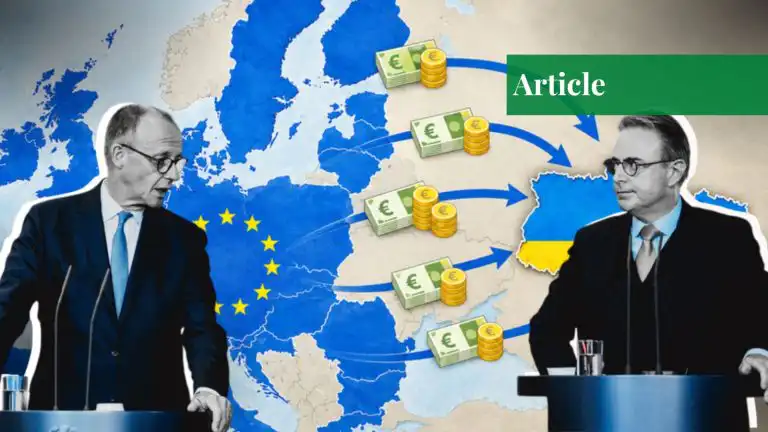
On Thursday, at a European Council summit that was disappointing even by European standards, the EU announced that not only would the long-awaited EU Mercosur trade deal be delayed by another month, but also that they’d failed to agree on a plan to use frozen Russian assets to fund Ukraine and would instead be funding Ukraine with another 90 billion of joint EU debt.
Ukraine is running out of cash. Trump has put an end to all US financial aid to Ukraine. European aid has been falling since mid 2025, and international bond markets aren’t willing to lend Ukraine any more money. Estimates vary a bit, but most well-informed people think that Ukraine is going to run out of money sometime in the second quarter of next year, and funding Ukraine past this point will be expensive. The European Commission, for instance, estimates that Ukraine needs something like €135 billion in financial aid to make it through 2026 and 2027.
Although this is probably an underestimate, given that this assumes that the war will end in late 2026, and that supporting Ukraine has cost something like a hundred billion dollars a year so far. Unsurprisingly, this provoked some anxiety among Ukraine’s backers in the EU, who realized that they’d somehow have to come up with hundreds of billions of euros.
Frozen Russian Assets, Legal Challenges, and the Failed Reparations Loan Scheme
For context, after Russia’s full-scale invasion, the EU and Ukraine’s other allies froze about €30 billion e worth of sovereign Russian assets. These assets were owned by the Russian central bank but held outside of Russia so that Russia couldn’t use these assets to finance its war. Out of this 300 billion, about 210 billion is in the EU, and about 185 billion of that is in Belgium, or specifically in a Belgian central securities depository called Euro Clear.
Since 2024, the EU has been using the interest accumulating from these assets to finance Ukraine’s war effort. But Europe refrained from actually seizing the assets for at least two reasons. First, and most obviously, it would be illegal. Euroclear and other European Depositories are obliged to hold those assets for the Russian Central Bank. While skimming interest off the top might be legally dubious, actually taking the assets and giving them to Ukraine would be pretty clearly illegal.
Now, it’s not clear how Russia would actually bring a case. After all, what jurisdiction would actually be able to hear and enforce such a case? But this was enough to put Europeans off seizing the assets while other funding sources were still available. The second and related reason, though, is that European policy makers worried that seizing assets would undermine the appeal of Europe’s financial system, which is supposed to be rules-based and predictable. They argued that not only would this mean less foreign money flowing into Europe, but it would also reduce the appeal of the euro as a reserve currency.
For context, a reserve asset is just an asset that financial institutions like to hold in their reserves. The US dollar has long been the world’s reserve currency, but Trump’s unorthodox economic policies have lessened its appeal, and European policy makers have quietly been trying to pitch the euro as an alternative. There remains some anxiety that seizing Russian assets would undermine this pitch because foreigners would be less likely to hold euros or assets in Europe if they thought they could be seized.
Anyway, that’s why the EU didn’t seize the frozen Russian assets earlier. They were worried both that it was illegal and that it might undermine Europe’s appeal as a financial haven. However, when it became clear that Ukraine was running out of money, there was a renewed push to seize these assets. Unfortunately, this was promptly blocked by Belgium, which said that it didn’t want to seize the assets because they were worried about legal challenges from Russia, pointing out that Belgium would really struggle to pay back €185 billion, given that its entire GDP comes out to about €600 billion.
EU Joint Debt, Political Divisions, and the Move Toward a More Federal Europe
Other European countries also worry that this might interrupt ongoing peace negotiations, not least because Trump’s original 28-point peace plan envisioned using about a hundred billion euros of these frozen assets to fund a US-led reconstruction effort in Ukraine. To block these concerns, the European Commission came up with the so-called reparations loan scheme.
The idea here was that instead of just seizing the assets, the EU would borrow the equivalent amount of money from Euroclear and other depositories and then lend that money at zero interest to Ukraine, and Ukraine would only pay back this money if it received reparations from Russia as compensation for the damage caused by its war of aggression. The EU would then pay the money back to Euroclear and the other depositories, who would then have enough cash on hand to meet their obligations to Russia’s central bank.
Technically speaking, with this reparations loan, the EU never seizes the Russian assets. They just remain frozen until Russia pays reparations. Again, though, Belgium wasn’t convinced, not least because Russia looks very unlikely to pay reparations unless Zelenskyy somehow ends up marching on Moscow. To locate these concerns, the European Commission went around and started asking member states for guarantees to foot the bill if Russia didn’t end up paying reparations, with richer countries expected to pay the most.
Unfortunately, once again, this didn’t really work because some member states apparently refused to sign up to these guarantees, and because only a couple of days later, Russia filed a legal challenge against Euroclear. While the challenge was filed in a court in Moscow, which obviously lacks jurisdiction, this revived anxieties in Belgium about the legal risks involved. Things weren’t helped by the fact that some member states apparently refused to end their bilateral investment treaties with Russia, with the European Commission suggesting they do in order to minimize legal risks.
This is why at the recent EU summit, the idea of a reparations loan ultimately collapsed, with EU leaders instead agreeing to fund Ukraine with 90 billion of new joint EU debt. Although Hungary, Slovakia, and the Czech Republic have said that they won’t help to pay off this new debt when it eventually comes due. And more joint borrowing will almost definitely be required unless a peace deal is negotiated in the near future. This continues a recent trend, though. Since the pandemic, the EU has been issuing a lot more joint debt to deal with the various crises facing the continent, with the EU’s debt burden rising from basically zero before the pandemic to 700 billion today, and that’s before the new 90 billion for Ukraine. History suggests this will ultimately lead to a more federal EU, and it’s how most big federal states like Germany and the US were actually formed.
Crisis for some central authority to act as a borrower of last resort, and then the process of repaying those debts spreads deeper political union because that central authority had to take on tax-raising powers, and taxpayers want more democratic input.
If you want to submit your articles and/or research papers, please visit the Submissions page.
To stay updated with the latest jobs, CSS news, internships, scholarships, and current affairs articles, join our Community Forum!
The views and opinions expressed in this article/paper are the author’s own and do not necessarily reflect the editorial position of Paradigm Shift.

Muhammad Haseeb Sulehria is a student of Defense and Strategic Studies at Quaid-i-Azam University, and a former internee at Pakistan’s Ministry of Defense. With a keen interest in national and international affairs, he actively explores issues of security, strategy, and global politics, aspiring to contribute to policymaking and peacebuilding.