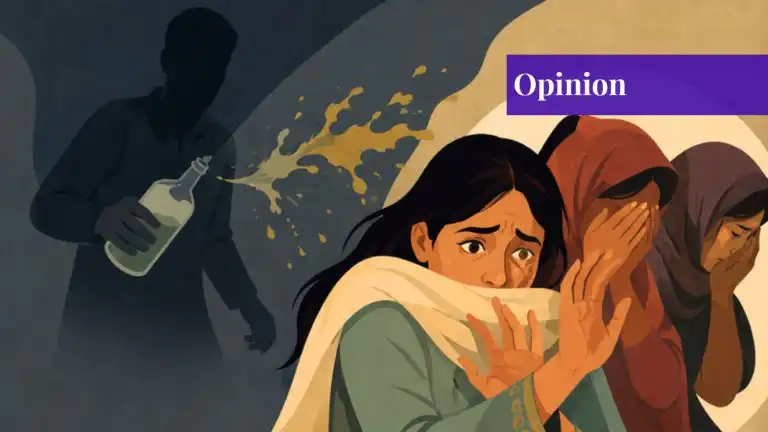
On June 7, 2026, a hospital employee at Quetta’s Civil Hospital waited outside a young doctor’s room, and the moment she stepped inside, he hurled acid at her before making his escape. Dr. Mahnoor Nasir, a surgery postgraduate trainee, sustained severe chemical burns covering around a third of her face and body. Given the severity of her condition, she was flown to Karachi’s Aga Khan University Hospital, where a team of plastic surgeons and eye specialists examined wounds across her face, stomach, legs, and right hand. The man behind the attack was no stranger; he worked in the same hospital as a lift operator and, according to police findings, had spent months pursuing and harassing her, unable to accept that she wanted nothing to do with him.

She said no. His response was to disfigure her.
What happened to Dr. Mahnoor was not bad luck or an unfortunate turn of events. It was premeditated punishment, rooted in the deeply embedded notion that when a woman refuses a man, she owes him something for it. Acid is not chosen randomly as a weapon. It is selected with intent: to obliterate the face, to strip a woman of her appearance and her sense of self simultaneously. The violence communicates a chilling message that a woman who asserts her will must be made unrecognizable.
Acid violence, therefore, must be understood for what it truly is: a weapon aimed specifically at women. Its victims are overwhelmingly female, targeted for rejecting advances, walking away from marriages, or simply living on their own terms. The fact that Dr. Mahnoor was an educated professional working in a formal institution makes this case even more telling. Her qualifications offered her no shield. Her workplace offered her no safety. The public nature of a functioning hospital offered her no protection. If this is the reality for a woman of her standing, one shudders to think of those with fewer resources and less visibility. When news of the attack broke, much of the public response centered on the fact that the suspect, Humayoun Shah, was shot dead by police within hours as he tried to leave the city. Many treated this as the story’s resolution. It is not. An extrajudicial killing shuts down every avenue for deeper accountability. It means no courtroom examination of how a man entered a state hospital with acid in hand, carried out an assault in broad daylight, and left without anyone stopping him. The state got to bury the case along with the perpetrator. This points to a much larger failure, one embedded in Pakistan’s legal architecture.
The Acid Crime Prevention Act of 2011 introduced Sections 336-A and 336-B into the Pakistan Penal Code, allowing for sentences as long as life imprisonment and fines of up to Rs 500,000. But the framework collapses under scrutiny. One of its most glaring weaknesses emerges when a victim succumbs to her injuries at that point, the charge shifts to Section 302, which permits the accused to reach a private settlement with the deceased’s family. In a society where poor families face enormous social coercion from community elders, these “compromises” are less agreements and more surrenders. Justice gets traded away before it ever arrives.
The unregulated availability of acid compounds the problem enormously. Sindh, one of Pakistan’s largest provinces, has no dedicated legislation governing acid sales at all, leaving enforcement to general legal provisions that were never designed for this purpose. Punjab has recently pushed forward a licensing law that would make unlicensed acid sales a non-bailable offence, but a single provincial measure introduced years into this epidemic is nowhere near adequate. Acid can still be purchased with minimal friction across much of the country. Layered on top of this is the jurisdictional tug-of-war between regular criminal courts and
Anti-Terrorism Courts, since acid crimes fall under both frameworks, which routinely bog down prosecutions and give perpetrators room to maneuver.
Dr. Mahnoor is alive. Her vision has been saved. But no medical outcome erases what was taken from her that morning, or the institutional failures that made it possible. The answer to acid violence is not an encounter killing followed by collective relief. It is comprehensive, enforceable acid sale regulation across every province, a legal system that removes the escape hatches currently available to perpetrators, and an honest national reckoning with the misogyny that makes women targets in the first place. These are not random acts of madness, but deliberate acts of patriarchy, and Pakistan cannot dismantle what it refuses to name.
If you want to submit your articles and/or research papers, please visit the Submissions page.
To stay updated with the latest jobs, CSS news, internships, scholarships, and current affairs articles, join our Community Forum!
The views and opinions expressed in this article/paper are the author’s own and do not necessarily reflect the editorial position of Paradigm Shift.

Laiba Asim is from the National Defence University, Islamabad, from BS-6, Peace and Conflict Department.