

Introduction
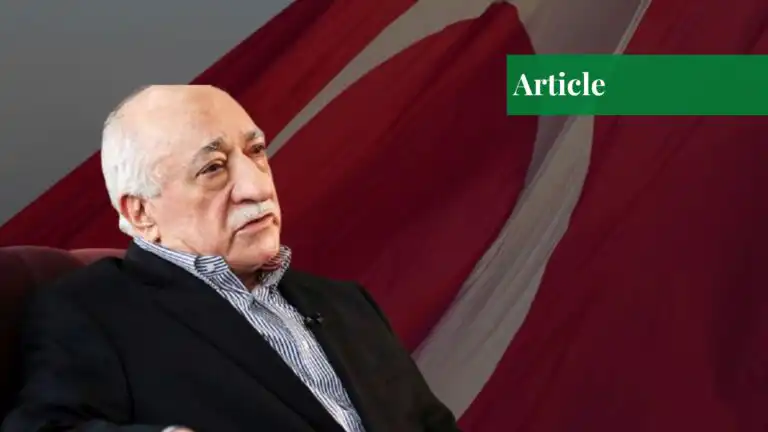
In the contemporary world, states continue to be faltered by the rise of nationalist, religious movements that keep on challenging the legacy of states through various means. Fethullah Gulen in Turkey was one of these leaders. Despite being accused of orchestrating a military coup against Turkey’s president and being forced to live in exile, he was bent on influencing the political and social-religious framework of Turkey. His recent death on October 20, 2024, has reignited debates about his impact on Turkey and the broader Muslim world, prompting reflection on the intricate interplay between faith, politics, and identity in an increasingly polarized landscape.
Who was Fethullah Gülen?
Fethullah Gülen was a prominent Turkish cleric and educator who has been a pivotal figure in shaping modern Islamic thought and civil society. Born in 1941 in Erzurum, his journey started in 1960 in the western province of Izmir, Anatolia, where he stratified the network of boarding houses encompassing schools, charities, and other civil society organizations. While these schools were not predominantly Islamic, they tended to offer quality education to all students.
Later on, these students took on roles in bureaucracy, police, and the judiciary in the country. Over the years, this took the shape of an organization and the “Hizmet Movement,” which formed its newspaper – Zaman Newspaper – in 1986, and Samanyolu Television in 1993. In 1999, Fethullah Gulen left Turkey for the US and started living there. While his allies purported his departure as a move owing to health reasons, the opposition cast aspersions that his move was likely to be prompted by the government’s decision to probe into his activities, which were deemed highly controversial and illegitimate.
What are the Objectives of the Hizmet Movement?
As the name evinced, the word “hizmet” in Turkish means “service.” This movement was likely intended to serve humanity through education, dialogue, and community engagement. The first and foremost objective of this movement is to establish a network of schools and educational institutions around the world. Over 1,000 schools are estimated to be associated with the movement in Turkey and internationally.
Additionally, the movement emphasizes interfaith and intercultural dialogue as a means to foster understanding and peace among different communities. According to the organization, this approach encourages cooperation between people of various religious backgrounds and aims to combat prejudice and intolerance. The organization has global outreach with a network of schools in approximately 170 countries. Its educational efforts are particularly focused on serving immigrant communities and promoting the Turkish language and culture abroad.
Since the movement operates with a decentralized organizational culture, it doesn’t have formal hierarchical or centralized governance. Consequently, individual schools and institutions are often established by local members who share Gülen’s vision, leading to a diverse range of educational practices within the movement.
A War of Tussles Between the Turkish Government & the Hizmet Movement
The movement was initially aligned with Turkey’s ruling Justice and Development Party (AKP). This led to the rise of many Gulen followers into influential positions in the state apparatus. Both camps sought to counter what they perceived as the influence of the secular elite in Turkey’s military and judicial establishments. However, rumors of tension between the two groups began to make the rounds in the early 2000s. They became palpable in 2013 when police officers and prosecutors, who were seen as Gulen followers, launched corruption probes into the upper ranks of the AKP and Erdogan’s inner circle.
Consequently, in December 2013, Istanbul police apprehended a businessman, several mayors, and various sons of government ministers on accusations of bribery and corruption. Erdogan’s son, Bilal, was also implicated. Erdogan alleged the network of institutions for orchestrating this scandal to operate a “parallel state” within Turkey. Three years later, following the 2016 coup attempt which the Turkish government attributed to Gulen’s followers, the movement faced significant backlash.
Following the year, suspected Gulen sympathizers were purged across the government, judiciary, and military. Additionally, the government designated Gulen’s movement as FETO (Fethullah Terrorist Organization). Since 2016, the Turkish government has been following a policy of granting control over and closing Gulenist schools abroad.
For this purpose, it has ascribed control of Fethullah Gulen’s schools to the Marif Foundation, an organization responsible for opening schools in Turkey. While some countries, including Pakistan, Venezuela, and 25 African nations, have cracked down against the Gulen schools, they continue to operate in 60 countries worldwide. Additionally, the US had struck down the Turkish government’s extradition requests for Fethullah Gulen, owing to lack of evidence.
Implications of Fethullah Gulen’s Death
Soli Ozel from the Institute for Human Sciences recounts that Gülen’s death would alleviate some of the political pressure on Erdogan’s regime. Without a central figure, the movement may struggle to maintain the same level of allegiance among its followers. This would potentially diminish its influence within Turkey. Additionally, Erdogan’s government, particularly Foreign Minister Hakan Fidan, has vowed to continue its fight against Gülen’s movement, labeling it a terrorist organization.
The Turkish government seems resolute in its stance against what it perceives as a threat, indicating that the crackdown on alleged Gulenists will persist despite the cleric’s passing. However, while the death of Fethullah Gulen may weaken the movement domestically, it could still pose challenges internationally. The Hizmet network has established a robust presence in various sectors in the US, including education and media.
This global network could continue to exert influence and mobilize support despite the loss of its leader. Furthermore, Gülen’s long-standing residence in the US has been a contention between Turkey and the United States. His death may not resolve these tensions, especially given Erdogan’s ongoing demands for extradition and accusations against Gülen’s followers. The US has historically been reluctant to extradite Fethullah Gulen without substantial evidence linking him to criminal activities.
Conclusion
The Hizmet movement holds sway in different countries due to its activities and strong lobbying. With Fethullah Gulen gone, questions arise about the future leadership and cohesion of the Hizmet Movement. Historically, movements led by charismatic figures often face challenges in maintaining unity and direction after their leaders pass away. This could lead to fragmentation or a shift in focus among Gulen’s followers.
If you want to submit your articles and/or research papers, please check the Submissions page.
The views and opinions expressed in this article/paper are the author’s own and do not necessarily reflect the editorial position of Paradigm Shift.

Qirat Mirza is currently pursuing her bachelor’s degree in international relations from International Islamic University Islamabad. She is also a writer for Modern Diplomacy, International Affairs Forum, Pakistan Today, KIIR, CISS AJK, and Pak Observer. Recently, she completed a six-week internship at the Kashmir Institute of International Relations and the Inter-Services Public Relations (ISPR) to foster her academic insights and gain practical experience.