Historical Background
Instability in Mali dates back to 2012, when the Tuareg ethnic community started a rebellion against their own government. Tuaregs belong to the Sahel region of Africa. Mostly they live in the northern and western states of Africa, including Mali, Niger, Libya, Burkina Faso, and Algeria. In 2011, they served in Libya’s “Islamic Legion”, the pan-Arabist paramilitary force created by Muammar Gaddafi, which was part of his dream to create “a greater Islamic State of the Sahel.” After the fall of Gaddafi, Tuaregs returned to Mali and Niger.
Mali is among the largest states of Africa. And due to its large area, some of its parts were not governed properly. The Tuaregs realised that the government of Bamako was not doing well with regard to governing northern Mali, which they called Azawad, a state that had no international recognition. This prompted them to form the National Movement for the Liberation of Azawad (MNLA) in order to fight against marginalisation and lack of economic development. However, the uprising was not very effective because of the presence of al-Qaeda in the Islamic Maghrib (AQIM). But it laid the foundation for the power vacuum and created a pathway for insurgency.
Emergence of the Islamic State in the Greater Sahara
Islamic State in the Greater Sahara (ISGS) was founded in 2015 by Adnan Abu Walid al-Sahrawi. It was the result of a power vacuum created by the Tuaregs. It is the subgroup of Islamic State West Africa Province (ISWAP) and operates in the Liptako-Gourma region of the Sahel, which includes states like Niger, Mali, Algeria, and Burkina Faso. In 2016, it formally pledged allegiance to the Islamic State. Before joining IS, Al Sahrawi was the leader of the Movement for Oneness and Jihad in West Africa (MUJAO), a splinter group of al-Qaeda.
In 2013, MUJAO merged with al-Mourabitoun, today known as Jama’at Nasr al-Islam wal Muslimin (JNIM). When al-Sahrawi pledged allegiance to IS in May 2015, Belmokhtar, the leader of JNIM, opposed the decision and showed loyalty to al-Qaeda. Al-Sahrawi’s allegiance was not immediately recognized by IS. So, to show its power to IS, ISGS started attacks in different military regions in North and West Africa. After their 4 years of malicious attacks, they were recognized by Abu Bakr al Baghdadi, the leader of ISIS until 2019.
After the acceptance by ISIS, they further expanded their territory and attacked the government leaders and officials. Their attack pattern included mass casualty attacks and ambushes. They recruited locals in their organization to increase their forces. They formed groups such as the Movement for the Salvation of Azawad (MSA). They fought using weaponry from the Tuareg, including rifles, mortars, rocket launchers, machine guns, and others. They targeted the Tuareg since the ideologies of the ISGS were for an Islamic state and not ethnic nationalism.
Emergence of Jama’at Nasr al-Islam wal Muslimin (JNIM)
Jama’at Nasr al-Islam wal Muslimin (JNIM) was formed in 2017 after the merger of several Jihadist organizations such as Ansar Dine, Katibat Macina, al-Mourabitoun, and the Sahara branch of AQIM. This is a Jihadist organization made up of Tuaregs, and its leader, Iyad Ag Ghaly, also belongs to the Tuareg community. Within the shadow of al-Qaeda, JNIM grew stronger. In the beginning, there was a good understanding between JNIM and ISGS. There have been many instances where they both collaborated in operations. Some examples include the attack on Tongo Tongo in 2019. Relations between JNIM and ISGS changed when ISGS pledged its allegiance to ISIS in 2015. At present, they have become enemies of each other. JNIM adopts the principle of ‘pastoralist populism,’ which is termed ‘religious populism’ as well.
ISGS vs. JNIM Power Struggle
Rivalry between ISGS and JNIM is among the following four (4) factors:
- Ideological: ISGS focuses on rapid territorial control through direct violence, while JNIM focuses on slow control by using religion as a soft tool. Motives are the same: to control the territory, but due to differences in ideology, they do not cooperate.
- Territorial: ISGS, being violent in its acts, wants to occupy the whole Saharan belt of Africa. For this purpose, ISGS conducts frequent micro-level attacks on the Sahel region. These attacks make them dominant across the entire region and put a strong hold on various territories. JNIM, on the other hand, makes negotiations possible and also conducts terrorism in the name of religious expansion.
- Recruitment: Both groups focus on the recruitment of locals. ISGS has occupied a vast area, due to which it has more fighters than JNIM. This is why ISGS attacks more frequently than JNIM, but historically, JNIM’s terrorist attacks are more violent and impactful than ISGS’s. This is because ISGS focuses on frequent microattacks, whereas JNIM conducts one impactful attack under the ideology of al-Qaeda.
- Natural Resources: ISGS occupies areas where there is an abundance of resources, which include trading (smuggling) routes, livestock, and taxation. Both groups came into clashes due to dominance over natural resources and ended up exploiting them.
External Interventions and Security Shifts
Operation Barkhane was France’s largest overseas operation. Barkhane is a crescent-shaped sand dune in the Sahara Desert. The operation was known as Barkhane to emphasize the motive of France to counter terrorism over the vast area of the Sahel-Saharan region. It succeeded Operation Serval in August 2014.
France intervened due to many reasons, including the following:
- Mali was previously a French colony.
- Instability in Africa can cause spillover effects in Europe.
- Acquisition of natural resources
- Strengthened its role in NATO
- Monitoring drug smuggling routes from Mali to Europe
For the success of the operation, France deployed more than a thousand troops and conducted airstrikes against the terrorists. This leads to the elimination of various leaders of JNIM and ISGS. Many civilians were recruited into terrorist organizations, and France’s counterattack made those civilians (militants) anti-French. After 9 years of countering terrorism in 2022, French forces withdrew because there was no impact on terrorist attacks in Africa; in fact, there was an increase in attacks during this operation. The operation failed because military measures were used by France instead of using political and diplomatic strategies.
This failure created a vacuum in Mali, which was filled by the Wagner Group. The Wagner Group is an ex-Russian military group that operates in the Sahel. Russia’s presence in a volatile region is of much concern. Wagner’s are in Africa so that they can counter Western narratives imposed by France, and also through this, Russia has made a mini-home in the backyard of the European Union (EU). Russia doesn’t recognize Wagner, but Wagner collides with Russia’s strategic interests and intelligence strategies. Now, Russia can surveil the EU without any fear because Russia has claimed that Wagner is not related to Russia.
Current Situation in Mali
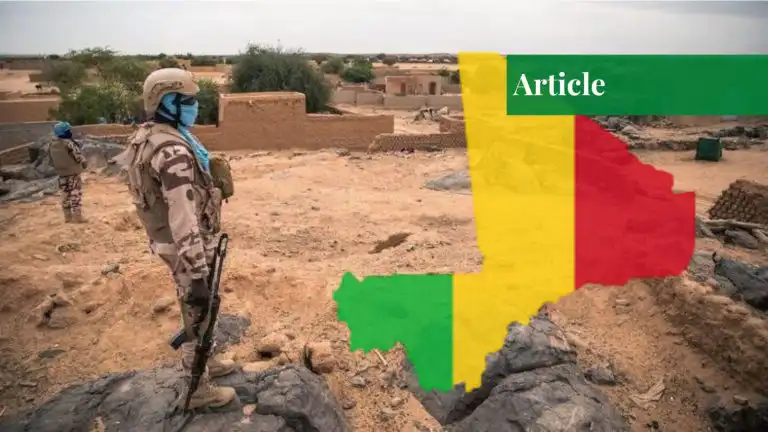
In mid-April 2026, 2026 JNIM attacked several locations in Mali, including Kati, Mopti, Gao, Kidal, and the capital Bamako. These attacks were of much impact due to attacks on multiple locations. Due to this, Mali’s forces were engaged on multiple fronts, which created a delay in responses. Attacks were mainly carried out on military infrastructures, which caused immediate shutdowns. JNIM used economic disruption as a weapon to gain success in its operation. Many state officials died during the attacks. The defence minister of Mali was killed in a suicide car bombing in Kati. Other than him, many military officers have been reported as injured. Unconfirmed reports say some of them died.
This was the operational victory of JNIM, which marked their shift from isolated attacks to multi-location attacks. Other than JNIM, the Azawad Liberation Front (FLA) of Tuaregs also attacked northern cities of Africa. An FLA field commander told the BBC that they were preparing for this attack for four months. Also, he said that now their next goal is Gao, and then Timbuktu would be an easy target.
Strategic Implications
The following are some strategic implications of JNIM insurgency in Mali:
- Fragmentation of Sovereignty: Mali would be a de facto multi-authority state where urban areas would be governed by the government and rural areas would be controlled by JNIM. This is because the northern cities of Mali are poorly administered. So, it would be easy for insurgents to control those areas without any fear.
- Militarization of Civil Areas: Due to the victory of JNIM over the Malian forces, JNIM will militarize the cities of Mali. This will require civil recruitment, and in the near future, the whole of northern Mali will become a territory held by JNIM. Also, Tuaregs will get their identity, as the leadership of JNIM belongs to Tuaregs.
- Spillover Effects: Historically, the African continent has always had spillover effects on neighboring states. This insurgency would have domino effects on the tri-border region of the Sahel. This will make it easier for JNIM to dominate in the Sahel and counter the influence of its rival, ISGS.
Conclusion
The current situation of Mali is the result of Libya’s civil war in 2011. Due to that internal clash, many insurgents rose and created a power vacuum in Africa, notably in the north and western region, the Sahel. One can say that insurgents like ISGS and JNIM are the plants of seeds planted in the 2011 Libyan civil war. Now, both groups have a rivalry; they have witnessed a path from cooperation to competition. Now the situation has worsened. No counter-terrorism act is fruitful because the insurgent ideologies are rooted in the minds of civilians, and most of the civilians have become militants. In this situation, the conflict continues to evolve, and no resolution is happening. Thus, Mali is a war without an end state.
If you want to submit your articles and/or research papers, please visit the Submissions page.
To stay updated with the latest jobs, CSS news, internships, scholarships, and current affairs articles, join our Community Forum!
The views and opinions expressed in this article/paper are the author’s own and do not necessarily reflect the editorial position of Paradigm Shift.

Syeda Farani Fatima is an undergraduate student of International Relations at the International Islamic University of Islamabad, with a strong interest in anti-corruption, counter-terrorism and geopolitics. Strongly committed to fighting corruption, terrorism, and supporting national reform through research and public service.