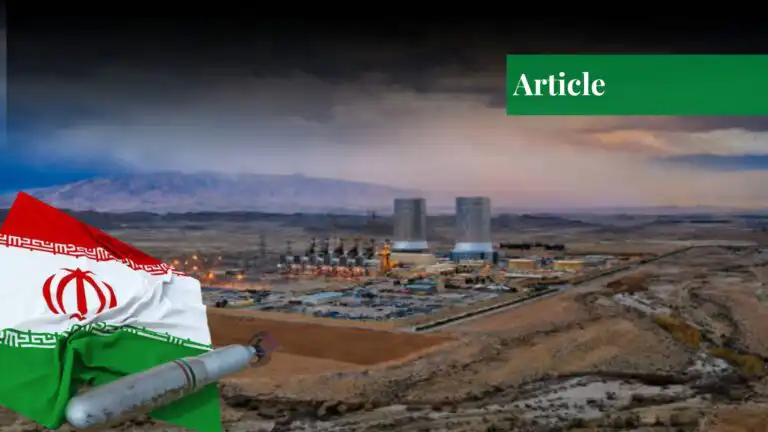
The nuclear program of Iran has long been at the center of suspicion, international debate, and diplomatic negotiations. The Fordow Fuel Enrichment Plant (FFEP) is not just a nuclear facility but also a geopolitical lightning rod that stands out as a symbol of Iran’s technological ambition and deep-rooted security concerns of the West, which catalyze them for global non-proliferation efforts. Hidden deep within a mountain under hundreds of meters of solid rock near Qom, the Fordow facility represents the complex and intricate intersection of energy independence, national security, international scrutiny, and potential proliferation risks.
Structure of the Fordow Facility
Geographically, Fordow is about 18.5 miles northeast of Qom and nearly 60 miles southwest of Iran’s capital, Tehran. The facility is highly fortified and resistant to even bunker-buster bombs, as it is constructed 260–300 feet underground with layers of rock and earth shielding it. Apart from this inner shield, it is outwardly protected by advanced surface-to-air missile systems from Iran and Russia, which make it immune to conventional airstrikes and sabotage.
The strategic importance of Fordow for Iran lies in its subterranean design, which was disclosed originally in September 2009 by the International Atomic Energy Agency (IAEA) soon after the detection of its existence by Western intelligence agencies. After this closure, Fordow became a flashpoint in discussions regarding Iran’s intentions to become a nuclear power. Although Iran has consistently claimed that its nuclear program is only for peaceful purposes and civilian welfare, its location, secrecy, and fortified configuration have fuelled suspicions as it seemed to serve as a Uranium enrichment site covertly with potential military dimensions.
Technical Capabilities
Fordow can enrich Uranium with as high as 60% purity with 2,976 centrifuges. According to recent reports, the purpose of Uranium enrichment was served by almost 1,000 IR-1 and 300 IR-6 centrifuges that were operational there. The report issued by IAEA indicated 83.7% enriched Uranium at Fordow, the only Iranian site with such a facility near the threshold limit required for weapons-grade material. The report further detected a major expansion of this facility with nearly 1,400 new centrifuges.
While Iran insists continuously on its right to produce energy for civilians by enriching Uranium under the Nuclear Non-Proliferation Treaty (NPT), Fordow’s operations raise serious proliferation alarms.
Fordow and the JCPOA
The Joint Comprehensive Plan of Action (JCPOA) was a nuclear disarmament-based treaty signed in 2015 among Iran and six major world powers, which directly addressed the Fordow site of Iran. Under the agreement:
- Iran agreed to cease uranium enrichment at Fordow.
- The facility was planned to be repurposed for scientific research and isotope production only.
- A significant portion of the installed centrifuges at Fordow was agreed to be dismantled or remain out of order under IAEA supervision.
The Unravelling and Fordow’s Resurgence
In 2018, Iran resumed and escalated its nuclear activities gradually after the unilateral withdrawal of the United States from the JCPOA and the re-imposition of US’ crippling sanctions. Since the rights of Iran were being denied, Iran made Fordow a center of its strategy. Uranium enrichment, escalation in purity by advanced centrifuges, and restriction of access to IAEA monitoring and verification capabilities created dangerous gaps between Iran and world powers.
Global Concerns and Diplomacy
The continuation of Fordow’s operation has strong implications for regional security in the case of the Middle East and global non-proliferation efforts. Israel critically views Iran’s nuclear advances as a severe existential threat to the world and has not ruled out any military options on the table to curb Iran’s nuclear program. In a similar manner, Gulf Arab states, especially Saudi Arabia, have voiced serious concerns about a potential nuclear arms race in the Middle East if Iran steps forward to cross the nuclear threshold.
Considering the global perspective, the Fordow facility is significantly challenging not only the IAEA’s verification regime but also the overall integrity of the West’s implemented non-proliferation system.
Recent Military Strikes in the Region
In June 2025, an exchange of airstrikes was observed between Israel and Iran. Here, the nuclear facility of Iran at Fordow, Natanz, and Isfahan was targeted by the US in coordination with Israel, where the use of B-2 stealth bombers and bunker-buster munitions was reported. Trump commented that all nuclear sites were “entirely and utterly destroyed,” but the Iranian officials asserted that no irreversible damage occurred.
Stalemate and the Future
Diplomatic efforts have stalled after these attacks, and no agreement can be signed in this political climate to find a better, more sustainable solution.
For Iran to get relief from sanctions, the West demands that it dismantle centrifuges and roll back Uranium enrichment at Fordow, restoring full IAEA access. At the same time, Iran demands a guarantee of their economic benefits and a complete end to the “maximum pressure” campaign before it makes any significant concessions on its fortified nuclear infrastructure, as Iran clearly views the Fordow facility as a bargaining chip.
A Buried Challenge to Global Order
Fordow, the core dilemma of Iran’s nuclear program, is not only a technical facility but also a profound geopolitical challenge. It embodies the basic tensions of the Iranian nuclear crisis: a war of national sovereignty versus international security, the right to have peaceful nuclear technology versus the risks of nuclear proliferation, and the extreme fragility of the West-led arms control agreements in this era of deep mistrust.
Moving forward toward a solution, transparency, international diplomacy, and credible verification mechanisms by the IAEA will be critical in addressing the concerns related to Fordow. Without a durable, trust-rooted agreement, the facility will remain a significant flashpoint in one of the world’s most volatile regions. Since the future of Fordow is directly related to the nuclear stability of the Middle East and the globe, it needs to be handled positively and peacefully.
If you want to submit your articles and/or research papers, please visit the Submissions page.
To stay updated with the latest jobs, CSS news, internships, scholarships, and current affairs articles, join our Community Forum!
The views and opinions expressed in this article/paper are the author’s own and do not necessarily reflect the editorial position of Paradigm Shift.

Qandeel Fatima is a Lecturer of Chemistry at the University of Mianwali. Alongside her dedication to teaching and research, she remains deeply engaged with Pakistan's socio-political landscape and global dynamics, believing that scientific thinking must inform public policy for meaningful national progress. As a committed aspirant of CSS and PMS, she aims to combine her scientific knowledge with public service.