
The Cost of Benevolence
King Leopold II of Belgium told the world in 1885 that he was a humanitarian committed to bringing civilization to the Congo by ending the Swahili-Arab slave trade, advancing Christianity, and liberating the vast region. Instead, he established one of the cruelest economic exploitation schemes in contemporary history, a system of forced labor that claimed millions of Congolese lives to enrich the Belgian monarchy with ivory and rubber. This atrocity was not coincidental with the discourse of humanitarianism and rather served as its cover.
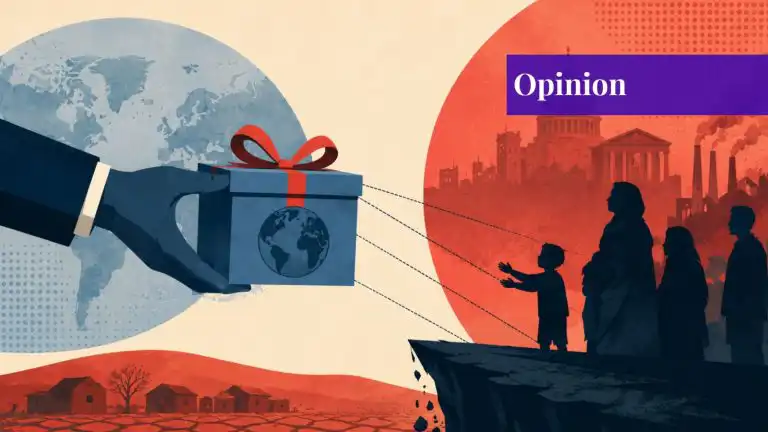
Treating the Congo Free State as an abominable anomaly from colonialism is tempting. However, whose interests are truly being served when a powerful state assists a weaker one? A century later, vocabulary has softened; instead of referring to civilizing missions, we now discuss infrastructure investment, strategic partnerships, and development assistance. Moreover, the underlying tensions remain unresolved regarding the Marshall Plan, US support for Egypt, France’s presence in the Sahel, and China’s Belt and Road Initiative. Foreign aid is frequently presented as either a tool of geopolitical ambition or altruism, as if the two were irreconcilable. They seldom are.
The debate itself starts with an erroneous premise.
Judging Aid by Motive, Not Just Outcome
Andreas Krieg argued that determining whether an intervention succeeded militarily or materially tells us little on its own. This raises an integral question: is intention more important than the outcome, or is the outcome that outweighs the intention? In the long term, does it really concern anyone if the outcome was for the betterment of the people even if the intention was not pure per se? Thus, outcomes can be misleading in both directions, as self-serving efforts can nonetheless yield genuine benefits while well-intentioned ones can fail.
Soft Power and the Limits of Attraction
In contrast, the soft power theory of Joseph Nye shows that a state’s power comes from two factors: firstly, attraction, the capacity to influence what other states desire by being a source of ideas, opportunity, and goodwill; secondly, coercion, which includes the usage of troops, tariffs, and threats to undermine landmark authority. Importantly, soft power only works when there is genuine goodwill, but undermining one’s own national security and prosperity in pursuit of global recognition masked as humanitarian goodwill, consequently, leads to failure to prioritize its own citizens.
Development Finance or Debt Leverage? The Belt and Road Test
Therefore, aid is an investment in creating diplomatic influence, i.e., China’s Belt and Road Initiative; since 2013, Chinese state banks have funded hundreds of billions of dollars’ worth of infrastructure in Africa, Central Asia, and Southeast Asia, including ports, railroads, and power plants. However, the debt relationships gave Beijing power that is hard to distinguish from the aid itself.
Gwadar Port in Pakistan offers a glimpse at the dual character of development. CPEC has contributed by building infrastructure, highways, and energy investment, but also occupies a strategically vital location near the Strait of Hormuz, enabling China’s access to one of the busiest maritime corridors. Subsequently, China’s ability to assert its power by providing economic aid to multiple vulnerable nations while presenting itself as a humanitarian ally allowed it to be the only one to gain permanent economic benefits and act as an economic imperialist.
The same dilemma exists with humanitarian intervention. NATO’s 2011 operation in Libya was justified under the Responsibility to Protect doctrine as an effort to avoid widespread atrocities against civilians in Benghazi. Many argue that engagement prevented an immediate humanitarian catastrophe. Others say that the motive gradually shifted beyond civilian protection into regime change, leaving Libya shattered and insecure. The same paradox is revealed by both frameworks: strategic objectives and humanitarian incentives do not always have to conflict. They frequently coexist within the same intervention.
When Aid Creates Dependence
Kwame Nkrumah predicted this possibility in the 1960s, when he first used the term neo-colonialism. He warned against political freedom without economic independence, control exercised through trade and loans rather than by governors and garrisons. Several West African countries serve as an example where fourteen former French colonies were pegged first to the French franc and now to the euro. Supporters call it monetary stability, while critics reckon it as the last currency of empire. The choice either way was never fully the member states’ own. Although the framework remains relevant, it risks oversimplifying the differences between predatory lending and true cooperation by characterizing every act of foreign assistance as extraction.
When taken together, these cases show that the central divide is not between self-interest and altruism, but between interventions that leave societies highly autonomous and those that keep them highly dependent.
Who Gets to be Saved?
Beneath these situations is another paradox. Who is considered to require assistance at all? A nation’s suffering must first be classified as a humanitarian emergency, fragile state, or least developed nation. The nations that have these labels seldom ever produce them. They originate from international organizations, credit rating agencies, and donor institutions, which then decide who qualifies for debt relief, emergency aid, or ongoing diplomatic attention and who remains invisible. Power does more than just command, as Michel Foucault observed; it also defines, classifies, and generates knowledge. Deciding not only who earns aid but also whose suffering is deemed deserving of intervention in the first place is arguably the most powerful kind of influence in international politics.
Conclusion
Therefore, the question that should be raised about any aid program is not whether interest is present, which is nearly always the case, but rather whether the recipient nation becomes safer, more capable, and more sovereign than it was before, or if it just becomes more indebted to the state that helped it. In addition to determining how a nation is assisted, strategic value also determines whether it is acknowledged at all. Aid will continue to come at a cost unrelated to the people it purports to help until compassion spreads as freely as the rhetoric employed to support it.
If you want to submit your articles and/or research papers, please visit the Submissions page.
To stay updated with the latest jobs, CSS news, internships, scholarships, and current affairs articles, join our Community Forum!
The views and opinions expressed in this article/paper are the author’s own and do not necessarily reflect the editorial position of Paradigm Shift.