Globalization refers to the increasing interrelatedness and interdependence of social, economic, and cultural factors worldwide. It is characterized by the breaking down of political and economic barriers, leading to the interdependence of markets across borders. Economic integration, cultural exchange, and technological advancements have laid the foundation of the globalization process.
Identifying a precise moment in history when the age of globalization formally began is challenging, as many argue that the concept has roots dating back to as early as the 1400s or even earlier, in the era of the Silk Road. However, in the modern world, it is typically traced back to the early 20th century, when “forced globalization” occurred through colonialism. However, this process was interrupted by the World Wars and later resumed in the post-World War period, marked by the formation of international organizations, such as the World Trade Organization, the International Monetary Fund, the World Bank, and the United Nations.
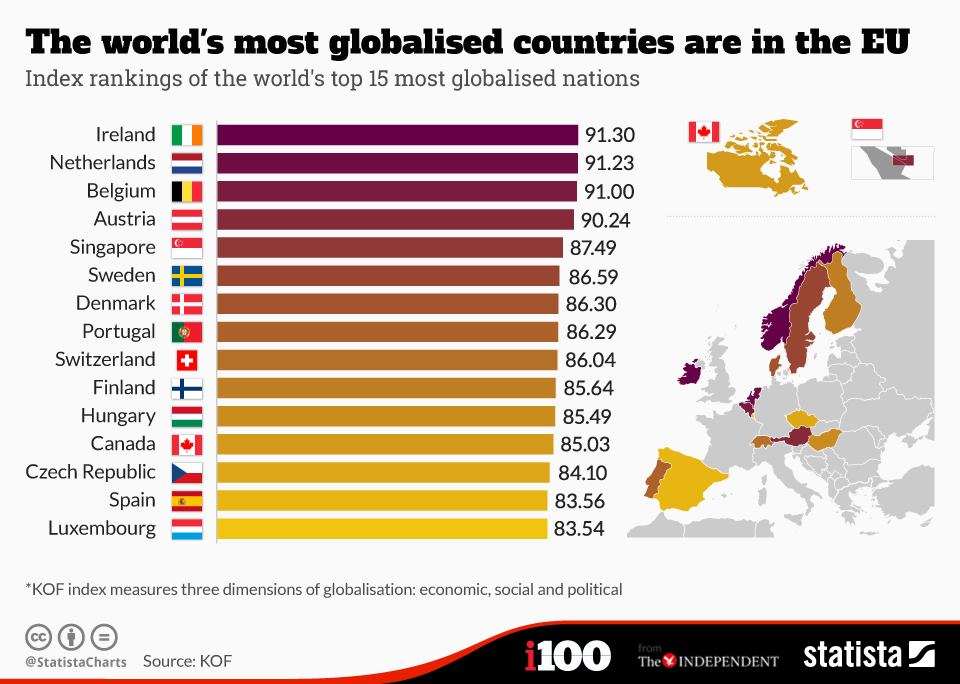 You will find more infographics at Statista
In the context of this article, progress can be understood as improving the living conditions, rights, and opportunities of individuals and communities, particularly those who are marginalized and vulnerable. Progress involves advancements in economic development, social justice, access to essential necessities, and the realization of human rights for all individuals, regardless of distinctions based on race, gender, nationality, religion, or socioeconomic status. Therefore, progress can be seen as the collective efforts to create a more equitable and inclusive world where the rights and dignity of every individual are respected and upheld, as there can be no progress without progress for all.
Globalization and Progress
Globalization has undoubtedly led to significant improvements in living standards worldwide, particularly in developed nations. With increasing interconnectivity, people are more aware of global inequalities and can contribute to international causes, fostering a sense of belonging to a global community. Greater awareness and the spread of information empower people and strengthen democracy. Civil society activism, supported by NGOs, social media, and advocacy efforts, plays a crucial role in promoting causes such as human rights, environmental conservation, and social equity.
Globalization has opened up new spatial and political avenues for advancing human rights. This includes rapidly disseminating information through social media, which enhances individuals’ capacity to mobilize and create large-scale popular movements. These developments are expected to expand the scope of human rights to encompass both individual and political rights, as well as collective social, economic, and cultural rights. The free flow of information improves the ability to educate individuals about their rights and how to seek remedies. It also makes it harder for governments to hide human rights violations and enables activists to shame governments into changing their behavior more effectively.
Along with the economic impacts of international trade, local communities are also experiencing a growing awareness of new notions of social justice and equity being disseminated globally. Traditional systems that were previously acceptable are now being challenged by their communities. Thus, global interconnectivity has enabled local people to call into question discriminatory norms, practices, and even laws that were used to marginalize or exclude minority and vulnerable groups systemically. For example, feminist movements worldwide have led to greater representation of women in social, political, and economic spheres, even in conservative communities.
Globalization and Regression
It is indisputable that progress through globalization has been uneven, with many developing countries facing challenges in integrating into the global economy. This has widened the income disparity between high- and low-income countries, resulting in an estimated 700 million people living in extreme poverty, with over two-thirds of this population residing in Sub-Saharan Africa.
While globalization has successfully enabled some economies to take off, it has caused others to decline further. Overall, biased globalization rules have allowed developed countries to exploit weaker nations in this neocolonial world order. The unequal distribution of wealth and development has deepened social and political divides within countries and fueled international conflicts and unrest.
Least-developed countries (LDCs), including most of sub-Saharan Africa and South Asia, have been unable to reap the benefits of globalization. These countries are caught in a cycle of interconnected challenges, including poverty and lack of education, internal and regional conflicts, geographical challenges, corrupt governments, and undiversified economies.
Moreover, apart from just the divide between developed and developing nations, globalization has also enhanced income inequalities within the developed countries of the West. Although the rich and poor seem to have made significant strides in globalization, the middle class has made virtually no progress. In 2016, the Financial Times surveyed to calculate the number of jobs lost due to globalization in America alone. They concluded that an alarming number of 5.6 million jobs disappeared in manufacturing in the US between 1990 and 2016. They also claimed that almost half of them, i.e., 2.3 million jobs, could have been ‘saved’ had production remained in America and if globalization had not affected consumption patterns post-1990. Thus, instead of advancing human civilization, globalization has led to regression by perpetuating inequality and widening the gap between the “haves and have-nots.”
Conclusion
In conclusion, globalization has progressed through various phases, affecting countries in distinct ways. Some gained great advantages, while others suffered due to marginalization and a lack of integration. Having said that, I believe human civilization over the past century has created more problems for itself and future generations than ever before. Any apparent progress that has been made in terms of technological advancement, economic growth, or political and social freedom has either been unsustainable, unequal, or largely symbolic.
If you want to submit your articles and/or research papers, please visit the Submissions page.
To stay updated with the latest jobs, CSS news, internships, scholarships, and current affairs articles, join our Community Forum!
The views and opinions expressed in this article/paper are the author’s own and do not necessarily reflect the editorial position of Paradigm Shift.

Jawairiya is a final-year Development Studies student at Bahria University Karachi with a passion for social justice, inclusive development, and community empowerment.