Georgia, nestled at the crossroads of Eastern Europe and Western Asia, has a protracted history marked by resilience on the surface of repeated invasions and foreign rule. From the Persians, Romans, Ottomans, Mongols, Seljuks, and Russians, Georgia has constantly fought to reclaim its dominion and preserve its unique identity. The current turmoil surrounding the 2024 Georgia elections is proof of just that.

Today, Georgia faces a similar dilemma, steering between Russian influence and its hopes for integration with the European Union. This balancing act reflects Georgia’s deep aspiration to align with the West, adopting European values and democratic principles, while also facing the realities of Russian influence. The 2024 election results, which saw the ruling party, Georgian Dream, retain power, highlight Georgia’s enduring struggle. The cautious stance of the Georgian Dream toward Moscow contrasts with the EU goals of opposition groups, hinting at continued domestic debate over the country’s direction as it seeks stability, growth, and security in a complex geopolitical landscape.
Political Climate of Georgia in 2024
On October 26th, the Georgian Dream party was seen celebrating the victorious parliamentary elections of 2024. Georgian Dream is the ruling political party in Georgia, founded by oligarch Bidzina Ivanishvili. Initially, it promoted European integration, but since it came to power in 2012, the party’s stance has taken a turn, mainly after Russia invaded Ukraine in 2022. Georgian Dream now has a more skeptical view of the West. Although it practices EU symbols in campaigns and claims to seek EU membership, it vows to do so independently and “with dignity.” However, at the same time, it also criticizes Western nations, asserting that they promote divisive social agendas and are driven by forces wanting to pull Georgia into the conflict with Russia.
Despite the electoral process being systematic and introducing new technology in voting, it did face democratic struggles with accusations of media manipulation, and voter intimidation which was observed by an international mission saying the elections were proof of “democratic backsliding.” The opposing party known as the United Nations Party (UNM) on the other hand accused the Georgian Dream of having a pro-Russian outlook, framing the political divide as a choice between aligning with Europe or with Russia. Meanwhile, the Georgian Dream presents itself as a protection against war, portraying closer Western ties as a potential path to conflict. The opposition says that the party has taken a friendlier stance toward Russia, despite ongoing tensions, such as Russia’s occupation of 20% of Georgian territory since 2008. Thus indicating a broader national debate on Georgia’s future.
Balancing Between Russia and the EU
The geopolitical dilemma of Georgia lies in its balancing act towards having EU aspirations, but Russian pressure at the back end is saying otherwise. The 2008 war where Russia occupied Abkhazia and the South Ossetia region of Georgia continues to maintain its influence. This deepened Georgia’s mistrust of Moscow, reinforcing the belief among many Georgians that EU and NATO memberships were crucial for security and sovereignty. However, Russia’s continued military presence and impact in these regions constrained Georgia’s moves toward EU integration.
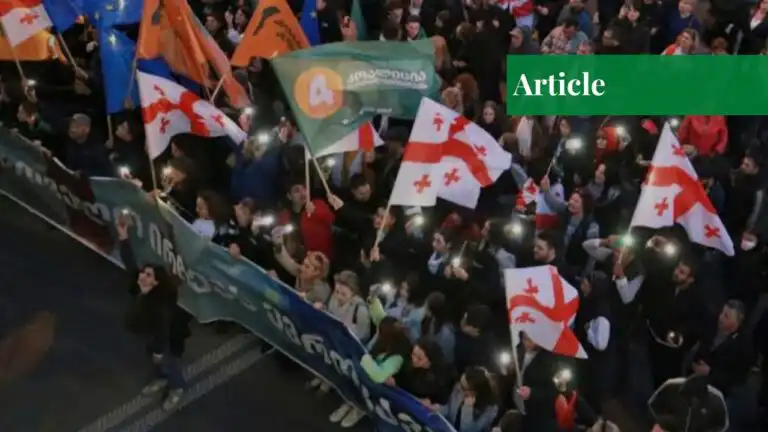
Many Georgians also consider that integration with the EU will increase democratic governance, the rule of law, and human rights protection in the country. Yet, recent legislation like the 2024 law on “transparency of foreign influence” demanding foreign-funded organizations to register as “foreign agents,” has sparked criticism, with many seeing it as a Russian-style constraint on civil society, potentially jeopardizing Georgia’s European path. This law ignited protests as many Georgians feared it would suppress dissent and thrust the country toward authority styles similar to Russia’s. Concerns were raised by international bodies like NATO and the EU, warning that such policies might prevent Georgia’s aspirations for closer Euro-Atlantic ties and compromise its democratic trajectory.
Georgia’s Geopolitical Role and Political Evolution Since Independence
A critical point in history took place on election day in Georgia, marking the nation’s evolving political and geopolitical landscape, formed by over three decades of independence. Since 1991, Georgia’s politics have transformed from initial instability and civil unrest to more structured governance, though still struggling with polarized views on EU integration and Russian influence. The 2003 Rose Revolution was a pivotal point that brought pro-European leader Mikheil Saakashvili to power, who highlighted reforms to curb corruption and create stronger ties with the EU and NATO. However, it was the 2008 war with Russia that created high stakes of Western alignment, leading to increased Russian influence in the occupied regions of Abkhazia and South Ossetia. This period of reform was later tempered by Georgian Dream in 2012, a more moderate party led by figures like Bidzina Ivanishvili, who was more focused on economic stability but simultaneously adopted a guarded approach toward Russia to avoid any kind of antagonism.
Moreover, Georgia’s geopolitical role is primarily shaped by its strategic position as a link between Europe and Asia, making it a vital energy and trade passageway. Since independence, Georgia has pursued close ties with the European Union to support its economic and democratic progress, reflected in its contribution to key energy projects like the Baku-Tbilisi-Ceyhan (BTC) pipeline, which transports Caspian oil to Europe. This orientation serves EU interests in expanding energy sources and reducing dependence on Russian energy.
However, Georgia’s EU-oriented stance or policies directly challenge Russian power, as Russia views Georgian alignment with Western institutions as a threat to its regional dominance. The result is a careful harmonizing act: Georgia seeks deeper integration with the West while managing Russian pressure. This balancing of interests accentuates Georgia’s critical geopolitical role as a bridge in the East-West dynamics.
Future Prospects for Georgia After the Election Results
Georgia’s path forward remains uncertain, hinging on its ability to maintain democratic principles and manage Russian tensions. While the pragmatic approach of the Georgian Dream may offer a measure of stability in the face of Russian pressure, critics argue it could slow Georgia’s EU aspirations. Pro-European factions, like the United National Movement (UNM), claim the election results were manipulated, heightening fears that Georgia’s democratic trajectory could be compromised.
The EU has voiced concerns over these developments, warning that Georgia’s future with the 27-member bloc could be at stake if democratic reforms stall. The increasing political division between a pro-Western youth population and a cautious government risks further societal fragmentation, possibly playing into Russian interests by destabilizing Georgian unity. Moving forward, Georgia’s success will depend on raising transparent governance, protecting civil liberties, and bridging these internal divides to maintain a sovereign course toward its European goals.
If you want to submit your articles and/or research papers, please check the Submissions page.
The views and opinions expressed in this article/paper are the author’s own and do not necessarily reflect the editorial position of Paradigm Shift.
She is a student of international relations, pursuing a bachelor’s degree in the field from Bahria University. With a deep interest in global affairs, she writes on topics related to geopolitics and international dynamics, aiming to contribute thoughtful analysis on contemporary global issues.