A Pivotal Shift Towards the East
The West’s engagement in support of the anti-government mass civil protests in Belarus during 2020-2021, which followed the highly disputed 2020 Belarusian presidential election and the deep political polarization of Belarusian society, consequently led to the breakdown of the fragile relations between Western political elites and the administration of Belarusian President Alexander Lukashenko (Аляксандр Лукашэнка).
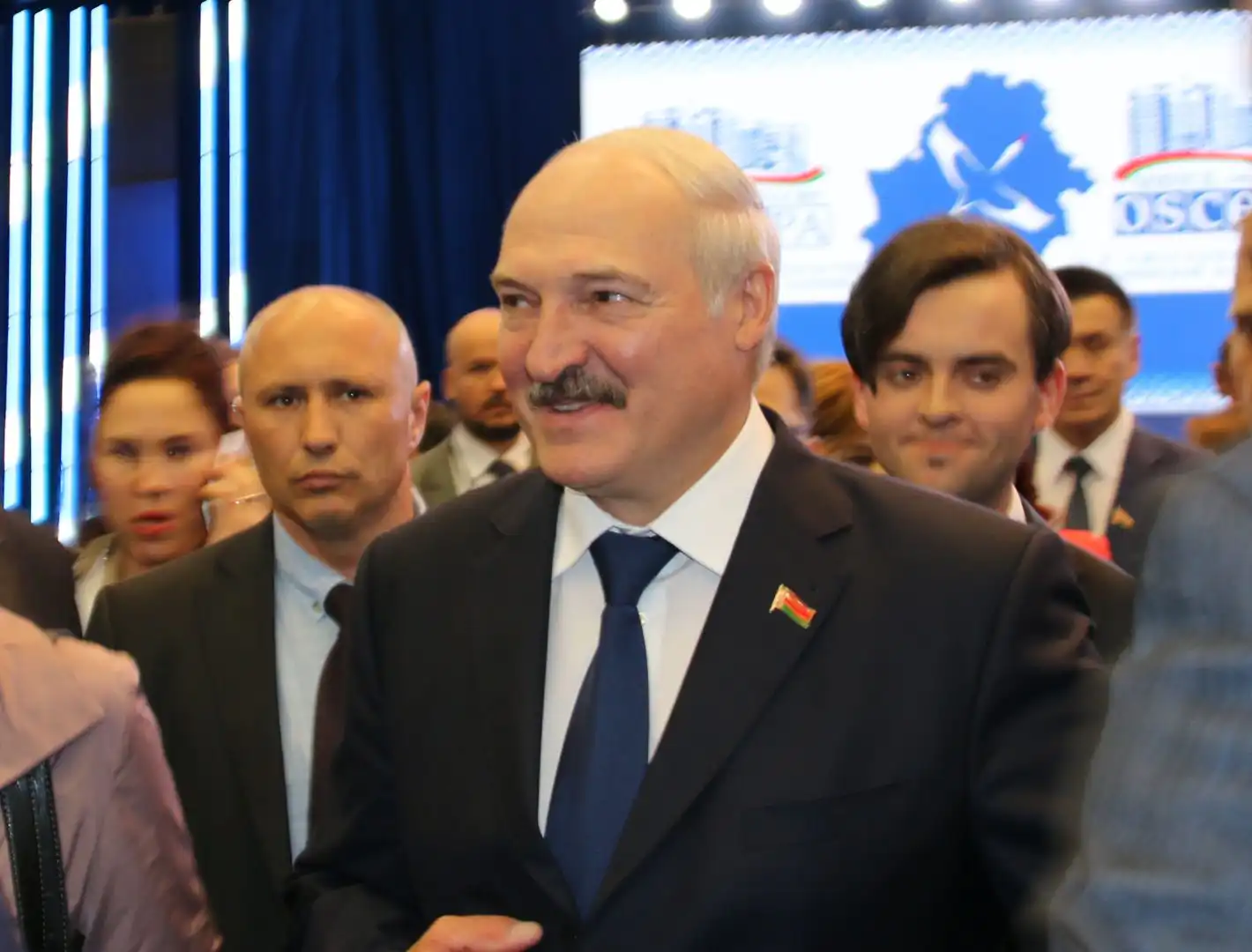
Minsk responded to this unparalleled Western interference in the country’s internal affairs harshly by drastically severing all direct (governmental) and indirect (non-governmental) political, economic, and socio-cultural ties between Belarus and the West. During the 2021-2025 period, Belarus suspended or significantly restricted its participation in Western-led or Western-oriented international or regional platforms, such as the Organization for Security and Co-operation in Europe (OSCE), the Council of Europe (CoE), and the European Union’s Eastern Partnership (EaP), viewing them as threats to the country’s internal political stability.
At the same time, Belarus also withdrew from several international treaties and agreements, such as the Treaty on Conventional Armed Forces in Europe (CFE), the Optional Protocol to the International Covenant on Civil and Political Rights, the Aarhus Convention on Environmental Matters, the Extended Partial Agreements on Sport (EPAS), and the EU–Belarus Agreement on Readmission and Visa Facilitation. This self-isolation reactionary policy has led Minsk to turn towards alternative organizations in the post-Soviet and Eurasian regional architecture, such as the Eurasian Economic Union (EAEU), the Commonwealth of Independent States (CIS), and the Collective Security Treaty Organization (CSTO), which were described by President Lukashenko as “important players in building a just multipolar world order.”
Meanwhile, from July 4, 2024, Belarus officially became the 10th permanent member of the Shanghai Cooperation Organization (SCO), and from January 1, 2025, the country formalized its status as one of BRICS’s 13 partner countries, which is seen as a springboard for full membership of the organization.
This pivotal shift in Minsk’s geopolitical course towards the East has also been accompanied by a change in its economic stance, with Belarus now focusing on expanding trade and economic cooperation by establishing a stronger legal framework for bilateral engagement with some key countries of these alternative organizations, relations with which aim to develop in order to explore new markets where prior cooperation was limited or neglected.
The Belarusian diplomatic apparatus has dubbed this politico-economic strategy the “Far Arc Policy,” thereby signaling an official shift towards countries in the Global South (Asia, Africa, and Latin America) in order to diversify Belarus’s economy by reducing its reliance on traditional Western markets (Polish, Baltic, and Ukrainian) and preventing total dependence on the Russian and Chinese markets.
Some of these key “Far Arc” countries include the United Arab Emirates (UAE), the Sultanate of Oman, the People’s Democratic Republic of Algeria, the Islamic Republic of Iran, the Bolivarian Republic of Venezuela, the Socialist Republic of Vietnam, the Lao People’s Democratic Republic, etc.
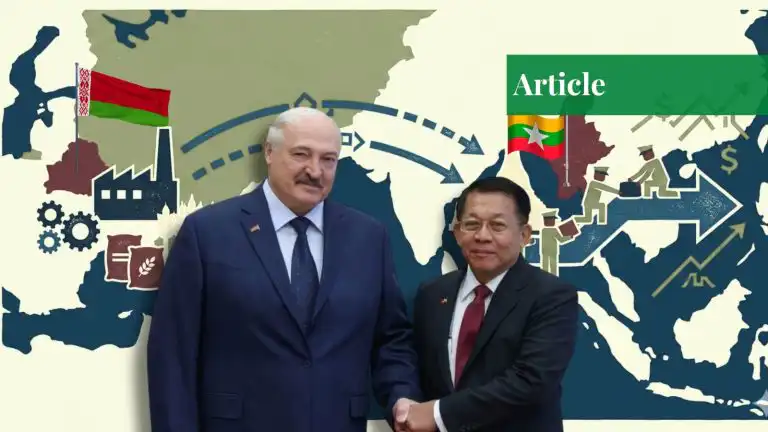
But Belarus’s recent relationship with one of these “Far Arc” countries in particular has drawn the attention of the international community, especially because of the ongoing internal polycrisis situation in this country, known as the Republic of the Union of Myanmar (Burma).
A Partnership Born Out of Political Necessity
Although the two countries are historically, culturally, and geographically very distant and different, they present themselves politically in a curiously similar way in many respects.
The Republic of the Union of Myanmar has been historically in a chaotic political situation (somewhat similar to that in Belarus in essence), characterized by alternating periods of repressive military rule and fragile proto-democratic governance.
On February 1, 2021, the Myanmar Armed Forces (Tatmadaw) launched a coup d’état, seizing power from the democratically elected government of the National League for Democracy (NLD).
The coup was followed by mass civil protests against the military junta and also by a civil disobedience movement, the brutal suppression of which by the Tatmadaw led to the emergence of an armed resistance, which has plunged the country today into a full-blown civil war.
However, despite this chaotic political situation dominated by violence, Naypyidaw, much like Minsk, has managed to geopolitically and economically reorient the country away from the Association of Southeast Asian Nations (ASEAN) towards closer cooperation with Russia, India, and the People’s Republic of China, while also integrating it more closely with regional Southeast Asian organizations such as the Bay of Bengal Initiative for Multi-Sectoral Technical and Economic Cooperation (BIMSTEC).
All these political commonalities between the Belarusian and Burmese governments, as mentioned above, appear to have helped create the right conditions for developing a strategic diplomatic and economic partnership between the two countries.
Belarus’ Economic Offer
The Southeast Asian country of 55 million inhabitants represents a long-term bet for Belarus, which, in addition to the challenge of developing an economic partnership under international sanctions and considerable geographical distance, must also “compete” with the giant economies of this region (such as India or the People’s Republic of China), which are also seeking to dominate the Burmese markets, consequently gaining a strong political presence in the country.
Minsk seems to have realized this and has therefore focused its economic offer to Naypyidaw on the key export sectors of the Belarusian economy:
Food Products
Belarus aims to supply the Burmese markets with high-demand dairy products, including whole and skimmed milk powder, whey powder, butter, and cheese, as well as baby food, tinned meat, and flour.
Agricultural Machinery
Belarus has expressed its support for the initiative to modernize the agricultural sector by the Burmese government and has agreed to export its MTZ tractors (particularly the 451, 522, and 820 models) and MAZ commercial lorries.

Fertilizers
As one of the world’s largest producers of agricultural fertilizers, Belarus is looking forward to playing a key role in the Burmese agricultural sector through its exports of potash and nitrogen fertilizers.
Pharmaceuticals
Belarus has also planned to export to Myanmar as well as pharmaceutical products, such as medicines and veterinary vaccines (another supply to the Burmese agricultural sector).
On the other hand, through this economic offer, Belarus is also seeking investment opportunities and logistical access to Myanmar’s deep-sea ports—specifically the Dawei Special Economic Zone and Kyaukphyu Deep-sea Port—to establish a maritime entrance to Southeast Asia markets and facilitate its trade.
Conclusion
At the moment, Myanmar’s importance to Belarus is not significant on the scale of the Eastern European country’s entire economy, and it cannot be compared with its Eurasian Economic Union partners (such as Russia, Kazakhstan, or Kyrgyzstan) or with those of other post-Soviet countries from the Commonwealth of Independent States (such as Uzbekistan, Turkmenistan, or Tajikistan).
Meanwhile, as we mentioned above, a number of challenges are posed to the development of normal bilateral relations, particularly geographical (the distance between the two countries), logistical (infrastructure to support the trade of goods), and competition from regional economic actors (Chinese, Indian, Thai, etc.).
Besides these “technicalities,” many experts and observers have seen it as an ambitious partnership and a strategically important ‘springboard’ for expanding Minsk’s economic presence in Southeast Asia, thus further decoupling the country from European economic architecture and aligning it with the Asian economic structures, which are seen by the Belarusian government also as more reliable politically and more profitable economically.
If you want to submit your articles and/or research papers, please visit the Submissions page.
To stay updated with the latest jobs, CSS news, internships, scholarships, and current affairs articles, join our Community Forum!
The views and opinions expressed in this article/paper are the author’s own and do not necessarily reflect the editorial position of Paradigm Shift!

Eljanos Kasaj is a student from Albania currently enrolled at the Institute of Political Science and World Politics. He is specializing in Global Security at the University of Wrocław (Poland).