Why Did Pakistan Enter a New Era of Coalition Politics after Imran Khan’s Removal?
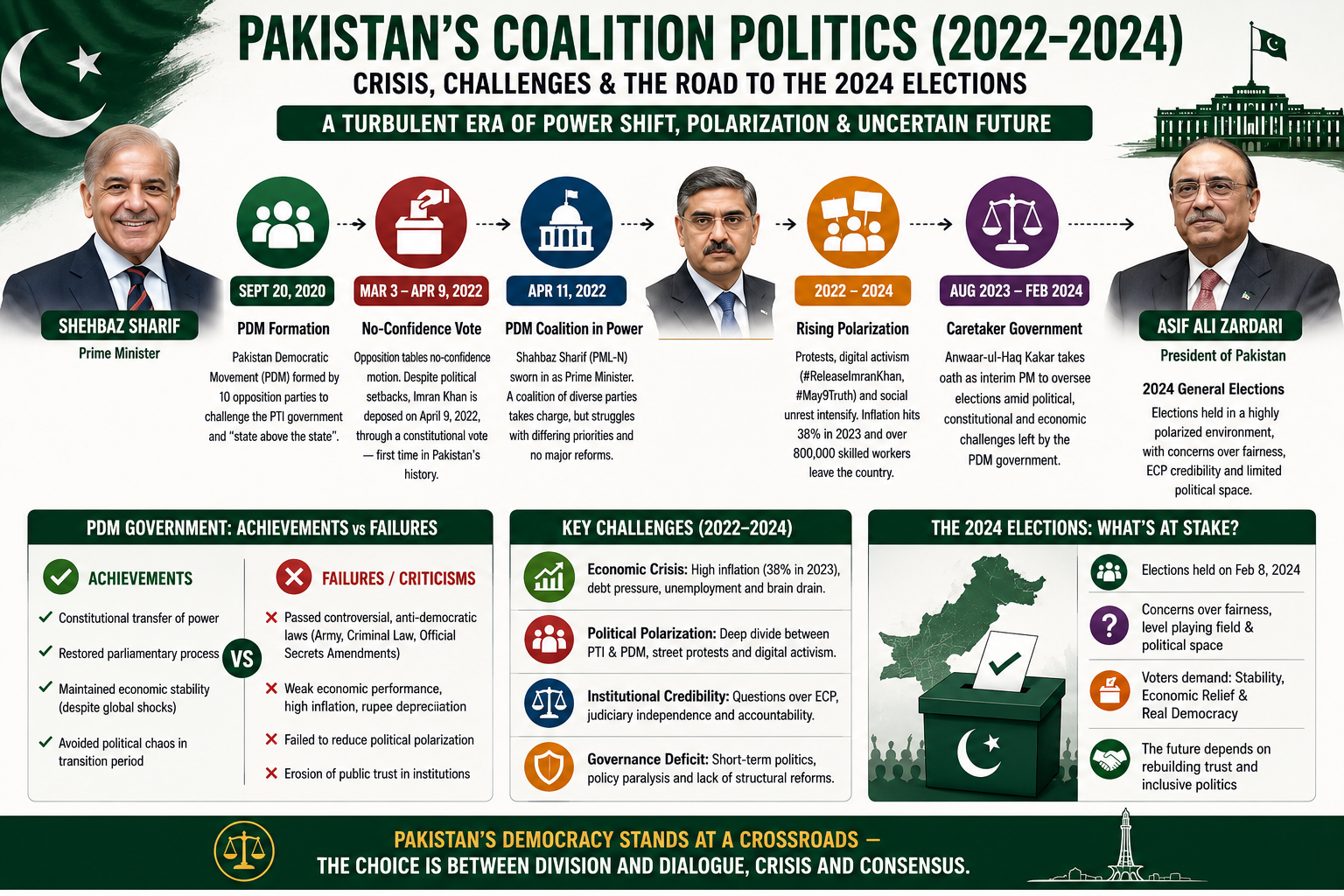
The Pakistan Democratic Movement was formed on September 20, 2020, in Islamabad as an amalgam of ten political parties to resist the PTI government. There have been several efforts to consolidate the disparate opposition under a single banner since the election of Imran Khan as prime minister in August 2018. Governmental political victimization of the opposition in the guise of accountability has driven the two major parties against the wall.
Therefore, the establishment of a common platform was agreed upon by the parties. The opposition parties’ position changed this time. The military organization, which was thought to be the true power supporting the PTI government, was their target. Nawaz Sharif considers “the state above the state” the problem that needs to be addressed.
How did Imran Khan lose his seat after a vote of no confidence?
On March 3, 2022, the opposition tabled a motion of no-confidence against the PTI government. It was initiated by members of different political parties. It was suggested by the prime minister to the president that the National Assembly be dissolved. The president signed the summary to dissolve the NA on April 3, the same day. The Supreme Court of Pakistan took suo motu action against the deputy speaker’s judgment. The PDM alliance was able to depose Imran Khan as prime minister at midnight on April 9, 2022, using a constitutional vote of no confidence, despite several political setbacks. Under the 1973 constitution, this was the first instance of a PM being removed from office via a vote of no confidence.
How Did the PDM Coalition Government Come to Power in Pakistan in 2022?
The PDM coalition, apart from the PPP and ANP, formed a joint administration after the government of Imran Khan, who lost power due to the no-confidence vote, became ineffective. The PML-N party’s Shahbaz Sharif, who won the majority of seats in the National Assembly, became the head of the government. He was sworn in as the prime minister on April 11, 2022. A coalition always finds it difficult to govern, but a collection of varied interests finds it even more challenging to accomplish. The partner parties were keeping an eye on the forthcoming elections and thus could not undertake significant structural changes in various areas.
PML-N and JUI-F requested early elections before the no-confidence vote in April 2022. However, PML-N was divided over early elections after the no-trust vote was successful. The PPP, on the other hand, maintained that the assemblies’ full five-year constitutional term should be allowed. Since the PPP had a government in Sindh and its Members of the National Assembly (MNAs) were receiving development budgets, this suited the party, and the PML-N’s political capital was declining as a result of making difficult choices to improve the economy.
How did political polarization intensify after Imran Khan’s removal?
Pakistan saw an unparalleled increase in social unrest between 2022 and 2024, which showed itself in a variety of public opposition movements. Peaceful demonstrations staged by both the opposition PDM alliance and the PTI began to escalate into more aggressive forms of dissatisfaction, especially after Imran Khan was detained in May 2023, at which time the protests escalated into full-blown riots aimed at military sites.
In a similar vein, digital activism developed as a formidable new front, with youth-led initiatives such as # ReleaseImranKhan and #May9Truth garnering millions of interactions on sites like Twitter and TikTok and going viral internationally. Pakistan’s youth bulge, which accounted for 64% of the population under 30 and contributed to both online and offline mobilization, was at the center of this disturbance.
The bulk of PTI’s digital campaigns were carried out by college students and recent graduates, while organizations like the Human Rights Commission of Pakistan (HRCP) kept track of state abuses and offered legal support to protestors. The socioeconomic implications of this time were deep and broad.
Economic grievances turned into strong political fuel for average Pakistanis as inflation reached its highest level in 2023 at 38%, putting them through considerable difficulty. The brain drain quickened considerably as more than 800,000 skilled workers left the country in 2023 alone, the highest yearly total in Pakistan’s history. This time was potentially a turning point in Pakistan’s turbulent political history, not just another cyclical crisis.
Why Was Pakistan’s 2023 Caretaker Government Formed?
The PDM government, which took over from Imran Khan’s hybrid government dominated by the military in April 2022, promised a comprehensive restoration of democracy. It is not difficult to determine whether they kept their word, and an analysis of their accomplishments reveals several flaws.
The PDM government quickly passed several rules and legislation in a short amount of time, many of which came under fire for being anti-democratic. For example, the Army Amendment Bill extends the jurisdiction of military courts to prosecute civilians and gives the Army the power to participate in strategic operations and national development without civilian permission.
The Criminal Law Amendment Bill, which punishes criticism of the Armed Forces with jail time, and the Official Secrets Amendment, which gives intelligence services extensive powers and permits civilian detention without appropriate legal processes, are also controversial pieces of legislation.
In light of this, Anwar-ul-Haq Kakar, a Pakistani senator, took the oath of office as interim prime minister to supervise the national elections. In light of this, the PDM administration left him with several political, constitutional, economic, and security difficulties.
What Happened in Pakistan’s 2024 General Elections?
Pakistan’s 2024 election, which took place on February 8 following a months-long delay and two years of political unrest, was both hopeful and ruined. In this election, the two major political parties were the Pakistan Muslim League (N) and the Pakistan People’s Party. The third largest party, Pakistan Tehreek-e-Insaf, was contesting the elections with independent candidates, since the Supreme Court banned the use of their election symbol.
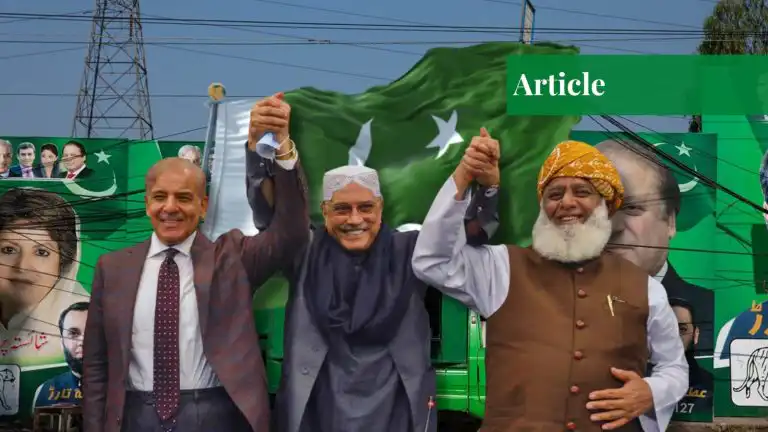
Former Prime Minister Imran Khan and his party were subjected to this as part of the crackdown. There has been much censorship and limitations on PTI’s campaign. There was no majority won by any one party in the National Assembly. But two of them nevertheless claimed victory. Thus, another coalition government was formed with the participation of PPP and PMLN. In so doing, Shehbaz Sharif became prime minister and Asif Ali Zardari, president of Pakistan.
Imran Khan was removed in April 2022 after losing a parliamentary vote of no confidence when opposition parties and former coalition allies secured enough support against his government.
The Pakistan Democratic Movement (PDM) government was a coalition led by Shehbaz Sharif that came to power after Imran Khan’s removal in 2022.
A coalition government was formed because no single political group secured enough seats to independently command a majority in the National Assembly.
The PML-N, PPP, and smaller allied parties formed a coalition government, with Shehbaz Sharif becoming Prime Minister.
A caretaker government was established after the National Assembly was dissolved to manage the country until general elections could be held.
If you want to submit your articles and/or research papers, please visit the Submissions page.
To stay updated with the latest jobs, CSS news, internships, scholarships, and current affairs articles, join our Community Forum!
The views and opinions expressed in this article/paper are the author’s own and do not necessarily reflect the editorial position of Paradigm Shift.

Syed Hammad Ali is pursuing a BS in International Relations programme from the International Islamic University, Islamabad, and has a keen interest in research works, policy analysis, defence and strategic studies, and conflict resolution.