

There is mostly a difficulty in defining or explaining fundamental concepts, for they form the basis for a plethora of things, whilst lacking their own. A physicist is yet to find out the building block of sub-atomic particles, a biologist, despite having a vast and extensive understanding of life’s working mechanism, would find himself wrestling with the concept of life’s origin, and a philosopher with the questions related to the temporal dimensions he resides in.
What are the questions I referred to in my most recent statement? They are, certainly, embedded in the social and cultural context one is a denizen of. What’s life and its purpose? How did life begin? What is the normative framework for life? These questions have, since humanity’s inception, troubled them. And as if it is some natural law, wherever there is an intellectual vacuum, a variety of forces come in to fill the void. That has happened in the aforementioned case.
The Realms Of Knowledge:
There have historically been two major forces trying to fill the vacuum, with each of them trying to degrade the other while standing on solid ground. These two are, namely, science and religious myths, forming two distinct realms of knowledge. Since the beginning of humankind, myths have enjoyed an absolute monopoly over the fundamental questions, with each one being addressed against the backdrop of metaphysical sayings. Science, sed contra, emerged initially as a peripheral force, beginning the conquest of the realm of knowledge, and now enjoys a predominant position. That is to say, even religious myths and explanations are now subjected to scientific scrutiny. However, the ultra-rationalistic position of science has created an existential and spiritual void in recent times, which has produced the result of the populace retreating to religion, and the former force is enjoying a resurgence.
However, in the middle of these two realms, therein lies a no-man’s land which derives spirituality from religion and rationality from science, serving as an exemplary “golden mean”, to employ Aristotle’s terms, who happened to be one of the pioneers of this no-man’s land called philosophy. This no-man’s land has the honour of being the mother of all disciplines, since every discipline commences with asking questions, which happens to be the brain-child of philosophy. Science answers the fundamental questions in the form of information; religion explains the form of myths; while the third invisible yet powerful force, namely philosophy, consistently interrogates both, the former on humanistic grounds and the latter on rational ones.
Moreover, as previously mentioned, the two forces of science and philosophy are on a quest to occupy the realms of knowledge, creating hostility between the two. This hostility compels them to employ tools to undermine each other, with the former instrumentalising reason to debunk religious myths and the latter, metaphysical scriptures to prove science as heretic. Philosophy, on the flip side, doesn’t primarily express hostility to these two and has a chameleon-like characteristic, for its questions take a different shape with the march of time. Natural philosophers of the Pre-Socratic era concerned themselves with the formation of matter, Plato and Aristotle with the state, ideas, and form; Machiavelli with strengthening the ruler, Emmanuel Kant with the peace of Europe, and Karl Marx with the miseries of the working class in the wake of the industrial revolution and subsequent increased working hours. The questions concerning a philosopher of modern times would be combating climate change, preserving nature, finding a “golden mean” to rival structural inequalities, and, not least, suspecting the unchecked sprint of technological proliferation. This characteristic of philosophy projects the impression of how crucial it is, and if viewed microscopically, the importance of contemplative thinking, a virtue that is slowly and gradually fading away.
Plot Of Sophie’s World:
In an effort to study the brief history of philosophy, I got my hands on Jostein Gaarder’s novel “Sophie’s World.” The story follows a 15-year-old Norwegian girl who, upon returning from school, finds in the mailbox a letter from an unknown sender who questions her identity, the purpose of life, and the origin of the universe.
. Sophie is perplexed and surprised at once to see this unexpected encounter. (The same was the case with me, and perhaps every reader. Have you ever interrogated your existence? And it was not the end. The unknown sender, who later turned out to be Alberto Knox, keeps on sending questions like these to stir up curiosity in her student and follows it with an explanation by the relevant philosopher. In this manner of conflictual dialectic discussion, Sophie is introduced to philosophers from Thales to Karl Marx, scientists like Charles Darwin, and Psychiatrics like Sigmund Freud. One might be pondering why the latter two personalities have been incorporated into the table of contents. The explanation is, as I previously mentioned, in the struggle of the aforementioned realms of knowledge to become the “Mr Know-it-all”. The boundary walls of these realms of science, myths, and philosophy are fluid, and each of them puts effort into usurping the other realm.
While reading this novel and following the story, I kept pausing repeatedly and asking myself, “Why couldn’t I think of all this before?” “Why am I yet to uncover the purpose of my life?” “Why am I yet to know my inner self and identity?” It was this curiosity that convinced me to dig for some insights about why I think that way, am I an exceptional case, or not? This led me to suspect the structure we live in and how culture shapes our beliefs and values. But before that inquisition, an analogy surfaced in my mind from the book, which stated, in an attempt to explain the philosophical quest, that the universe was created by a magician, and the world is like a rabbit. When we begin our life as a child, we are at the top of this rabbit’s hair, staring him in the eyes, interrogating everything else that confronts us. That is why we ask questions. But as life marches onwards, we lose touch with reflective thinking, go deep down the rabbit hole, and adopt some definitions of social realities that we hardly challenge. Encouraged by this analogy, I pondered that I being a university student, may have well went down the rabbit’s hair, hence unable to stare in the eyes of that very magician; I turned towards a class 5th student in our vicinity with the hope that he is yet to go down deep into the rabbit’s hair and would still be able to stare in the eyes of magician; and asked him his purpose of life. His answer was, simply unsurprising, “Allah ki Ibadat” (Praying to God).
Now there must be some serious problem in our society. A class 5th student, yet at the top of a rabbit’s hair, has the same answer to a fundamental question as that of an undergraduate student and perhaps, as that of a 60-year-old individual. Although my sample size is small, I can speak with conviction that the same answer would resonate in a larger sample. How could such homogeneity of thoughts exist in a population of 240 million people? Or philosophically speaking, how could the essence of all these be pre-determined? There are certain points of origin to this rigid thinking, which I would extend upon subsequently.
The Case Of Pakistan’s Intellectual Health:
The country of Pakistan was formed, according to the state narrative, on the premises of the two-nation theory. Muslims of the subcontinent, after having ruled ‘justly’ for 1000 years, felt “threatened” by the resurgent Hindus who had joined hands with the ruler Englishmen and sought revenge from Muslims and erected exploitative structures to “marginalise” them, and later, rule India and avenge them. This narrative, while instrumental in forging a sense of common belonging, had strings of problems attached.
When there is a large number of people living in a specific area having at least one thread in common, it reaps the benefit of instrumentalising that singular thread to construct a common identity that unites the populace. With Pakistan comprising the majority of its population of Muslims, the threat of Islamic identity, albeit weak, was strategically employed to ward off the threats originating from geopolitical location and the internal challenges, on which I will elaborate later in my explanation of the term “Strategic Culture”.
But on the contrary, the problem that concerns us, that of intellectual stagnancy, emerged. Wherever there is a large populace united by a shared sense and thinking, there emerges an echo chamber. When you stroll back and forth, you find the same mode of thought, and your psychology will naturally attest your point of view with successive encounters, and resultantly, it is consolidated. Consequently, any mode of thought that questions the existing structure is labelled as exotic and, in the most exaggerated form, heretic. Worse, in the case of Pakistan, the very principles of “Islamic Unity” and disregard for individualistic ideas like rationalism are structurally and pedagogically discouraged.
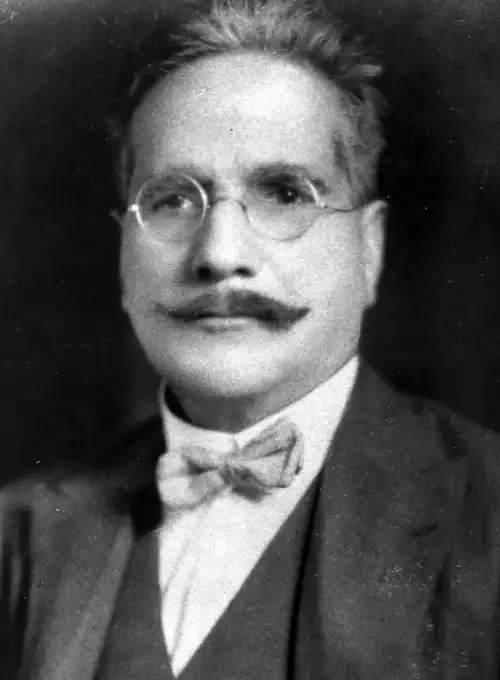
We can take, for example, Allama Iqbal, the Islamist philosopher and “poet of the nation” who is repeatedly quoted to consolidate the “indoctrinated identity”. Iqbal, in Bang-e-Dara, remarked to express distaste for heretic thought
“Don’t compare your nation with the nations of the West
Distinctive is the nation of the Prophet of Islam
Their solidarity depends on territorial nationality
Your solidarity rests on the strength of your religion
When faith slips away, where is the solidarity of community?
And when community is no more, neither is the nation.”
This is a singular example of how first an identity is created and then the literature is curated accordingly to accumulate support for that very identity. Ironically, Allama Iqbal was a product of a Western education. This leads us to a question: why do Pakistan, founded by secular personalities like Muhammad Ali Jinnah and Liaqat Ali Khan, etc., have such hyper-religious orientations? Here, I pause describing the reasons for this intellectual stillness and introduce the term “strategic culture”.
Strategic Culture Of Pakistan:
An idea put forth by Jack Snyder in the 1970s, strategic culture is defined as:
“A series of general beliefs, attitudes and behaviour patterns about nuclear strategy [that] has achieved a state of semi-permanence that places them on the level of “culture” rather than a mere “policy.”
We can further extend this explanation by positing that, unlike strategy, which is described as a rational calculation of means and ends, strategic culture suggests that no state comes to the International Chessboard with a blank mind. Just as individuals have past experiences that shape the onward trajectory of their lives, so has a state. Every nation has a set of inherited traditions, traumas, and myths that shape its decisions, and this amalgam, in turn, formulates the internal set of factors of a state in the form of strategic culture, which is used as a glass through which policies are evaluated, and these collectivity of beliefs are often self-justificatory. In the case of Pakistan, the strategic culture is dominated by the experience of partition, perpetual rivalry with India, and the military’s role in national security.
Pakistan, after coming into being, was entangled in several problems and challenges. Weak infrastructure, low political culture, and an important geo-political position paved the way for a relatively well-equipped and modern military to fill the void created at the political level, hence transforming Pakistan into a “security state” from its very inception, and resultantly, beliefs and norms were shaped in accordance with the requirements of a security state. Now, as previously discussed, the best instrument to curb democratic ideals, a significant rival to the security state, like individualism and critical thinking, and forge a national identity was Islam. Hence, since the inception, Islamic identity wasn’t a cultural expression but a strategic resource to fight the perceived “existential threat” from India and the internal ethnic fragmentation, like that of [then] NWFP.
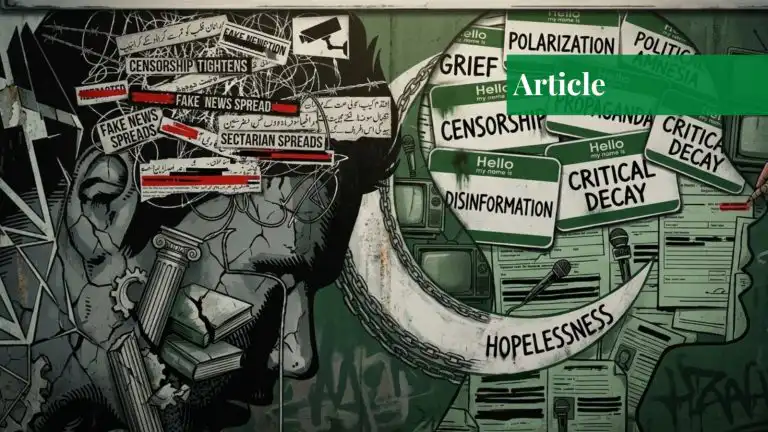
In the subsequent stages, Islamic identity was not only organic but reinforced through curricula (as mentioned previously), media, and sermons. It was less about cultural flourishing and more about securing loyalty against “threats”. When religion is used as a strategic instrument and not a philosophical project, it is some equivalent of asking intellectual flourishing to leave by the back door. Because identity was framed strategically, the narrowing down of the intellectual horizon was a natural by-product. Everything was seen in black and white. Any inquiry into raw history, pluralism, and alternative traditions was treated as a threat to “security”. Intellectual curiosity was made subordinate to state survival, producing what I called a crisis of intellectual health, conformity marginalising critical thinking. This didn’t end here. Once embedded into the state’s strategic culture, every new policy crisis, like Afghan jihad, the sectarian politics, and the War on Terror, only functioned to amplify its salience. This scheme of things produced an intellectual dilemma; scholars, writers, and students learnt to avoid suspecting state narrative for the fear of being labelled as heretics and unpatriotic.
To sum up, strategic culture instrumentalised Islam as a mechanism of survival, precipitating the unintended consequences of stifling intellectual diversity. As this rigidity continued to get entrenched, any dissenting or pluralistic thought was cast as disloyal and hence, peripheralised.
Explaining Pakistani Society Through “The Authoritarian Personality”:
The embodiment of strategic culture disseminated from the top wasn’t quite forced. Certainly, the lower strata have to be welcoming enough to accept this culture. Any policy or, in this case, set of policies applied from the top could be only embodied after trickling down by the lower strata when conditions are conducive for it. And the Pakistani society provided a fertile ground. I here introduce my second theoretical framework, Adorno’s concept of “The Authoritarian Personality“, to discuss the internal set factors of individuals in Pakistani society that became an efficient receptor of strategic culture trickled down.
Theodor Adorno, one of the pioneers of the Frankfurt School (a neo-Marxist tradition that employed Freudian psychoanalysis to evaluate the delay of the Communist Revolution), was funded by the Jewish Scientific Committee of America to trace the origins of anti-Semitism in the Third Reich. Upon examination, Adorno and his fellows discovered some common threads in what they called The Authoritarian Personality. But before I move to discussing the characteristics, here is a brief background. In post-World War 1 Germany, parents trained their children in strict disciplines due to financial strains, which resulted in building resentment among the inter-war period generation, and they sought a “messiah” under whom to gather and project their frustration against a foreign group. Additionally, ethnocentrism had witnessed a surge in this period, which became another underlying personality syndrome of what they called the Authoritarian personality. In these moments of crisis, individuals feel insecure and jump onto any strong bandwagon. And what could’ve been a better bandwagon than Hitler’s Reichstag erected on anti-intellectualism, ethnocentrism, and unquestionable obedience, which culminated in the loss of individualism, critical thinking, and scapegoating Jews.
Notwithstanding the assumption that Pakistan and Hitler’s Germany are cut from the same cloth (there are certainly, various cultural, social and political differences), one can still employ Adorno’s concept or at least, draw some insights from it to explain Pakistan’s intellectual stagnancy, to prove that Adorno’s theory isn’t just a European relic but a living pathology that predominates conventional societies like Pakistan.
In Pakistan, intellectual life is deeply bound by traditions and religious interpretations. Not only that, the educational curricula only filter “approved knowledge”, which effectively marginalises curiosity and exploration, and any deviation from religious and nationalist conventions is stigmatised. Additionally, citizens who challenge prevailing norms, liberals, and dissenting journalists are labelled “foreign agents”. Any act of introspection and emotional nuance is ridiculed as “soft”, while hard certainties, be it religious or political, that limit the cultivation of critical and reflective modes of thought are prioritised.
Although Adorno enlisted 9 major characteristics of an authoritarian personality that abhors intellectualism, I still confined myself, in the preceding paragraph, to conventionalism, Authoritarian aggression, and anti-introspection.
Social problems like poverty, corruption, etc., aren’t seen as a structural failure but a foreign conspiracy. This phenomenon of scapegoating blocks honest self-criticism. Additionally, public discourse in Pakistan is disproportionately preoccupied with regulating sexuality and using women as “objects of honour”. This obsessive fixation with rigid sexual behaviour signals a repressed society where intellectual energy is diverted towards moral policing of women’s dress.
Conclusion:
From this essay, what emerges is not a critique of structure that conspires to keep people subordinate but rather an indictment of the intellectual habits they engender; for a society that persistently subordinates inquiry to conformity, and reflection to survival, not only constrains its present imagination, but gradually relinquishes the very faculties through which it might have once conceived, contested, and perhaps realized, an alternative trajectory.
If you want to submit your articles and/or research papers, please visit the Submissions page.
To stay updated with the latest jobs, CSS news, internships, scholarships, and current affairs articles, join our Community Forum!
The views and opinions expressed in this article/paper are the author’s own and do not necessarily reflect the editorial position of Paradigm Shift